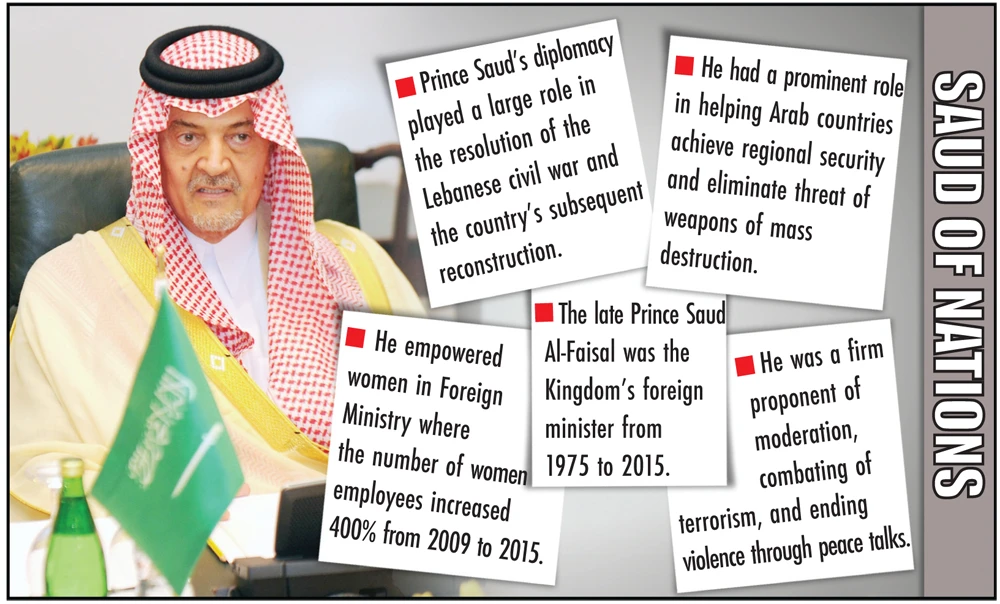
RIYADH: The late Prince Saud Al-Faisal was honored at a special event here earlier this week for his efforts to bring stability and security to the Middle East during some of its worst crises.
Prince Saud, who served as the Kingdom’s foreign minister from 1975 to 2015, the longest ever globally, was hailed for his efforts in Lebanon, Kuwait, Iraq and other countries during various conflicts.
The international conference, entitled “Saud of Nations,” was organized by the King Faisal Center for Research and Islamic Studies at King Abdulaziz International Convention Center in Riyadh.
The fourth session, entitled “The Kingdom’s Efforts to Bring Peace to Lebanon During the Civil War” highlighted Prince Saud’s efforts to achieve reconciliation in Lebanon and the signing of the Taif Accord.
Minister of State for Foreign Affairs Nizar bin Obaid Madani moderated the session in which the speakers were former Lebanese President Amin Gemayel, former Lebanese Prime Minister Fouad Siniora and former Assistant Chief of General Intelligence Rtd. Staff Maj. Gen. Mohammad Eid Al-Otaibi.
Gemayel said Prince Saud played an important role in reviving Lebanese-Saudi bilateral relations. Prince Saud had done a great deal to resolve the civil war in Lebanon with diplomatic efforts involving some of the world’s most powerful nations, he said. He said Prince Saud had always been a firm proponent of moderation, the combating of terrorism, and ending violence through peace talks. This has been the hallmark of Custodian of the Two Holy Mosques King Salman, who with his young team is bringing about positive change to Saudi Arabia, said Gemayel.
Siniora said Saudi-Lebanese relations were an “integral part” of Prince Saud’s history, demonstrating his efforts to end the Lebanese civil war and convening the Taif conference in the face of the Syrian occupation of Lebanese lands, his proposal to send Arab peacekeeping troops to Lebanon and reconstructing the country after Israel’s aggression in 2006.
Al-Otaibi praised Prince Saud’s peace efforts in Lebanon, Muslim and Arab countries, and other nations around the world. He said the Kingdom was a neutral player with regard to challenges in Lebanon and was doing everything it can to bring all parties closer together.
The fifth session of the conference, chaired by Anwar Gargash, the United Arab Emirates’ minister of state for foreign affairs and federal national council affairs, was entitled “Efforts of Saudi Arabia for Regional Security.”
Gargash, in his speech, said Prince Saud had played a leading role in regional security. “He also had a prominent role in deepening ties for peace and understanding and helping Arab countries to achieve security and eliminate the threat of weapons of mass destruction, terrorism and sectarian conflict.”
Taher Al-Masri, the former prime minister of Jordan, stressed that during Prince Saud’s tenure, the Kingdom fought terrorism and extremism and provided great assistance to African and Arab states to ward of threats, including that of Iran. He had also helped the Yemeni people against the aggression of the Houthis, he said.
Abdul Latif bin Rashid Al-Zayani, secretary general of the Gulf Cooperation Council (GCC), said Prince Saud, under the direction of the late King Fahd, had set in motion a series of diplomatic initiatives to liberate Kuwait, in an attempt to find peace solutions to the conflict.
Al-Zayani said everyone had been surprised that Iraq had attacked a friendly fellow Arab country. It was under these trying circumstances that Prince Saud showed that he was a man of principle and wisdom, with these words: “We will not rest until Kuwait is returned to its owners and liberated from the invaders and haters.”
Al-Zayani said Prince had been a leading proponent of Gulf unity, because he thought it was the best way to ensure beneficial development for all nations. In particular, he believed in a strong Gulf defense system that could stand independently from international alliances.
Abdulrahman Al-Saeed, adviser at the Royal Court, praised Prince Saud for his contribution to resolving the Kuwait crisis, with the formation of an alliance of Arab and other countries to confront the Iraqi regime and liberate Kuwait.
The seventh session of the conference focused on Prince Saud’s efforts to empower women in foreign policy, which an official from the Saudi Foreign Ministry saying that from 2009 to 2015 women employees had increased 400 percent.
Late Saudi FM honored