RIYADH: A new experimental Middle East Respiratory Syndrome (MERS) coronavirus vaccine has shown promise in animal studies, an international science publication reported Thursday.
According to the report in Science Daily, a novel synthetic DNA vaccine can, “for the first time, induce protective immunity against MERS” in monkeys. David B. Weiner, a professor of pathology and laboratory medicine, and colleagues published their work in Science Translational Medicine this week. They are from the Perelman School of Medicine at the University of Pennsylvania in the United States.
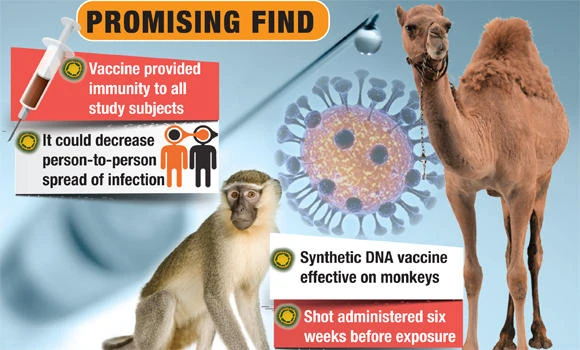
“The experimental, preventive vaccine, given six weeks before exposure to the MERS virus, was found to fully protect rhesus macaques from disease. The vaccine also generated potentially protective antibodies in blood drawn from camels, the purported source of MERS transmission in the Middle East,” the report in Science Daily said.
“The significant recent increase in MERS cases, coupled with the lack of effective antiviral therapies or vaccines to treat or prevent this infection, have raised significant concern,” Weiner said. “Accordingly the development of a vaccine for MERS remains a high priority.”
“The vaccine was able to prevent MERS disease in the monkeys and offered benefit to 100 percent of the animals in this study in terms of minimizing symptoms,” the report said.
“In addition, the vaccine induced antibodies that are linked with protection in camels, a species that is thought to be a major source of transmission to humans in the Middle East, showing that this vaccine could be deployed to break this link in the MERS transmission cycle.”
“In the field, say the researchers, this vaccine could decrease person-to-person spread of infection in the event of an outbreak and help to protect health care workers or exposed individuals,” the report stated.
“This study was only possible by bringing together an international group of investigators with the necessary skills, including the lab of Heinz Feldman at the NIH, Gary Kobinger from the Canadian government, scientists from Inovio who developed the plasmid delivery technology, along with Penn colleagues,” said first author Karuppiah Muthumani, a research assistant professor of pathology and laboratory medicine.
“This simple synthetic vaccine has the potential to overcome important production and deployment limitations, and what’s more, the vaccine is non-live, so it does not pose a risk of spreading to unintended individuals.”
Collaborators include researchers from the National Institute of Allergy and Infectious Disease, the Public Health Agency of Canada, Inovio Pharmaceuticals, the University of Washington, and the University of South Florida.
Currently, no licensed vaccines are available for MERS, a disease that first appeared in 2012. In the Kingdom, it has already caused 485 deaths out of 1,128 cases. There has been a spike in cases in Riyadh this week, with eight deaths over the past four days.
An outbreak in South Korea that began in May has caused more than 180 confirmed infections, including 36 deaths, through July 15 as well as widespread social disruption.
The disease can cause severe, often fatal, respiratory infection. However, so far there are no vaccines or drugs that target the virus, thought to be harbored by camels. The virus has been linked to large hospital outbreaks, including recent ones in South Korea, the current one in Riyadh, and others in Saudi Arabia.
MERS is caused by an emerging human coronavirus, which is distinct from the Severe Acute Respiratory Syndrome (SARS) coronavirus. Since its identification, MERS has been linked to over 1,300 infections and over 500 deaths. It has occurred in the Arabian Peninsula, Europe, and in the United States.
The recent 2015 outbreak in South Korea was of great concern as the infection spread from a single patient to infect more than 181 people, resulting in hospital closings and severe economic impact. During this outbreak, rapid human-to-human transmission was documented with in-hospital transmission the most common route of infection.
MERS vaccine protects monkeys