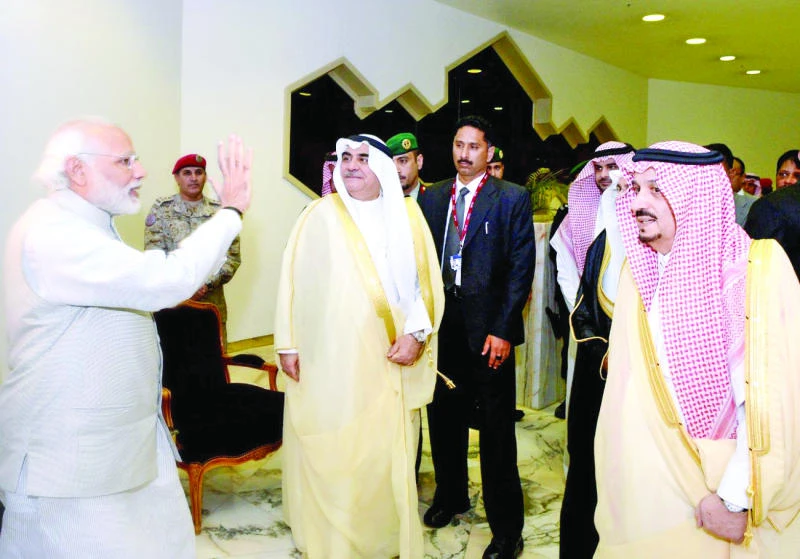
RIYADH: Saudi Arabia and India launched joint efforts to fight terrorism, boost defense ties and ramp up security and intelligence cooperation after Custodian of the Two Holy Mosques King Salman met Indian Prime Minister Narendra Modi in Riyadh on Sunday.
The two leaders called on all countries to dismantle terrorist infrastructure and cut off any kind of support and financing to terror groups and organized crime.
A joint statement signed by India and the Kingdom on Sunday said that the two nations “condemn efforts, including by states, to use religion to justify, support and sponsor terrorism against other countries.” They called on all nations to “dismantle any terrorism infrastructure where it exists and bring the perpetrators of terrorism to justice.”
Affirming that the menace of extremism threatens all nations, the two leaders rejected completely any attempt to link this worldwide problem to any particular race, religion or culture.
The joint statement released Sunday following talks between the two leaders was an oblique reference to Iran which is behind sectarian tension and supports efforts to destabilize Arab countries. The communique said that Prime Minister Modi expressed his sincere gratitude to the king for his warm welcome and gracious Saudi hospitality.
He invited King Salman to pay an official visit to India at a mutually convenient time. The invitation was accepted.
Both leaders agreed to promote cooperation in cyber security, including prevention of use of cyberspace for terrorism, radicalization and for disturbing social harmony. The two leaders directed their relevant agencies “to coordinate efforts to counter radicalization and misuse of religion by groups and countries for inciting hatred, perpetrating and justifying terrorism for pursuing political aims.”
The two leaders also welcomed “dialogue between religious scholars of both countries, and the organization of conferences and seminars to promote values of peace, tolerance, inclusiveness and welfare, inherent in all religions.”
The two sides agreed to work together toward the adoption of India’s proposed “Comprehensive Convention on International Terrorism” at the United Nations.
Security cooperation
Acknowledging and commending the strong bilateral security cooperation, the two leaders agreed to improve cooperation in counterterrorism operations, intelligence sharing and capacity-building and to strengthen cooperation in law enforcement, anti-money laundering, drug-trafficking and other such crimes. They welcomed the signing of an MOU on cooperating in the exchange of intelligence related to money laundering, related crimes and terrorism financing. The two sides further agreed to take action against illegal transfers of money.
The two countries agreed on the need to boost defense cooperation through an exchange of visits by military personnel and joint exercises. King Salman and the Indian leader also welcomed the decision to convene the second meeting of the Joint Committee on Defense Cooperation in Riyadh to follow up on the visit of the Indian premier. Both leaders also agreed to increase cooperation to strengthen maritime security in the Gulf and Indian Ocean regions which is vital for the security and prosperity of both countries.
Bilateral interaction
Reiterating the significance of regular bilateral interactions in reinforcing the momentum for cooperation, King Salman and Modi directed their finance and trade ministers to work together “to find ways and means to substantially increase the flow of bilateral investments and the growth of trade ties.” Acknowledging the steady increase in bilateral trade over the last few years, the two leaders expressed satisfaction at the $39 billion trade in 2014-15.
The statement noted that King Salman expressed appreciation for Prime Minister Modi’s remarkable vision for the future of the country. He commended Modi’s worthy initiatives of “Start Up India,” “Make in India,” “Smart City”, and “Clean India”, noting their strong potential to provide the Indian economy a positive impetus for growth.
The two leaders also expressed the need for regular meetings under the umbrella of India-Saudi Arabia Ministerial Energy Dialogue.
Recognizing the importance of people-to-people contacts that provide strong bonds between the two countries, the two leaders lauded the valuable role of the Indian community in Saudi Arabia and its contribution to the progress and development of both countries. Both sides also welcomed the establishment of a Joint Working Group on consular issues under the umbrella of the India-Saudi Arabia Joint Commission which would meet on a regular basis.
Mideast situation
Referring to problems in the Middle East, the joint statement said that King Salman and Prime Minister Modi had discussed regional and international issues of mutual interest, including the security situation in the Middle East and South Asia, in the light of their common interest in regional and global peace, security and stability. Referring to the earlier declarations with regard to the situations in Yemen and Syria, they also called “for the implementation of relevant UN Security Council resolutions 2216, 2254 and 2268.”
They expressed grave concern regarding the security situation in Libya and Iraq. They reiterated the importance of peaceful resolution of the issues through dialogue and political negotiations. Both leaders also emphasized the importance of an effective multilateral system, centered on a UN reflection of contemporary realities as a key factor in tackling global challenges.
They stressed the urgent need to pursue UN reforms, including the Security Council through an expansion in both categories of its membership which would make it more representative, credible and effective.
Modi invites King Salman to visit India