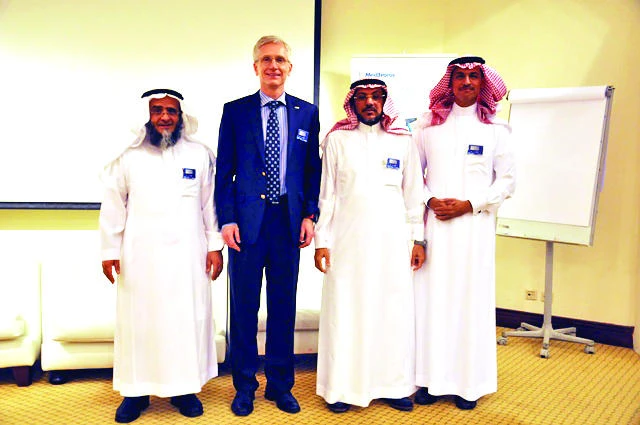
The Ministry of Health has launched a new program to train health officials in treating diabetic patients through insulin pump therapy.
Muhammed Al-Harbi, director general of Diabetes Centers and Units at the MoH, said that the ministry is keen on introducing the insulin pump therapy through its diabetic centers in the Kingdom. He said that 12 officials attached to the center are being trained under the program and another 15 will be trained subsequently.
An insulin pump is a small device about the size of a small cell phone that is worn externally and can be discreetly clipped to the patient’s belt, slipped into a pocket, or hidden under the clothes. It delivers precise doses of rapid-acting insulin to closely match the body’s needs. Small amounts of insulin are delivered continuously throughout the day for normal functions of the body (not including food). The program rate is determined by a health care professional.
Al-Harbi explained that the ministry would like to launch this treatment after giving the right training to its health officials. He added that it’s a five-day course conducted by professor Tadej Batellino from Slovenia, an expert in insulin pump treatment.
Al-Harbi said the ministry has distributed 500,000 glucometers in the past 18 months and an additional 300,000 will be distributed soon. He added that this initiative is part of a three-year program undertaken by the ministry to check the growing incidence of diabetes in the Kingdom.
“We have 20 specialized clinics to treat diabetics throughout the Kingdom,” he said, noting that the awareness program will not only help to prevent the condition but also educate diabetics on how to live with it.
Al-Harbi said that type 2 diabetes is normally found in adults over 40 but children can also get it due to obesity. He pointed out that diabetes is hereditary and there is a 60 to 80 percent chance for people to get it if their parents are diabetic.
Al-Harbi also said that type 2 diabetes among children can be prevented with a healthy diet and weight reduction, as well as exercise and adequate rest. He noted that early detection of the condition will also help to keep it under control with proper medication and medical advice.
About 90 percent of diabetics in Saudi Arabia fall under type 2 diabetes. The condition is usually caused due to unhealthy dietary habits, lack of exercise and obesity.
Loss of vision is one of the primary concerns for people with diabetes. Approximately two-thirds of diabetics are likely to experience loss of vision after 35 years of diabetes.
The Ministry of Health is not only providing treatment to diabetics but also indulges in preventive measures such as mass education.
The prevalence of diabetes in the Kingdom is reported at an alarming rate of 25 percent among adults with the figure expected to double by 2030.
Half of the population over 30 is prone to diabetes. Saudi Arabia has the second highest rate of diabetes in the Middle East and ranks seventh in the world, according to the World Health Organization.
Reports suggest that the Kingdom spends approximately SR30 billion annually on the treatment of diabetes. The government spends SR5,000 on a diabetic patient annually and the cost can increase to around SR98,000 to SR180,000 to treat patients with renal failure.
MoH trains officials to help diabetics with insulin pump therapy