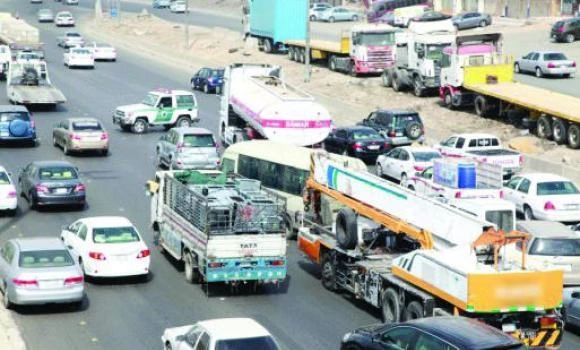
Authorities recently approved a plan to ensure that the movement of trucks around the cities will not disturb public traffic or endanger road safety. The new plan comes amid heavy truck traffic due to some of the construction projects in cities such as Makkah and Jeddah.
Col. Salman Al-Jamiei, director of the Makkah Traffic Department, told Arab News that more than 7,000 trucks make over 30,000 trips a day on the city’s roads.
“Makkah is witnessing the implementation of a number of giant projects, mainly the expansion of the Grand Mosque and the construction of ring roads, in addition to the projects being developed by the private sector,” said Al-Jamiei. These activities require an efficient traffic flow, which is why the plan is expected to regulate the entry and exit of trucks through about 20 points that will prevent traffic congestion during peak hours.
“Trucks are allowed to travel during two periods. The first extends from six until eight o’clock in the morning, while the second goes from midnight until 2 o’clock in the morning,” the official added, pointing out that checkpoints to prevent entry and exit of trucks are distributed on all the entrances to Makkah.
The plan was announced after a meeting between a number of law-enforcement officials and businessmen at the Makkah Chamber of Commerce and Industry. During the meeting, projects’ owners, venture capitalists and the operational companies implementing the projects were briefed on the new regulations.
Maj. Gen. Saeed bin Salem Al-Qur’ani, director of Makkah police, called on businessmen and truck owners in Makkah to ease traffic on the Third Ring Road until the project of the Fourth Ring Road is completed.
According to Al-Qur’ani, the department will make no exemptions or concessions regarding the decision to prevent trucks from passing through the Third Ring Road during school time.
He promised to put in place suitable solutions for the evening.
“The projects which the holy city will benefit from require the cooperation of all parties concerned so as not to affect the movement of worshipers, pilgrims and visitors, or delay their frequency trips between the holy sites,” said Al-Qur’ani, adding that the projects in Makkah are extraordinary and might face some obstacles.
“This requires us all to be patient and bear the burden. But later on, we and our children shall reap the fruits of such projects,” he said.
New Makkah plan to regulate truck traffic