JEDDAH: A Saudi security official revealed there is no hard labor, no racism and no violation of personal rights in Saudi prisons.
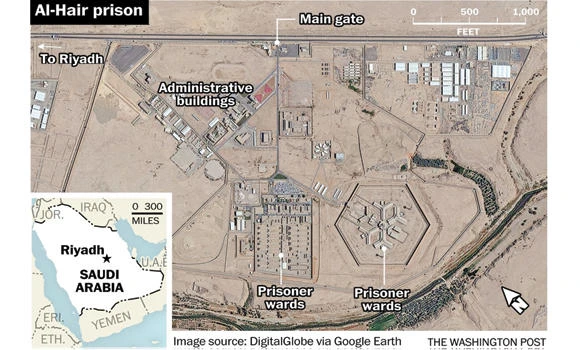
During a press tour of Ha’ir prison in Riyadh for local media, Col. Khalid Al-Maliki, director of Ha’ir Prison, said Saudi prison systems classify inmates according to age group and type of crime to prevent any problems. Some of these classifications are brought together under one division, such as promoters and sellers of drugs, and those addicted to them.
Al-Maliki said that Saudi prison systems do not impose hard labor. “The type of work is decided by inmates for which they receive money in exchange,” he added.
He said all employees and staff care about the dignity of inmates and treat them according to principles of humanity.
Saad Al-Arifi, engineering affairs director, said the prison, which was opened last year, accommodates 7,272 inmates. “The department takes into account the situation of the elderly and persons with special needs by allocating one room for two inmates with all the equipment and appliances that help them move and use all the facilities of the prison,” he explained.
He added that there are future plans to raise the capacity of the prison to accommodate 9,400 inmates.
“The area of the prison is 1.8 million square meters and includes five complexes; each complex contains four units and each unit accommodates 256 inmates divided into two sections or wards, each ward includes 22 rooms. Each room accommodates six inmates,” he said.
He added that about 90,000 square meters are allocated to building an industrial city which will allow inmates to work in the professions they desire. The prison also includes health clinics for dentistry, internal medicine, ophthalmology, dermatology, radiology and laboratory departments in addition to 11 preliminary diagnostic clinics.
The prison adopts a specified schedule for implementing educational, and technical and vocational training programs. There are 38 classrooms to accommodate 750 students in one shift, in addition to 17 vocational training workshops, said Al-Arifi.
He said there is a plan to take advantage of the space area of the prison to build greenhouses for vegetables and fruits, and barns for livestock and poultry.
He said there are controls on visits, such as limiting them to first degree relatives, and foods are banned from entry inside the prison. For family visits, he added, every inmate has the right to a one-day visit for up to 12 hours.
“There are very special cases where the prison administration takes into account allowing family visits for those who suffer infertility. There is no racial discrimination between citizens and residents,” he said.
'No hard labor, racism in prisons'