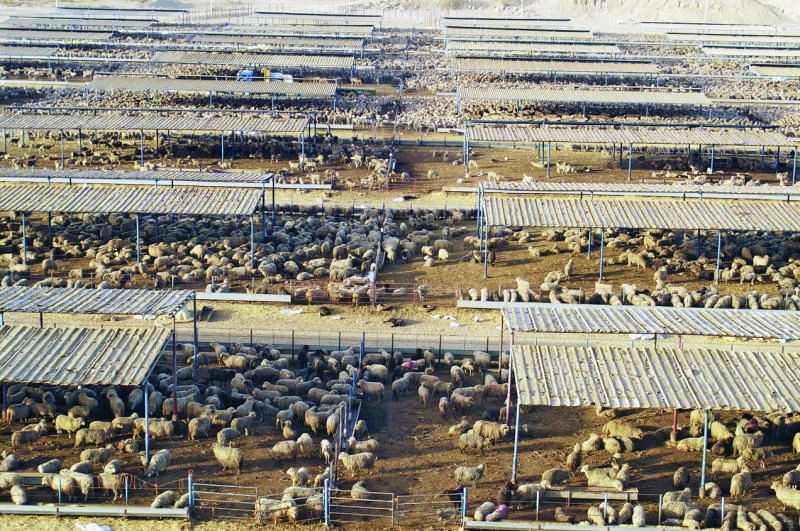
The Jeddah Chamber of Commerce and Industry (JCCI) has rejected claims on social networking sites that there would be a shortage of livestock at local markets for the upcoming Haj.
Suleiman Al-Jabri, chairman of the livestock traders committee at the JCCI, said there was enough supply for the Eid Al-Adha season. More than a million sacrificial sheep, goats and cows are expected at the Jeddah Islamic Port, he said.
Al-Jabri said the imported livestock was in addition to the strategic reserves at local farms of 200,000 animals. “We will be supplying about 500,000 head of livestock and more if needed, to maintain price stability and make the animals accessible for all,” he said, adding that the imported livestock had started to arrive at the end of August.
He said there would be a minimal increase of 10 percent in prices due to high demand during the peak season. He urged citizens not to be misled by rumors about the rising prices of imported sheep. “In fact, the prices of imported sheep will remain steady but the prices of local sheep will fall.”
He said that the average price for a barberry sheep from the Sudan was SR500, and SR900 for the Alsoakny breed from Somalia.
He said the committee had developed a strategy to deal with industry problems in coordination with relevant government agencies.
The Kingdom imports about 70 percent of its livestock due to the insufficient number of domestic animals. More than 2.5 million head of sheep is imported from neighboring Sudan and Somalia for the Saudi market.
Jeddah’s stagnant livestock markets have been revitalized after the lull in trade during Ramadan and Eid Al-Fitr. There was significant sales at Al-Khamra neighborhood recently, with an influx of sheep from neighboring governorates.
The prices of local breeds, in particular Al-Hari, ranged between SR1,100 and SR1,500, compared to SR1,300 previously.
Fahd Al-Sulami, a livestock investor and businessman, told Arab News there was an abundant supply of local sheep. “Livestock merchants have more than 1 million head of sheep in stock.”
Al-Sulami said more than 20 ships loaded with sheep have arrived at the port. “A medium-sized vessel carries between 100,000 to 450,000 head of sheep, while a big ship can carry up to 700,000,” he said.
He said government inspectors choose 100 head of sheep randomly to check quality, and make sure no sick animals enter the country.
Salem Al-Khaldi, a livestock merchant, said trade has started to pick up at local markets with the countdown to Eid Al-Adha, with many traders arriving in Jeddah and Makkah to sell their livestock to pilgrims.
‘No livestock shortage’ for Haj at local markets