RIYADH: Prince Sultan bin Salman, founding member of the Association of Space Explorers and chairman of the Organizing committee, said here yesterday that Saudi Arabia is making rapid advances in the field of education, science and technology since Custodian of the Two Holy Mosques King Abdullah began leading the country.
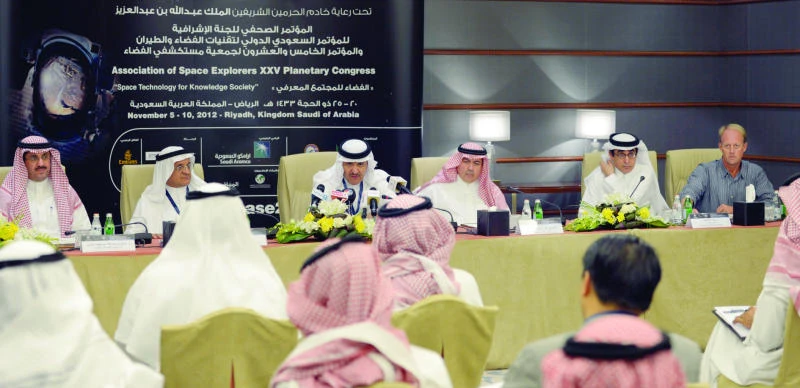
Prince Sultan, who is also president of the Saudi Commission for Tourism and Antiquities, attributed the growth to the active role being played by King Abdullah as part of his intensive drive to promote a knowledge-based economy in the Kingdom. Prince Sultan was addressing a press conference on Saturday ahead of the 25th annual Association of Space Explorers Congress (ASE) and the 2nd Saudi International Space and Aeronautics Technology Conference scheduled to be held here from Nov. 5-10.
The conference will be attended by more than 100 astronauts from 18 different countries along with experts in the space and aeronautics sector from all around the world. Prince Sultan made history when he became the first Muslim and Arab astronaut to fly as a payload specialist on STS-51-G Discovery from June 17 to 24, 1985.
Prince Sultan said: “Today we see King Abdullah pushes this country toward the highest horizon — a new horizon in the field of science and technical areas in all its forms, including space technology.
He commended the attention being given by the Kingdom to science, space and technology and its importance in national development, as one of the most prominent main founders of the Arab Satellite Communications Organization Arabsat and main contributor to this project. This conference will showcase Saudi Arabia’s capacity in organizing this important high-profile conference.
The head of the SCTA has also arranged a comprehensive program for all the participating delegations including their families to explore and discover Saudi Arabia by providing its guests all avenues of hospitality and Saudi Arabia’s typical entertainment program.
They will be visiting Saudi tourist spots and historical places.
“We would like to show them our hospitality and the beauty of this country,” Prince Sultan said.
The Saudi International Space and Aeronautics Technology Conference is being organized by the King Abdulaziz City for Science and Technology (KACST), an autonomous scientific organization that reports to the prime minister. It acts as both the Saudi Arabian National Science Agency and the country’s national laboratory.
The congress and the conference will bring together experiences of astronauts with other leading experts in the field. It will cover the latest developments and research in space and aeronautics technologies.
The main topics to be discussed will be: space exploration missions and collaborations at the International Space Station; evolving trends and the future of space exploration by the participating nations; ‘Windows on the Earth’ -– ASE initiative and the KSA Earth observation and visualization programs.
KACST is leading the development of the National Plan for Science, Technology and Innovation, involving more than 60 national agencies and 190 programs, in a multibillion dollar undertaking, focusing on the development of 15 strategic technologies and their incubation and commercialization, with the aim of transforming the Kingdom into a knowledge-based society.
ASE is represented by over 350 space fliers from 35 different countries — Afghanistan, Austria, Belgium, Brazil, Bulgaria, Canada, China, Costa Rica, Cuba, Czech Republic, France, Germany, Hungary, India, Italy, Japan, Kazakhstan, Malaysia, Mexico, Mongolia, the Netherlands, Poland, Romania, Russia, Saudi Arabia, Slovakia, South Africa, South Korea, Spain, Sweden, Switzerland, Syria, the United Kingdom, the United States and Vietnam. KACST has played a major role in strengthening the Kingdom’s position as the leading provider of commercial earth observation products for the region, with 12 of the major satellites for the Middle East’s observation being designed and manufactured in Saudi Arabia.
It also has a comprehensive system for the processing of satellite images covering the Middle East and helps regional governments and private companies with their needs in this area. The development of advanced geographical information systems is also a key element of the KACST Space and Aeronautics Program.
KACST collaborates with many international organizations in the field of space and aeronautics, including NASA for the sector's strategic development, and the Center of Excellence for the study of near earth objects. In addition, KACST has created a joint space and aeronautics research center with the Stanford University in the US. The press conference was attended by main sponsors including KACST President Mohammed Al-Suwaiyel; Prince Turki bin Saud bin Mohammed, vice president for research institutes, KACST; Khaled Abdullah Al-Sabti, deputy minister of education; Azzam Mohamed Aldakhil, CEO of Saudi Research and Marketing Group; and Nawaf Al-Sha’lan, media director of STC. The ASE Congress is an annual gathering of people who have visited space and is held all over the world. Saudi Arabia hosted this congress in 1989. The ASE astronauts will also participate in the upcoming conference. The ASE is an international nonprofit professional and educational organization. Founded in 1985, ASE’s mission is to provide a forum for professional dialogue among individuals who have flown in space, support space science and exploration for the benefit of all, promote education in science and engineering, foster greater environmental awareness and encourage international cooperation in the human exploration of space.
The astronauts participating in the congress will also be taking part in the Kingdom’s International Space and Aeronautics Conference 2012, which is being held in association with the ASE event.
The international space and aeronautics sector has witnessed increasing competitiveness and significant technological advancement in recent years. Space and aeronautics systems and technologies have become a key part of the Kingdom’s economic, scientific and national security capabilities.
The current global environment for space and aeronautics technologies presents significant opportunities for Saudi Arabia as the Kingdom is well positioned to contribute to the regional development of these technological systems.
There are also huge opportunities to commercialize Saudi technologies, particularly those related to the constellation of Saudi Comsat satellites and Global Navigation Satellite System applications.
This 25th Congress and the conference will bring together the unique experiences of astronauts with that of leading experts in this field, and will cover the latest developments and research in space and aeronautics technologies, particularly those of major interest to Saudi Arabia.
The planetary congress held by the ASE every year serves as a forum where members interact professionally and develop ASE programs. It is the largest gathering of its kind for space pioneers and explorers.
Members exchange information about their national space programs, make technical presentations on selected topics relevant to human space flight operations and visit with media and local communities to promote expanded awareness of the benefits of human space exploration.
The event will be addressed on the first day by Prince Sultan bin Salman. Other speakers include KACST President Mohammed Al-Suwaiyel and Prince Turki bin Saud bin Mohammed Al-Saud.
Among the foreign speakers will be Dumitru-Dorin Prunariu, president of ASE and the United Nations Committee on the Peaceful Uses of Outer Space; George W. Abbey, former director of Johnson Space Center, USA; Charles Elachi, director, Jet Propulsion Laboratory in the US; and Thierry H. Duquesne, director for strategy, programs and international relations, Center National d’Études Spatiales — CNES, France.
Prince Sultan’s memorable flight into space aboard the space shuttle Discovery paid dividends well beyond the launch of ARAB SAT and the scientific achievements of that flight. It contributed to inspire a generation of Saudi scientists and youth to embrace science, technology and space. The results are achievements that the Kingdom can be proud of as its youths are now up to date with the latest technologies, follow the latest scientific and space achievements on multiple information processing and communication platforms, confirming that the knowledge-based society is not coming to the Kingdom, it is actually already here and on its way to driving further achievements and empowerment for its people.
Saudi Arabia has launched over 12 communications, GPS and Earth observation satellites into space. Operation, management and data analysis of these sophisticated technologies would have been a feat by itself. However, the achievements go well beyond that, since these satellites have also been designed, manufactured and are being operated by Saudi scientists.
In research and development, the situation is the same. The Kingdom is participating in research and development. Its scientists in collaboration with NASA, Boeing, IBM, Intel, and Stanford University among others, are establishing patented innovative solutions that are needed in the Kingdom and worldwide.
Over 100 astronauts to attend Riyadh meet