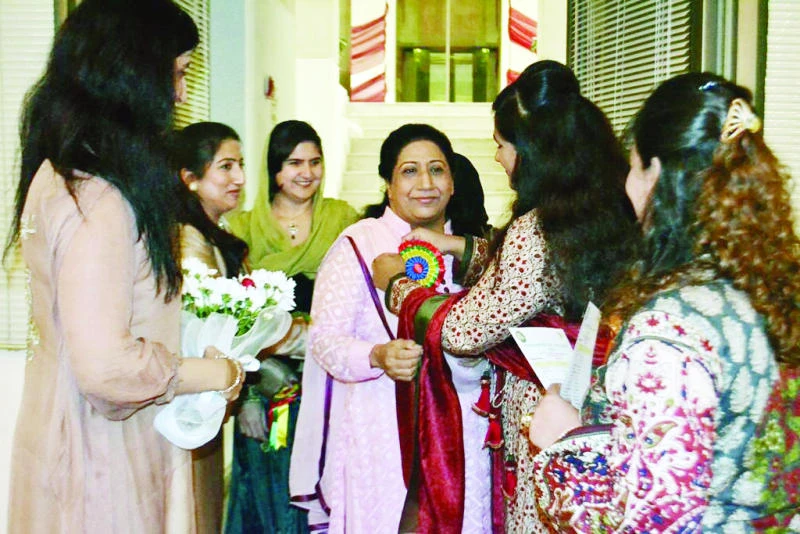
Lubna Khayyam, the wife of the charge d’affaires of the Pakistan Embassy in Riyadh, has outlined the significant role that women play in society and in molding the family unit on the occasion of the United Nations International Day for Elimination of Violence Against Women. The event was organized by the women's wing of the Pakistani Writers Club (PWC) in Riyadh.
Khayyam noted in her address that “gender equality is specifically guaranteed in the constitution of Pakistan.” She said that Pakistan is moving forward legally and socially by creating awareness about practices that lead to violence and discrimination against women.
Further, she stressed the impact of certain laws and bills that were passed effectively to outlaw violent and discriminatory acts such as acid attacks as well as harassment at work place, pointing out that while mind-sets ingrained over centuries are difficult to change, their change is inevitable.
Held at the Embassy of Pakistan on the weekend, the evening was presided over by convenor Dr. Wardah Qureshi, and was hosted by Dr. Erum Qalbani and Aisha Khanum.
Guests included Saida Oihabi, an adviser to the UN, and Margaret Beisty, a prominent motivational speaker against domestic violence. Delegates from the Netherlands, Norway, Singapore, Sri Lanka, Switzerland, Thailand, the United Kingdom, the United States and Uruguay also attended.
The theme of the event was “the victims of abuse and their abusers.”
Black and white masks decorated the tables and the hall. “The blank faces represent the silent and anonymous victims of abuse in a society,” said Asma Tariq, senior member of the PWC. She added, “We wanted to show how these abusers often lie hidden in plain sight and force their victims into silence as well.” Some young performers showcased the different forms of abuse that society perpetrates on girls and women in an artistic presentation.
Clippings were shown from the Oscar winning documentary “Saving Face,” featuring the plight of victims of acid attacks, and their inspirational stories of triumph against overwhelming odds. Just as the women in the documentary struggled for their happy endings, so did a young woman in a play that was presented at the event. The play, “A Tale Untold,” produced and directed by Asma Tariq, told the story of a young woman who at the height of her happiness was chained, bound and thrown into despair by society. The play concluded with a note on how it was only through the help of other people that the young woman was able to fight her way back to life and sanity. “It is always society which throws women into despair and it is only society which can bring them back to life,” commented Madiha Noman, the event coordinator, stressing the role society had to play in the protection and well-being of women.
Ambreen Faiz presented a fitting and poignant eulogy to Parveen Shakir, one of Pakistan’s prominent female poets and a well-known writer about women and their status in Society. Parveen Shakir’s words reflected the pain felt by the victims as well as the survivors of abuse when she wrote, “O, how these strangers bury me alive within these walls (and) bind me with chains of their honor.”
These sentiments were echoed by Margaret Beisty, a motivational speaker and survivor of domestic abuse herself, when she said that a woman’s forced silence is what keeps her down. She also went on to explain that often violence against women is not as dramatic as an acid attack. “Most domestic violence goes unseen,” said Margaret, as she recounted her own moving tale of domestic abuse, as well as the inspirational strength of her mother that helped her whole family move past their painful ordeal. Financial dependence on their abuser, according to Margaret, is one of the key reasons why some women are still trapped in abusive relationships. She also recommended establishing refuges for those women who are not financially independent.
Dr. Wardah Qureshi, PWC-Ladies Chapter convenor, offered her own words of appreciation to the Kingdom and Custodian of the Two Holy Mosques King Abdullah for furthering the empowerment of women by opening more universities for girls as well as including them in the Shoura Council as members.
‘Pakistan moving forward in upholding rights of women’