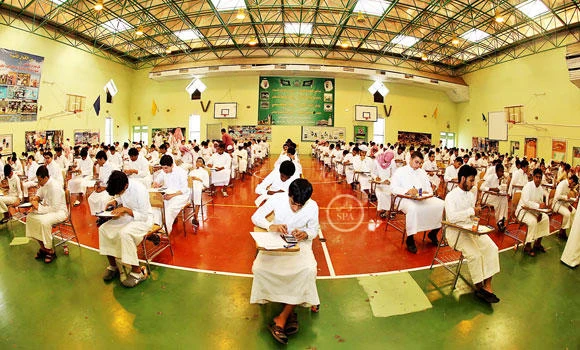
As students prepare for mid-term exams that started on Sunday across the Kingdom, their parents are complaining of the soaring private tuition fee.
Advertising posters of private tutors have been displayed at different venues on Jeddah streets with their phone numbers. Private tuition fees vary depending on subjects, which parents describe as unreasonable.
Workers in the education sector have called for putting a limit to the private tuition fee rise and warned that this trend has many side effects and contributes negatively to the education process.
Abu Meshal, father of a student, told Arab News that he hired a teacher to review the math and English subjects with his son and agreed to pay him SR1,000 for each subject per semester.
Meshal, however, had to pay SR4,000 in the end because he had to hire more tutors, “The difficult (school) curriculum and the poor way of delivering information to students made me look for additional tutors so that my son can excel in school,” he explained.
Ibrahim Khaled, a high school student, said that he and his friends privately take lessons together so they can share the cost. “We collect SR1,000 to take extra lessons in subjects we find difficult to understand like chemistry and math,” he said.
Khaled added that private tutors show students the most important parts in the curriculum and give them questions to study and answer. “These questions are very similar to the ones we have to answer in the exams and are very important,” he added.
A researcher at Jeddah Education Department, Abdul Khaliq Al-Qarni, said there are many reasons behind parents’ decisions to seek private tuition for their children. “The curriculum is extremely difficult and some teachers don’t have the qualifications to deliver information to students or they lack communications skills. This stems from the lack of professional practical training of teachers,” Al-Qarni said. He added that some teachers forget the noble job they are performing and think more of money.
Al-Qarni described private tuition as a dilemma in the education system as it kills positive and fair competition among students and encourages blackmail, cheating and dependence apart from being costly.
“Some teachers charge SR400 per hour where they give students the exam questions in advance to encourage them to keep taking these lessons and paying the money,” Al-Qarni said explaining that the focus on money is tarnishing the teachers’ image and reputation as integrated and loyal educators.
Educationist Hussein Al-Turki said private or group lessons are an interesting phenomenon that intensifies during the mid-term exam season. He blamed the openness provided by the new channels of communication such as the Internet and satellite TV channels. “They distract students who tend to ditch their textbooks,” he said.
He added that many students decide not to pay attention to the teachers’ explanation during the school time because they decide to entirely rely on private lessons after school. He added that students are more inclined to do so if the school teacher is the one to give them the extra lessons. “In this case, they would have the chance to get the exam questions and answers in advance,” he added.
Al-Turki said the Ministry of Education is working to avoid this problem. “The government and private schools offer extra classes after school in exchange for a symbolic fee to help the students learn under the school’s supervision,” he added.
Private tuition fee rises during exam season