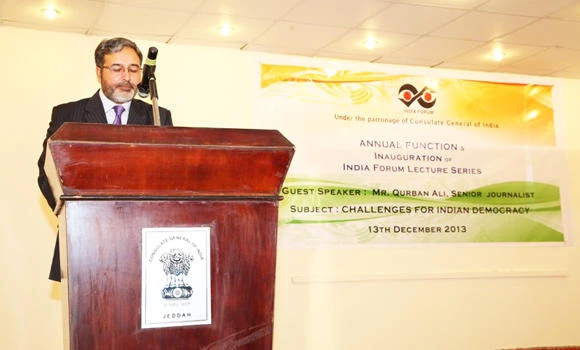
India’s democracy is resilient enough to overcome the country’s many economic, social and political problems, a leading Indian journalist said here recently.
Qurban Ali made this assertion during the first lecture organized by the India Forum. About 300 people attended the event.
Indian Consul General Faiz Ahmad Kidwai, who is vice patron of the forum, said Ali raised important and topical issues, particularly in the wake of recent events in New Delhi.
Qurban Ali said India’s problems include social, economic and political inequality, poverty, illiteracy, lack of sanitation and poor health services. There was also gender discrimination, religious fundamentalism and high levels of corruption in the political sphere.
He said that India has to contend with the effects of the ingrained caste system and the growing relationship between crime and politics. He said that in the 2009 general elections, 153 people, some of them convicted or accused of serious crimes including murder and rape, were elected to the Lok Sabha, the lower house of the Indian parliament.
He said politicians continue to exploit religion for narrow gains, knowing the important cultural role it plays in Indian politics. He said the country is still ruled mainly by members of the so-called upper caste of society with many political parties drawing support from specific castes or sub-castes.
Qurban Ali said the government faces a major challenge in providing over a billion people access to jobs, health care, education and other public services. He said the continuous denial of social and economic equality has led to the Naxalite problem, which he believes is the biggest threat to the country’s democracy and its unity and integrity.
From its beginnings in West Bengal, the Naxalite movement of militant Communist groups, has spread into less developed areas of rural southern and eastern India, such as Chhattisgarh, Odisha and Andhra Pradesh. For the past 10 years, it has grown mostly from displaced tribes and natives who are fighting against alleged exploitation from the state, major Indian corporations and local officials whom they believe to be corrupt.
He stressed that despite all the problems and challenges, India’s democracy will survive and prosper. “In recent decades, India has proven itself capable of not only preserving democracy, but of deepening and broadening it by moving to a more inclusive brand of politics,” he said.
He added that political participation has widened, electoral alternation has intensified, and civil society has pressed more vigorously for institutional reforms and greater government accountability.
“Yet political scientists still have not devoted India the kind of attention it deserves,” Ali said. “Having a mix bag of failure and success, India’s democracy has proved to the world that in a multi-cultural multi-religious society, it has the best form of government to fulfill the aspirations of the common man.”
India Forum Director Sheikh Mohammed Noor Rahman, the Haj consul, said many prominent Indians from different fields would be invited to Jeddah as part of the lecture series.
India Forum’s outgoing President Danish Abdul Ghafoor appreciated Qurban Ali’s scholarly lecture. “The success of new political parties and groupings has changed the political landscape of the country,” he said. “The traditional parties have been forced to reassess their commitment to the people. Political ethics is back in vogue, thanks to the thumping success of value-based parties.”
‘Resilient India can overcome its social, economic problems’