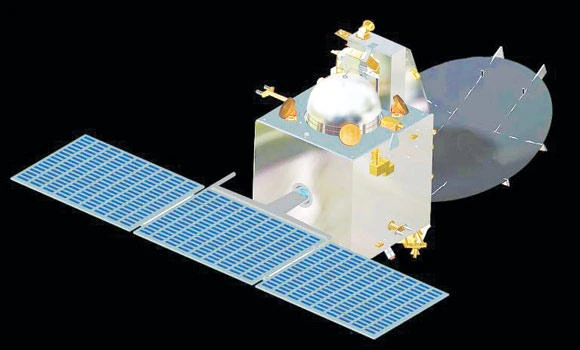
The Indian expatriate community in the Kingdom is euphoric at India having successfully completed the Mars Orbiter Mission (MOM) on Wednesday.
India is on the cusp of history due to this rare success of the maiden mission to the red planet at a cost of only $74 million which is far less than the estimated $100 million budget of the sci-fi blockbuster “Gravity” and a tenth of NASA’s Mars mission Maven that entered the Martian orbit on Sept 22.
Expressing pride in the rare success of his country, Misbah ul Arfin, a senior NRI in Riyadh, who leads the association of Indian researchers and scientists, told Arab News on Thursday: “It is indeed a proud moment for us as Indians to have our country be the first in the world to reach the distant Mars planet on its own steam in the first attempt. It is a rare feat for this unmanned robotic mission.” He added that apart from the success of the maiden journey, the mission called Mangalyaan (Mars craft) is the cheapest inter-planetary mission to date.
Echoing similar sentiments, Obaidur Rehman, an NRI working with an IT solution company here said: “As Indians, we are proud of this rare feat which has catapulted India into the world’s elite club of deep-space explorers.”
He pointed out that the success is a fruit of several years of hard work by scientists at the Indian Space Research Organization (ISRO) and “we are particularly proud that MOM was developed with indigenous and homegrown technology,” Rehman said.
Zakir Aazmi, another Indian working in Riyadh said: “This is a marvelous achievement and it was no easy task considering that more than half the world’s previous attempts have failed.”
Shabbir Nadwi, also based in Riyadh, shared his feelings saying: “It is a proud moment for India and this huge success will be a global advertisement for our ability to design, plan and manage a rather complicated deep-space mission.”
The Indian MOM successfully reached Mars after a 300-day marathon journey covering over 670 million kilometers when ISRO slowed down the spacecraft enough to enter the Mars orbit.
The MOM was launched from the rocket port at Sriharikota on the coast of the Bay of Bengal on Nov. 5, last year. Since then, it has been cruising at a fantastic speed to reach close to Mars, half-way around the Sun.
Notably, Russia and the US failed in their maiden attempts and the first Chinese mission to Mars, Yinghuo-1, failed in 2011 alongside the Russian Phobos-Grunt mission which was launched simultaneously.
Moreover, in 1998, the Japanese mission to Mars ran out of fuel and was lost in space.
Riyadh NRIs delighted over successful Mars mission