RIYADH: The Ministry of Education has announced that Saudi universities would accept 95 percent of high school graduates, despite a royal decree four years ago setting a ceiling of 70 percent.
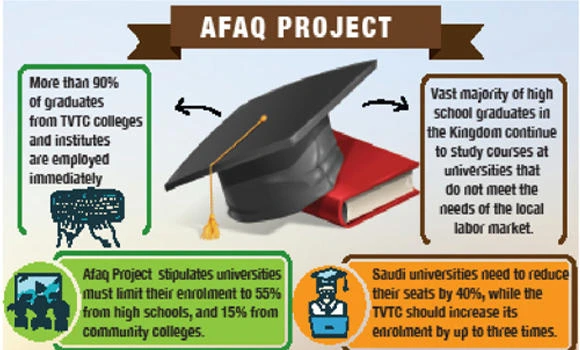
The royal decree had approved the “Afaq Project,” a strategic plan for higher education in the Kingdom, which stipulates universities must limit their enrolment to 55 percent from high schools, and 15 percent from community colleges, a local publication reported recently.
It also states that the Technical and Vocational Training Corporation (TVTC) should accommodate at least 25 percent of high school graduates. The remaining 5 percent of students should be accepted by other higher education institutions or proceed directly to work.
However, currently the TVTC only takes 5 percent of high school graduates, showing a clear deviation from the Afaq Project’s aims and prevailing global trends.
While Saudi Arabia now has more than 30 universities, other developed and industrialized countries are replacing these institutions with technical colleges, despite their wide availability of skilled labor.
The vast majority of high school graduates in the Kingdom continue to study courses at universities that do not meet the needs of the local labor market, while more than 90 percent of graduates from TVTC colleges and institutes are employed immediately, sometimes before graduation.
Recently in Japan, Makiko Tanaka, the country’s minister of education, culture, sports, science and technology, rejected a proposal from an advisory body to build three new universities, arguing that the large number of such institutions had caused a decline in quality education, and difficulties in employment among graduates.
Japan had begun reducing the number of universities in the 1990s in line with government policies aimed at supporting employment, while China has converted half of the country’s higher education universities, about 600, into training, technical and professional institutions.
China’s experience was based on studies indicating that 80 percent of the graduates of these institutions found jobs during the first six months after graduation, compared with only 60 percent among university graduates.
Enrollment at Saudi universities exceeds those of other countries. At 95 percent, it is far ahead of the 57 percent in Britain, 50 percent in Japan, 38 percent in Switzerland, 36 percent in Germany, and 30 percent in Turkey, according to 2012 statistics of the Organization for Economic Cooperation and Development.
According to the royal decree and Afaq Project strategy, Saudi universities need to reduce their seats by 40 percent, while the TVTC should increase its enrolment by up to three times. This translates into 170,000 students annually for the TVTC, while universities should take 225,000 students, to achieve the decree’s objectives by 2019.
However, the TVTC currently takes 110,000 trainees across 50 technical colleges and 72 secondary industrial institutes. It is currently working to increase the capacity of its colleges to accommodate more than 300,000 students.
Saudi universities to accept 95% of high school graduates