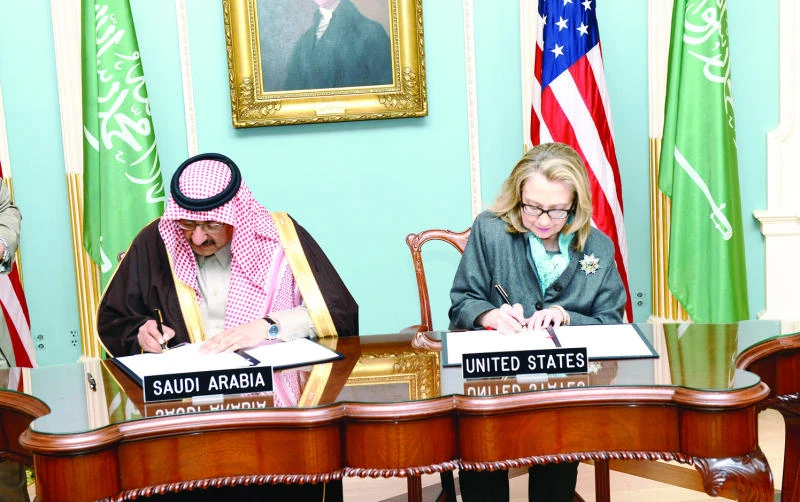
Saudi Arabia and the United States yesterday signed an agreement for trusted traveler programs and strengthening cyber security, opening a new era in political, cultural and trade relations between the two longtime allies.
The landmark accord was signed by Interior Minister Prince Muhammad bin Naif with US Secretary of Homeland Security Janet Napolitano in Washington following talks on expanding security cooperation.
Saudi officials, students and businessmen and businesswomen have welcomed the agreement, saying it would facilitate travel and boost trade between the two countries.
In a joint statement, the Saudi Interior Ministry and the US Department of Homeland Security (DHS) said the accord to begin implementation of trusted traveler programs reaffirmed the extraordinary bond between them.
“The trusted traveler programs will facilitate trade and travel between Saudi Arabia and the United States and will help authorities from MOI and DHS more effectively identify potential threats to keep their borders and countries secure,” the joint statement said.
The accord will come into effect within six months. “The objective will be to start implementation within the next six months with full operations starting in 2014,” the statement said.
“This is an excellent program and will promote Saudi-US relations,” said Abdulelah Saaty, dean of College of Business in Rabigh. “Saudis traveling to the US were facing difficulties in the past. Now things have improved.”
Speaking to Arab News, Saaty said the new agreement would encourage more Saudi families to visit the US. “There are about 100,000 Saudi students and their relatives in the US. I am glad to see this agreement. It shows Saudi-US relations are improving," said Saaty, a regular visitor to the US.
US Customs and Border Protection (CBP) screens all travelers entering the United States using a risk-based approach. Automated advanced data, combined with intelligence and new biometric travel documents, facilitate travel while keeping the country’s borders safe.
CBP has established expedited trusted traveler programs that facilitate the entry process for frequent travelers who have undergone prior screening of their biographical and biometric data. “Through CBP’s trusted traveler programs, we are enhancing the agency’s ability to expedite and facilitate known low risk 'trusted travelers' arriving into the US," said Homeland Security.
“These programs allow pre-approved low-risk travelers expedited processing at ports of entry. This makes it faster and easier for millions of visitors and business people to enter the US,” it added.
CBP Trusted Traveler programs include: Global Entry, SENTRI, FAST, and NEXUS. Pre-screened Global Entry members experience expedited entry benefits at select US international airports, such as no processing lines, no paperwork and reduced wait times.
“Though intended for frequent international flyers, there is no minimum number of trips necessary to qualify for the program,” the department said. Global Entry streamlines the screening process at airports, allowing members to use Global Entry kiosks at select airports to swipe their passports, scan their fingerprints, and make customs declarations without waiting in line, the department added.
One US citizen said he has no plans to take advantage of the Trusted Traveler program because of the bureaucracy involved to become eligible. “I appreciate that the United States and Saudi Arabia feel it’s time to start a program to make it easier for Americans to enter Saudi Arabia, but I don’t think it’s something I will use,” said the 52-year-old American businessman. “It is already pretty convenient for me to go through customs since the lines are not really that long, and I prefer not to go through the trouble of qualifying and going through an interview process.”
In their joint statement, the Kingdom and US also disclosed plans to strengthen their cooperation on cyber security. The MOI and DHS have a mutual interest in partnering to protect critical vital government and private sector infrastructure of bi-national importance, and to make cyberspace more secure for citizens of both countries. “Given the significance of each nation in the global economy, this partnership also contributes to global security,” it added.
The two countries underscored the continuing efforts in combating international security challenges in the areas of cyber crimes, physical infrastructure protection and maritime security through the joint Office of Program Management-Ministry of Interior (OPM-MOI) initiative. “These areas signal further the strong bond between MOI and DHS and recognize the vital importance for both of cooperation in the security field,” the statement said.
Earlier Prince Muhammad met with Napolitano and discussed prospects of expanding security cooperation. The prince was accompanied by Saudi Ambassador to the US Adel A. Al-Jubeir and members of his delegation.
The Saudi minister also held talks with Secretary of State Hillary Clinton at the State Department on Wednesday and renewed the Technical Cooperation Agreement that was signed in May 2008 by then-Interior Minister Prince Naif and then-Secretary of State Condoleezza Rice during the visit of President George W. Bush to the Kingdom.
Prince Muhammad also met with US Attorney-General Eric Holder at the Justice Department. He had separate meetings with Deputy Secretary of State Bill Burns and General Keith B. Alexander, director of the National Security Agency.
Saudi-US accord to ease travel