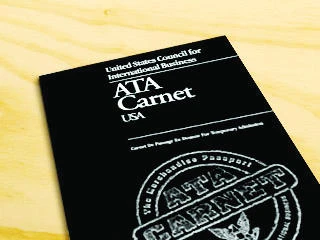
The Saudi Chambers of Commerce & Industry (SCCI) sent a three-member delegation to UAE recently to study the implementation of the ATA Carnet system, according to a Dubai Chamber of Commerce & Industry (DCCI) senior official.
The ATA Carnet is an international customs document that permits duty-free and tax-free temporary importation of goods for up to one year. The initials ATA are an acronym of the French and English words ‘Admission Temporaire/Temporary Admission.”
“The system is a perfect illustration of how close cooperation between business and customs can facilitate international trade,” Atiq Juma Nasib, Dubai Chamber’s SVP for Commercial Services, told Arab News on Thursday in his office at the DCCI headquarters in Deira District here.
Nasib said that the Dubai Chamber has been implementing the system for at least a year and a half and that its counterpart in Saudi Arabia also wants to do the same.
“ATA Carnets cover almost everything — commercial samples, professional equipment, and goods for use at trade fairs, shows and exhibitions,” the DCCI official said. It may cover he said
However, the DCCI official said that they do not cover perishable or consumable items, or goods for processing or repair. Talking about the benefit of the Carnet system, he said that it reduces costs to exporters by eliminating value-added tax (VAT) and customs duties with the added advantage that Carnet holders are not required to post securities with customs.
“Carnets also simplify customs border crossings and cut red tape by allowing importers and exporters to use a single document for all customs formalities,” he said.
With their ATA Carnet, salesmen, exhibitors, and other business travelers may make advance customs arrangements at predetermined costs, visit several countries, use their ATA Carnet for several trips during its one-year validity, and return to their home country without problems or delays.
He said that the beneficiaries of the system include trade shows and fairs which easily attract foreign exhibitors, tourism and transport industries, the entertainment industry and tourism promoters, sports events like the Olympic Games, and countries wishing to take full advantage of the global economy.
Carnet fees vary for each country and are determined by the value of goods, the number of countries to be visited and the costs for security, insurance or other services.
Each country in the ATA chain has a single guaranteeing organization approved by its national customs authorities and the World Federation Chambers (WCF).
“The guaranteeing body is entitled to issue Carnets and to authorize local entities to deliver Carnets on its behalf,” he said.
He added that the ATA international guarantee chain provides reciprocal guarantees assuring customs administrators that duties and taxes incurred in case of misuse will be paid-- for example, if goods are sold instead of re-exported.
The ATA Carnet cooperates under international customs conventions administered by the World Customs Organization (WCO). The ICC/WCF World ATA Carnet Council manages the system in cooperation with the WCO.
The council and STA experts promote the ATA Carnet in Africa, Asia and Pacific, Latin America, Eastern Europe and the Middle East.
Over the past 45 years the Carnet system has spread from a few Western European countries to include over 60 economies. In 2007, approximately 160,000 Carnets were issued worldwide, covering goods valued at almost $17 billion.
SCCI team studies Carnet system in Dubai