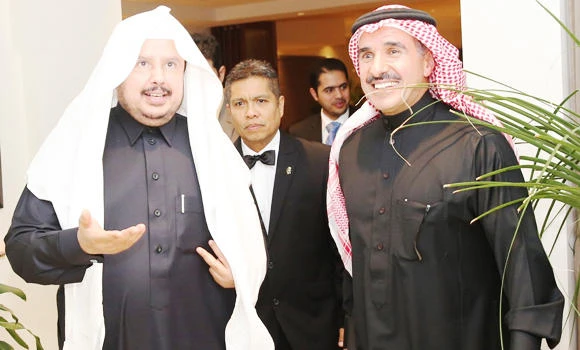
RIYADH: The visit by Saudi Shoura Council members to Australia would help boost ties between the two countries, said Abdullah Al-Asheikh, the Shoura speaker, in Sydney on Tuesday.
Al-Asheikh is leading a Shoura delegation invited by the Australian parliament. He was welcomed at the airport by Saudi Ambassador for Australia and New Zealand, Nabil bin Mohammed Al-Saleh, and senior Australian government officials.
During his stay, Al-Asheikh will hold talks with the head of the Australian Parliament Tony Smith, Senate President Stephen Parry, Governor General Peter Cosgrove, Foreign Minister Julie Bishop and Minister of Trade and Investment Andrew Robb.
Al-Asheikh said the visit comes as the Kingdom, under the leadership of Custodian of the Two Holy Mosques King Salman, seeks to strengthen and develop bilateral relations based on the shared experiences gained as G20 members.
“The exchange of visits between the Shoura Council and the Australian parliament and senate will further bolster the understanding and cooperation between the two bodies,” he said.
Australia and Saudi Arabia enjoy a friendly and substantive relationship. This is underpinned by commercial ties and supported by shared membership in the G20, as well as Australia’s engagement with the Gulf Cooperation Council and Organization of Islamic Cooperation, which are based in the Kingdom.
People-to-people contacts are also an important aspect of the relationship, with over 10,400 Saudis studying at Australian education institutions. Saudi Arabia is Australia’s second-largest trading partner in the Middle East.
There is significant potential for growing economic ties — in agriculture, education and construction. The establishment of the Australia-Saudi Business Council in 2013 supports the promotion of bilateral business ties.
As Australia’s second-largest market in the Middle East, Saudi Arabia is an important trading partner. In 2014, the total two-way merchandise and services trade totaled more than $3 billion. Of this two-way trade, Australia’s merchandise exports to Saudi Arabia amounted to $2.263 billion.
Passenger motor vehicles were Australia’s largest commodity export to Saudi Arabia, worth $748 million in 2014. Other major exports were beef, other meat and barley. Saudi Arabia is also a substantial market for wheat, dairy products, vehicle parts and accessories, and vegetables.
Services exports, notably education, are also significant. A large number of Saudi tertiary students study in Australia, mostly under the King Abdullah Scholarship Program. Saudi students represent the largest contingent from the Middle East.
Australia-Saudi business ties have expanded. The March 2013 Joint Ministerial Commission meeting saw the signing of a memorandum of understanding to set up the Australia-Saudi Business Council.
In April, Minister for Trade and Investment Andrew Robb visited Riyadh to promote Australia’s trade and investment links. He also supported 29 Australian education institutions exhibiting at the annual International Exhibition and Conference on Higher Education.
Shoura visit boosts Saudi-Australia ties