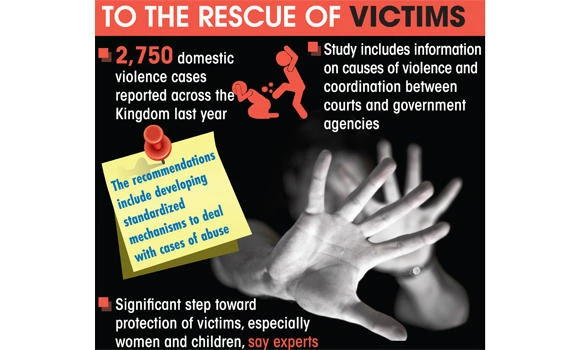
JEDDAH: At least 13 women and children, who are victims of family violence, are living in Dar Al-Himayah (House of Protection), according to Ibrahim Al-Munieh of the Ministry of Social Affairs.
The violence against those in the Dar, he said, varies from physical, psychological, sexual harassment and non-care. Those engaged in the violence are mostly the family members like mother, father and step-mother.
He said if aggressors refused to let the victims return to their homes, the department can provide protection to the victims with the help of police. Not satisfied with the role of welfare homes, some abused women said these homes are sometimes merely satisfied with a pledge formality by the aggressor to stop the abuse.
Al-Munieh said written pledges are not always sufficient. There is a law and official regulations that are applied by the Bureau of Investigation and Public Prosecution (BIPP), and then the judiciary to procedures of the welfare homes that are done according to the protection from harm system according to the degree of violence and its frequency.
He said each abuse case has its particular procedures according to seriousness, which defines the followed procedures in each case. He confirmed that protection system work is done according to clear procedures.
He pointed out that some families are not aware of the role designated to protection homes, in addition to the existence of long bureaucratic procedures whereas some cases need quick intervention, which obstructs hour work.
This calls for activating the role of relevant authorities in implementing the system so as to decrease long procedures and provide protection for all abused inmates and workers in welfare homes.
Al-Munieh said security authorities, represented in the police, the governorate and the BIPP, embody participating and supporting bodies in the implementation of the protection from harm system, and provide protection for potential abuse victims. He denied that workers at the protection home lack professionalism and are unable to contain abuse victims.
He said workers are specialized in social services and psychology, and have gone through training workshops to identify new occurrences in the field of social protection and methods of dealing with abuse cases.
Shoura Council member Haya Al-Manei described preliminary procedures used by the protection home against aggressors are represented in the aggressor taking a written pledge not to approach the victim, which means filing a complaint is useless and drives victims to stop reporting these abuses again.
She said the lengthy bureaucratic procedures experienced by the protection home and the lack of a defining protection system, and the absence of an executive authority to implement punishment make the system lose its strength and power and become useless.
She called on relevant authorities to activate social police that work under the umbrella of protection homes and provide permanent shelters to protect abused women. She called on those responsible for the judiciary to activate a penal law that includes specific articles that inflicts severe punishments on abusers.
He called on Crown Prince Mohammed bin Naif to supervise executive list memos for all relevant bodies that cooperate with the protection home and follow up on their performance.
Steps not enough to check family violence, say victims