The social contribution and philanthropy of the late King Abdullah has been honored by people from all walks of life following his passing on Friday.
People who had the good fortune of knowing him personally said that these traits spoke volumes of his magnanimity and care for people, including for youth seeking education.
The King Abdullah Scholarship Program, for instance, was established in 2005 and has benefited some 160,000 Saudi scholars studying in various universities all over the globe. Some have finished their courses after years of studying and have come back to the Kingdom, now giving back in terms of knowledge and expertise that they had received from other universities through the grants of late king’s government.
His donation of $104 million for food vouchers for 1.7 million Syrian refugees before the the onset of winter has also not gone unnoticed. UN Secretary General Ban Ki-moon expressed his profound gratitude to the late king, saying that the money will help get food for millions of refugees from Syria as well as South Sudan and Somalia. He also contributed $104 million to the World Food Program (WFP) for the benefit of millions of refugees in Syria, Ethiopia and Kenya.
“The contribution to the World Food Program reflects King Abdullah’s sincere desire to help those in need, regardless of religion, sect or ethnicity,” said Saudi Ambassador to the United States Adel bin Ahmed Al-Jubeir. The contribution includes $52 million to assist nearly 1.7 million Syrian refugees, $42 million refugees in Ethiopia, many of whom are from South Sudan, and $10 million for refugees in Kenya. “We are extremely grateful for this assistance, which comes at a crucial moment for these refugees — all of whom have fled protracted conflict,” said WWP’s Executive Director Ertharin Cousin.
The late king also donated $35 million to help West African countries to combat Ebola, as implemented by the Islamic Development Bank (IDB), according to Dr. Ahmad Mohamed Ali, IDB president.
The donation also benefits schools in the concerned countries by providing them with thermal sensors and offered a means of medical examination and screening that allows them to identify infected people and provide early redress for their treatment without infection transmission.
He also donated SR100 million to the Palestinian Health Ministry which is in need of medicine and medical supplies to treat the injured during Israeli attacks on Palestinians in Gaza. This was in addition to a donation made earlier to the Palestinian Red Crescent to secure medical supplies for the injured.
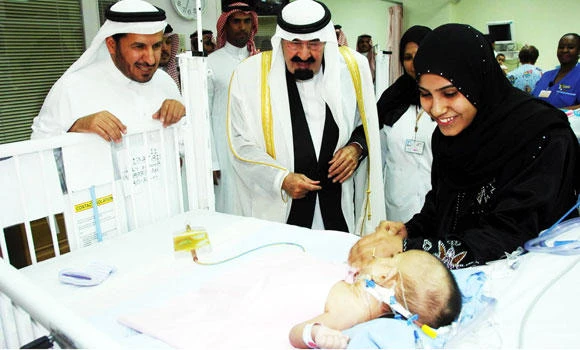
But his philanthropy was not limited to cash donations. It extended to helping the less-fortunate live a normal and better life such as the separation of Siameese twins. At the request of Syrian parents, he ordered a surgery to separate them in March last year.
The two girls — Taqi and Yaqin — were conjoined at the head. The relatives of the twins expressed their gratitude to the king.
The father, Hussain Eissa Al Khedr, is a farmer who could not afford the operation.
The late king was known for his magnanimity