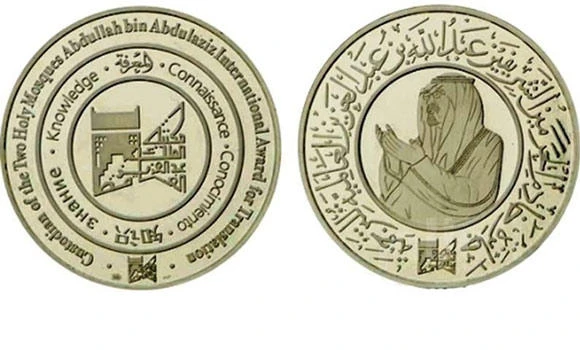
The winners of the prestigious 7th King Abdullah International Award for Translation (KAIAT) will be named in the capital on Tuesday, according to a King Abdulaziz Public Library (KAPL) official.
The announcement was made on Sunday by KAPL Deputy General Supervisor, Abdul Kareem Al-Zaid who said that the works of this year’s winners will enrich the Arab and world libraries with authenticated knowledge application.
The high-profile event will be attended by Deputy Foreign Minister Prince Abdulaziz bin Abdullah, KAIAT chairman of the board of trustees, and Faisal Al-Muammar, adviser of King Abdullah, who is also the general supervisor of KAPL. Members of the diplomatic corps and academics will be attending the event.
According to Al-Zaid, this year’s awards in the areas of scientific knowledge were due to the directives and support of Custodian of the Two Holy Mosques King Abdullah. This makes it the most prominent award in terms of the cash prizes and the number of diversified works nominated ranging from humanities and applied scientific research.
Last year’s ceremony was held in Brazil reflecting the openness of the award irrespective of any cultural or linguistic bias while the 5th awarding ceremony was held in China.
Last year’s winners received a cash prize of SR750,000 each, while the last category for individual prizes got SR500,000.
KAIAT is an annual event for distinguished works of translation and prominent institutions, which have contributed significantly to the field of translation from and into Arabic.
"The translation work has always been a link among different civilizations besides being a potential mode for interaction. It allows people and the nation to see what others have achieved in the fields of science, literature, and arts,” said Prince Abdulaziz in a previous statement, adding that translation enriches culture and ensures richer experience and higher exposure to those who adopt the translation method.
The award has opened up a wide range of knowledge networking and humanitarian strands between the Arab-Islamic culture and other cultures in all areas of knowledge. The objectives of the award are the transfer of knowledge from other languages into Arabic and vice versa.
“This also encourages translation of scientific fields to the Arabic language and enriches the Arabic library that publishes the distinctive translation work,” said Al-Muammar.
The most important feature of this global award, among other things, is that it has also become a major source for the cross-fertilization of Arab culture with other cultures in the melting pot of the interaction of Arab scientific output with other nations and other cultures, he noted.
He cited the indications of the success of the award not only by the increasing number of works being nominated every year, which has reached more than 810 during the past six years alone, but also by the keenness of major scientific and academic institutions to provide the best quality works.
Translation award winners to be named tomorrow