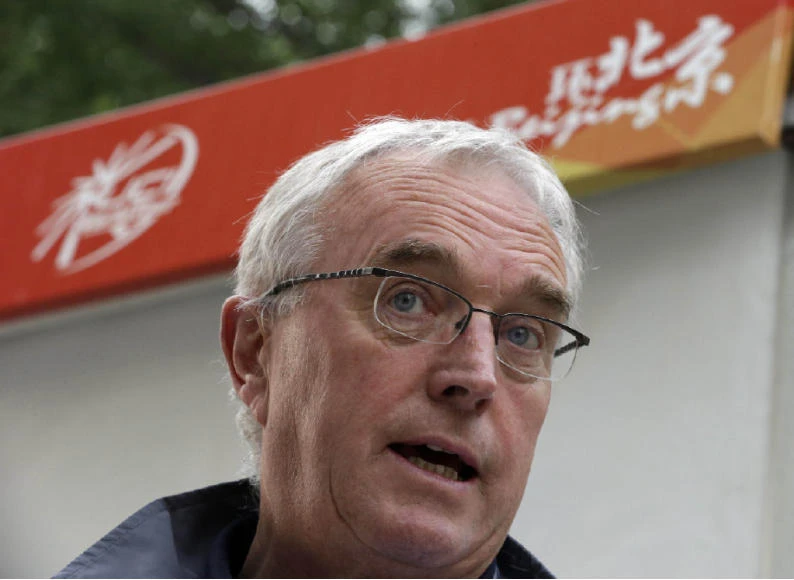
BEIJING: The President of the International Cycling Union defended his organization’s efforts to catch drug cheats in the wake of a damning report on Lance Armstrong’s doping practices, saying yesterday that the testing system must be more stringent.
UCI President Pat McQuaid refused to comment on the US Anti-Doping Agency’s report this week that accused Armstrong of systematic doping. Instead, McQuaid cited inadequacies in the anti-doping system for failing to catch drug-using athletes.
“At UCI, all we can do is test and test and test and send the tests to the lab, and if they come back negative they come back negative,” McQuaid said at the Tour of Beijing. “If athletes, not just cyclists, can beat the system, then the system isn’t strong enough.”
The UCI has yet to decide whether to ratify USADA’s decision to strip Armstrong of his seven Tour de France titles. The USADA report said that Armstrong was able to cheat doping tests because some staff members of the US Postal Service team knew in advance when testers were going to be at races.
McQuaid said it would be inappropriate for him to comment on that and other allegations while the organization was in the process of examining the report.
He said, however, that the anti-doping system has improved since the 1998-2009 period of Armstrong’s career examined in the report. He was optimistic that the cycling union can recover from the blow the report dealt to the sport and his organization’s reputation.
“Time will tell. It’s not something that we have never dealt with before, we’ve had problems like this before. We’ve got through and the sport has got through and we will work through this one as well,” McQuaid said.
Asked if the report will prompt changes in how the UCI is run, he said that “we have to wait and see exactly what’s in there, and if there are things to be learnt from it, well, we will do so.”
IOC to consider
The International Olympic Committee yesterday said that they would be looking at the US Anti-Doping Agency’s report into cyclist Lance Armstrong before deciding whether to strip him of his Olympic bronze medal.
“The IOC is aware of the USADA report and is currently studying it with all the corresponding documentation,” a spokesman for the Lausanne, Switzerland-based body said.
“It would be premature at this stage to say if the IOC envisages taking any steps. If we find proof that justifies the opening of disciplinary procedures, we will of course act as a result.” Armstrong, who risks being officially stripped of all his seven Tour de France wins, won bronze in the individual time trial in Sydney behind gold medalist Vyacheslav Ekimov of Russia and Germany’s Jan Ullrich who took silver.
The Texan was on Wednesday placed at the heart of what the USADA said was the biggest doping program in sports history, as it published a 202-page document to back up its previous decision in August to ban him for life.
The world anti-doping code has a maximum eight-year delay to put forward evidence of drug misuse but the USADA has exceeded that given the extent of the program used by Armstrong and his entourage.
Tyler Hamilton, one of the 11 former teammates who testified against Armstrong, handed back the time-trial gold medal that he won at the 2004 Athens Olympics in early 2011, after he confessed to doping.
The IOC corrected the podium before the time limit expired, handing the gold to Ekimov.
After Armstrong, UCI cites anti-doping regime gaps