
 From digital to AI: Saudi Arabia takes its next LEAP
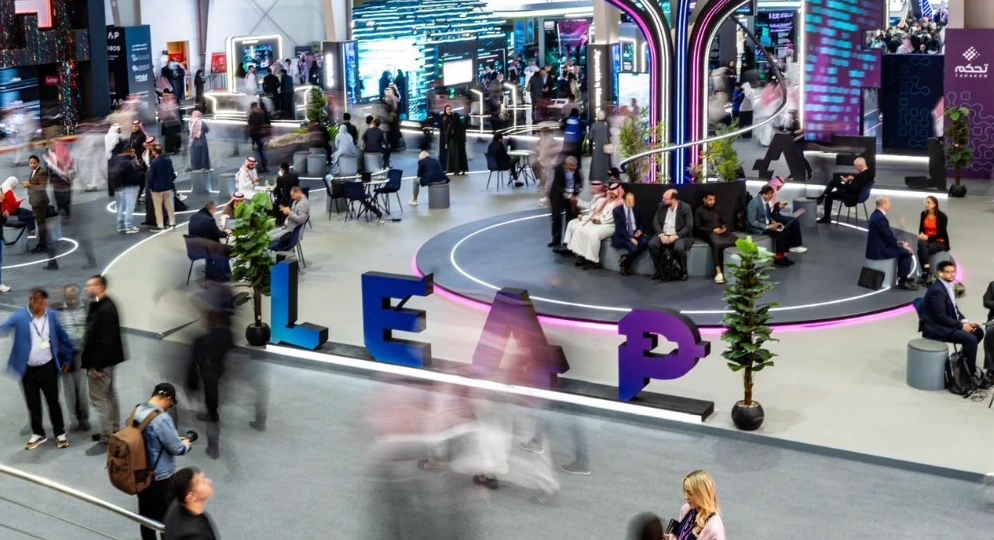
Technology conference LEAP launched in Riyadh in 2022 — a time when digital transformation was accelerating rapidly worldwide. The conference welcomed companies, investors, startups, and global leaders to a country that was positioning itself as a growing player in this sector.
Four editions later, LEAP has become much more than a conference. With hundreds of thousands of visitors from around the world and billions of dollars in investments and partnerships announced through the event, it has become a global digital hub.
Yet, as LEAP 2026 concludes under the theme “Into New Worlds,” its significance may have less to do with how large the event has become and more to do with what it represents.
LEAP has clearly evolved alongside Saudi Arabia. Its earlier editions reflected a country focused on digital transformation: expanding digital services, encouraging entrepreneurship, and creating the foundations of a modern digital economy. Today, those foundations are allowing the conversation to introduce a new topic: Artificial intelligence.
AI is increasingly being treated as an area in which the Kingdom will invest, develop capabilities, and compete globally. This shift is particularly relevant in 2026, which Saudi Arabia has officially designated as the Year of Artificial Intelligence. The decision reflects a broader national focus on accelerating AI adoption, developing talent, encouraging innovation, and attracting investment into an industry that is rapidly reshaping economies around the world.
LEAP 2026 arrived at an interesting point in Saudi Arabia’s technological journey. The Kingdom did not suddenly become an AI contender this year. Rather, its current ambitions are the result of several years of investment in the digital ecosystem.
The scale of investment announced through LEAP illustrates how quickly that ecosystem has developed. The first edition saw more than $6.4 billion in technology and startup investment announcements, followed by $14.9 billion in 2025. But looking at LEAP only through its investment figures misses part of the story. The question to be asked is what the investments are being used to build; the answer is the infrastructure of an AI economy.
AI requires enormous amounts of computing power, data, and energy, making data centers and digital infrastructure just as important to the AI race as the companies developing new models. Saudi Arabia’s second-place ranking globally in data-center market attractiveness in 2026 reflects the country’s growing potential to support the physical infrastructure behind the next generation of digital technologies.
I believe the infrastructure story is one that deserves a much closer look. For now, however, it is enough to recognize that Saudi Arabia’s AI ambitions are increasingly being supported by something tangible: the physical and digital capacity required to make those goals achievable.
There is another part of the equation that cannot be measured in gigabytes or investment figures: people. An AI economy cannot be built simply by attracting international companies or constructing data centers. It also requires a generation capable of developing, applying, and questioning the technologies being introduced. This is where Saudi Arabia’s growing focus on human development becomes important. Organizations such as Tuwaiq Academy, alongside national initiatives focused on AI education and training, support young talents to adapt to and develop a technology-driven future.
AI has gradually moved from being another subject within the technology conversation to a common thread running through much of it. The discussions around infrastructure, cloud computing, investment, talent, and even government services increasingly lead back to the same question: how will AI change what comes next?
The agreements and partnerships announced during LEAP 2026 provide another indication of how this point will be addressed. Agreements involving international collaborations and companies expanding their presence in Saudi Arabia show the growing number of actors participating in the Kingdom’s technology ecosystem.
The individual announcements are significant. However, their collective meaning is more important. They suggest that Saudi Arabia is moving from a phase of adopting digital technologies to one focused on influencing how AI is developed, deployed, and commercialized.
That is also why the Kingdom’s recent position in global technology rankings should be viewed as a sign of progress. Digits can summarize years of progress, but they can’t fully explain what produced that number. A leap can appear sudden when viewed from a distance; in reality, it depends on everything that happened before that.
That may be the most fitting way to understand LEAP 2026. The event has not simply become larger each year; its evolution reflects a change in the ambitions surrounding it. Saudi Arabia’s earlier technological story was largely about digital transformation. The emerging story is about AI — not only adopting it, but creating the conditions to develop and build with it. This makes this year’s conference theme, “Into New Worlds,” very fitting. The question is no longer whether Saudi Arabia will participate in the technological changes shaping the world, but about what role it will play in shaping them.
LEAP started by bringing the world of technology to Saudi Arabia. Five years later, it is increasingly becoming a place where the world comes to see what Saudi Arabia is building next. Perhaps that is the most important leap of all.
Ritaj Hussain Al-Hazmi is a young columnist and Guinness world record holder. She believes in empowering the new generation to reach their full potential.