
 The balancer: what six weeks of Saudi decisions reveal about the region's next order
For decades, the security of this region has rested on partnerships with powers beyond it, and those partnerships remain among the Kingdom's most valuable assets. Yet the war that began on Feb. 28 has confirmed something the region had long understood. Gulf capitals were struck in a conflict they did not start, and the lesson was plain: no single partner, however capable, can carry the entire weight of a region's stability, and security that is only borrowed is never entirely one's own.
The question that follows is not whether those partnerships still matter, because they plainly do. It is which state within the region will build the arrangements that complement them. Over the past six weeks, Saudi Arabia has answered that question through its actions rather than its speeches.
In the classical balance-of-power tradition, a region is stabilized not by its most powerful state but by the one on which all the others can rely. That state has enough weight to check any aspiring hegemon, enough restraint never to become one, and enough standing to bring the rest to the table. The role has long carried a name of its own, the balancer, and the summer's events amount to a sustained argument that it now belongs to Riyadh.
The argument rests on a combination of assets that no other capital in the region holds in full. Geography places the Kingdom on two seas and at the approaches to two of the world's critical chokepoints. Custodianship of the Two Holy Mosques gives Saudi Arabia a legitimacy that cannot be borrowed. Its financial depth allows it to underwrite a security architecture, and Vision 2030 gives it the economic weight to make peace worth more than war to everyone within reach of it.
Above all, it has a leadership pursuing a long-term transformation agenda, and that agenda is the key to reading its regional conduct. Crown Prince Mohammed bin Salman's domestic transformation is often discussed as though it were separate from his foreign policy, when in truth the two are inseparable. The Kingdom intends to become a leading global economy, and it cannot do so in a region at permanent war, which makes its regional strategy the external face of its domestic one. Seen in that light, the summer's moves cease to look like a sequence of separate events and begin to reveal a coherent strategic pattern.
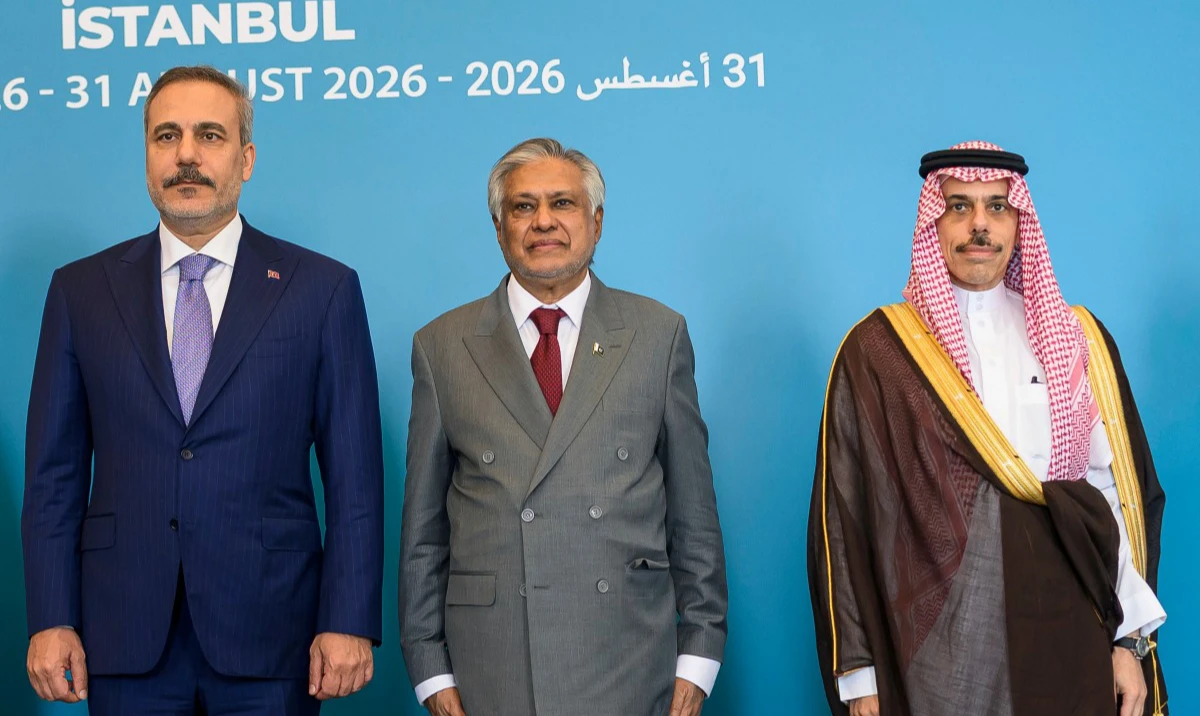
Within the space of a month, the Kingdom put in place the scaffolding of a new regional order. A nuclear cooperation agreement with Washington in July set the American relationship on new terms. On July 30, following a meeting in Riyadh attended by chiefs of staff and representatives from 43 countries and the European Union, the Kingdom announced the Multinational Maritime Defense Alliance; 14 states endorsed its founding declaration. On Aug. 7, the Makkah Joint Defense Agreement with Turkiye and Pakistan followed and, by Aug. 31, that agreement had acquired a name, a permanent secretariat in Riyadh and a first secretary general from Islamabad.
Arrangements of this kind do not substitute for immediate defensive capability; what they establish is a framework for a coordinated response. In doing so, they alter what the region sees when it looks toward the Kingdom: no longer a state under fire but a state organizing the answer.
Every element of the choreography reinforced the point: King Salman issued the invitation, Makkah hosted the signing, the three leaders prayed together at the Grand Mosque, and Riyadh keeps the secretariat. What emerges is the pattern of a convening state drawing its partners into a shared structure without diminishing their standing. That is how durable balances have always been built, around a center that others choose to join.
Equally revealing is what the Makkah agreement leaves unsaid. It names no adversary, speaking instead of “collective deterrence against any aggression,” and from its first day was presented as open to others. Bangladesh has since been invited, and Cairo and Damascus are in conversation. An alliance directed against no one is far harder for anyone to organize against, and it is the kind of arrangement a balancer is particularly well placed to lead.
It also explains Washington's welcome. A region able to carry more of its own security does not displace the American partnership so much as make it sustainable. In offering to be the partner that organizes the others, Riyadh has read the American mood with some precision: the US wants partners rather than dependents.
Still, the clearest evidence of the design lies not in the alliances themselves but in the Kingdom's temperament under attack. On July 28, before any of the summer's agreements, the Council of Ministers set out the governing doctrine: the Kingdom would respond firmly to hostile acts “within international humanitarian law and the principle of proportionality,” and the region required a new order. Every action since has remained within that frame.
When the tanker Sidr was struck in the Strait of Hormuz, the Foreign Ministry named Iran directly and, in the same statement, condemned the Iranian attacks on Jordan, Bahrain and Kuwait, affirming its solidarity with all three. It was a statement framed around the neighborhood rather than a single grievance. When the East-West pipeline was hit, the drones were attributed to Iraqi territory rather than to Iraq's government or Tehran. The Kingdom announced that it had “chosen not to respond directly at this stage” at Baghdad's request, while reserving every right to act. In each case the attribution was calibrated: Iran held accountable as a state, Baghdad treated as a partner, the Houthis denied the standing of a party.
The pipeline episode rewards a slower reading, because it is where the strategy is at once most visible and most often misread. In July, the Kingdom demonstrated that it could strike the sources of such attacks, and did so. In September, it demonstrated that it could choose not to.
The frame for that restraint had been prepared a month earlier, when Saudi Defense Minister Prince Khalid bin Salman wrote that “Iraq will remain a dear neighbor.” When the crisis came, Baghdad could therefore be handed both ownership of the problem and a date, Sept. 30, by which the armed groups on its soil must disarm.
Meanwhile Aramco's public voice never departed from resilience. It recalled a pipeline built four decades ago for precisely this contingency, running at seven million barrels a day within days of Hormuz closing, and the market heard an operator managing an asset rather than a nation in distress. A power that plans its restraint in advance is a power confident of its options, and that confidence was the real message.
Where, then, does the design lead? The pattern is more consistent with a strategy of regional balance than with a bid for hegemony, and the region's history is a caution to anyone tempted by the latter. If the pattern holds, its implications are an equilibrium with Riyadh at the fulcrum.
That would mean an Iran that is contained rather than crushed, with a place available to it in a security framework that it cannot dominate; an architecture that gives Arab and Muslim states weight of their own in the balance with Israel; Turkiye and Pakistan bound into the Gulf's security rather than competing at its edges; Egypt drawn in; a more coordinated Gulf with Riyadh in a central convening role; and the United States kept close as a partner rather than leaned upon as a guarantor.
None of this is announced policy; it is where the summer's choices point. But it describes what a stabilizer looks like in practice: not a state that others must pass through, but one they find it in their interest to work with, because doing so strengthens their security without costing them their independence.
What comes next will be judged against what has already been done. The crown prince's record, at home and abroad, is that of a leader who gives strategic priorities lasting institutional form, and a structure built this deliberately invites three tests.
The first concerns definition. Now that the Makkah alliance has a name and a secretariat, the region will watch how its purpose is articulated, and in particular how it accounts for the Kingdom's decision, so far, to answer Houthi attacks through its own forces and the Yemeni government rather than through the pact.
The second concerns the maritime alliance, which its commander has described as purely defensive, directed at no state and respectful of sovereignty. Whether it becomes the framework through which the security of Bab Al-Mandab is treated as a shared international responsibility rather than a Saudi burden will say a great deal about the reach of the Kingdom's convening role.
The third is Baghdad's Sept. 30 deadline. It has become the first test of a principle Riyadh has now written into its own statements: that no neighbor's territory may serve as a platform against another.
None of these outcomes is assured. But each follows from the logic that produced the past six weeks - establish a center, hold to a doctrine, keep options open - and each will show whether that logic is strong enough to carry the region's next order.
When this summer began, the region was asking who would organize its stability. The answer has since been given in the one language that cannot be counterfeited - in what the Kingdom did, and chose not to do, under fire. Saudi Arabia is not reacting to the region's new order. It is arranging it.
Dimitris Mouchlidis is a strategic communications consultant based in Riyadh, advising institutions on positioning, institutional language, and executive communications.