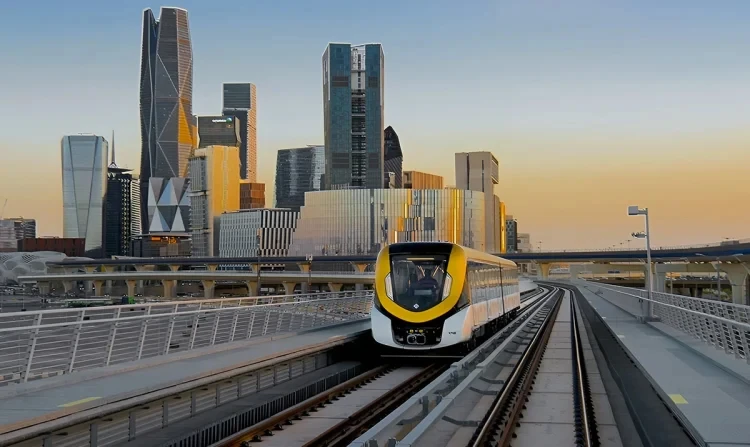
RIYADH: Passenger numbers on Saudi railways surged 266.5 percent to 156.4 million in 2025, as the impact of Riyadh Metro was felt in its first year of operation.
According to the General Authority for Statistics, intracity traveler numbers jumped to 145.4 million from 31.1 million in 2024, an increase of 368 percent.
The increase came after the $22.5 billion Riyadh Metro, designed for an eventual daily capacity of up to 3.6 million passengers, opened to the public in phases from Dec. 1, 2024.
Official figures show that the transport system accounted for 949,400 trips, prompting Joseph Salem, a partner in Arthur D. Little’s Travel and Transportation Practice, to tell Arab News that Saudi Arabia's “investment in urban mobility is delivering, with the Riyadh Metro now carrying most of the (Kingdom’s) 145.4 million intracity trips.”
City-to-city down; freight up
Intercity passenger numbers fell 5.6 percent to 10.9 million across the year, GASTAT said in its Railway Transport Statistics 2025 report.
The Haramain High Speed Railway accounted for 76 percent of passenger transport performance despite a 6.1 percent annual decline.
Rail freight volumes rose to 16.1 million tonnes in 2025 from 15.6 million tonnes a year earlier, with the North Train accounting for 14.4 million tonnes, or 89.7 percent of the total, GASTAT said.
Salem said this increase “adds a strong commercial dimension, confirming the network’s value for both people and the economy.”
He added: “This is a solid foundation for Vision 2030, and the same model can now be scaled to other major cities and corridors.”
Regional
Across the Gulf, governments are also pursuing greater railway connectivity to facilitate cross-border passenger and freight movement.
Saudi Arabia and the UAE signed a memorandum of understanding on Oct. 8 to develop cross-border rail connectivity for goods and freight, while Oman ratified a railway-linkage agreement with the UAE in September.
The Kingdom is also advancing design work on its section of the planned Gulf Cooperation Council railway, which aims to connect all six member states.
In June, Saudi Arabia and Turkiye signed a railway cooperation agreement to exchange expertise and collaborate on infrastructure and technology, while a proposed rail corridor linking the two countries through Jordan and Syria remained under technical evaluation.