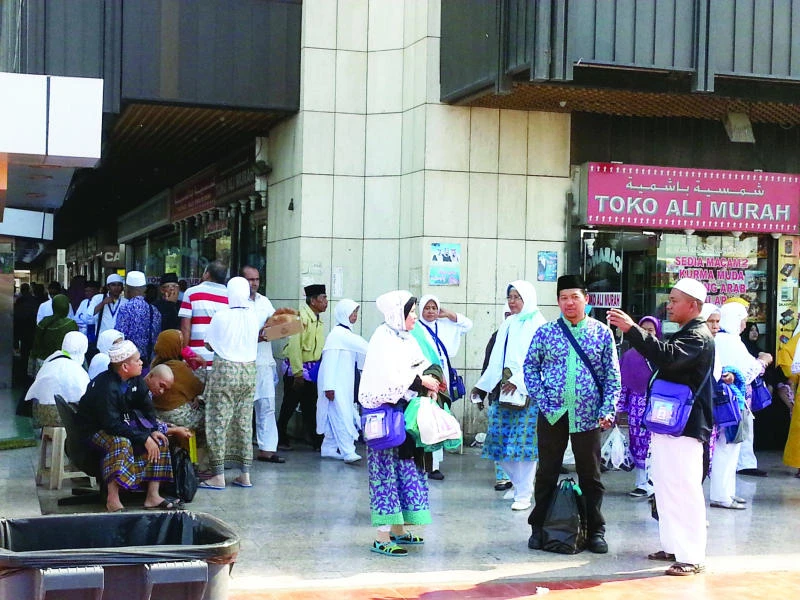
One occasion that brings the most delight to any Muslim’s heart is a pilgrimage Makkah, the heart of Islam.
Through Haj and Umrah, Muslims believe that there is a great chance to achieve Jannah as the Messenger of Allah (peace be upon him) said: “An Umrah to another Umrah expiates what was between them, while the righteous Haj (mabroor) receives no other reward except Jannah.”
Many people, especially from poorer countries, spend their entire lifetime putting aside money, hoping that one day they would get a chance to fulfill this once in a lifetime obligation (for those who can afford) — the Haj.
Haj has been prescribed and made obligatory, once in a lifetime, for all Muslim men and women who have the physical strength and financial means to go to Makkah to perform it.
The current Umrah season began on Dec. 4 and will go on till the end of Ramadan in the last week of July.
The Ministry of Haj announced recently that so far more than 3.2 million pilgrims have arrived through the Kingdom’s air, sea and land inlets to perform Umrah.
The Kingdom has plans in place to receive 6 million Umrah pilgrims this year, up from the over five million who came last season, according to Bandar Hajar, minister of Haj.
The Saudi authorities have a host of facilities and services in place to facilitate the pilgrims. The Ministry of Haj is electronically monitoring the services being provided to the guests of God.
The ministry is receiving Umrah visa applications online, which is linked directly to the Ministry of Interior, the Ministry of Foreign Affairs and other government agencies.
More than 50 Umrah companies are providing services, such as housing accommodation in Makkah and Madinah, for these pilgrims.
The Umrah Information Center facilitates and controls the arrival of millions of pilgrims from around the world.
The Ministry of Haj oversees pilgrims leaving the country according to an approved schedule to prevent delays. This takes place through an electronic monitoring system.
The ministry keeps an electronic record of each stage of the journey.
This system includes an automated link between the Ministry of Haj, the General Authority of Civil Aviation (GACA) and Saudi Arabian Airlines.
Information is then transmitted directly to the Umrah companies and institutions through the Haj and Umrah Information Center.
The government penalizes airlines for failing to transport pilgrims according to agreed schedules.
The ministry has also set up the electronic service at King Abdulaziz International Airport in Jeddah and Prince Muhammad bin Abdulaziz International Airport in Madinah.
Pilgrims are only allowed to leave their accommodation if other pilgrims have left the airports on their scheduled flights. This is to prevent overcrowding at the airports.
The decision taken by the Ministry of Haj to issue Umrah visas during the month of Safar has proven to be a boon for domestic tourism. About 750,000 pilgrims performed Umrah during the month.
Last year, the Haj Ministry reduced the number of Umrah pilgrims by 20 percent from all countries even during peak seasons as also in the month of Ramadan and Shaban, following concerns over pilgrims’ safety.
The decision to reduce the pilgrim numbers is temporary, until the completion of the expansion projects at the Grand Mosques.
According SPA, the expansion projects of the Grand Mosque in Makkah will add 400,000 square meter space to the current area to accommodate 2.2 million worshippers, the Jamarat Bridge from 6 to 12 floors to accommodate 5 million pilgrims per day and the Prophet’s Mosque in Madinah will add 1.6 million pilgrims to accommodate more than two million worshippers.
The Prophet (pbuh) said that the reward for an accepted Haj is to return as if one was born that day from the womb of his mother — completely free from sin.
This is what the pilgrims are headed for. And this is what the Kingdom is facilitating since long.
Facilities in place for journeys of a lifetime