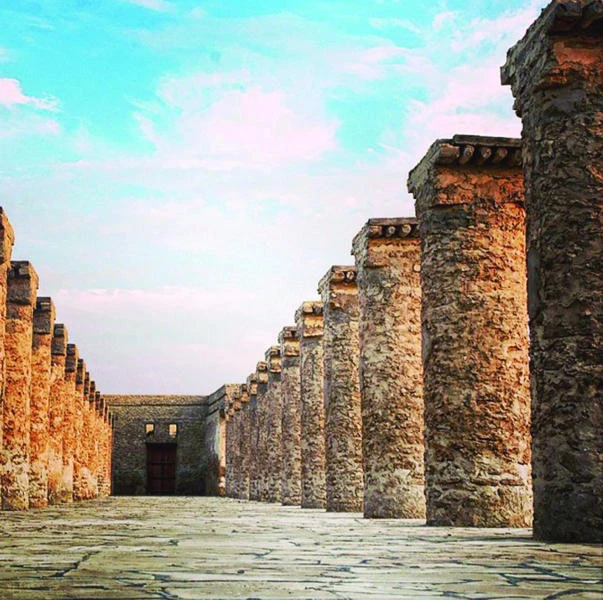
The Kingdom has mounted a concerted effort to upgrade the infrastructure and related facilities at historical and cultural sites as part of its effort to promote cultural tourism.
The thrust of its program is eventually to get several historical sites of the Kingdom declared as a World Heritage site on the UNESCO list within next few years, says Prince Sultan bin Salman, president of the Saudi Commission for Tourism and Antiquities (SCTA).
The prince was addressing a committee to monitoring the development of the project.
He said the committee would redefine the territorial limits of the surrounding regions to be protected and developed.
An office will also be set up for completing formalities to obtain government funding for the project, besides undertaking archaeological excavations.
The Kingdom had submitted applications to register three sites on UNESCO’s World Heritage List.
The first two sites — Madain Saleh in Madinah Province and Al-Diriyah, site of the first Saudi state — were successfully registered.
The SCTA subsequently submitted the preliminary application for the nomination of Jeddah’s downtown historical center Balad in the World Heritage Committee in 2010. UNESCO declared Madain Saleh as a site of patrimony in 2008, and it became Saudi Arabia’s first World Heritage site.
It was chosen for its well-preserved remains from late antiquity, especially the 131 rock-cut monumental tombs, with their elaborately ornamented facades, of the Nabatean kingdom.
Madain Saleh, also called Al-Hijr, is a pre-Islamic archaeological site located in the Al-Ula sector in Madinah province of the Kingdom.
The site constitutes the Kingdom’s southernmost settlement.
Accounts from the Holy Qur’an place the settlement of the area by the tribe of Thamud after Noah but before Moses, which can be interpreted as the third millennium BC.
The Thamudis, who would carve out homes in the mountains, were punished by Allah for their persistent practice of idol worship.
The government has developed Madain Saleh, officially protected as an archaeological site since 1972, for its tourism potential.
The long history of the place and the multitude of cultures to have occupied the site have led to the several names that are still in use to refer to the area.
The place is currently known as Madain Saleh, Arabic for “Cities of Saleh,” which was coined by an Andalusian traveler in 1336 AD.
The name “Al-Hijr,” Arabic for “rocky place,” has also been used to allude to its topography. Both names have been mentioned in the Holy Qur’an when referring to the settlements found in the locality. Al-Diriyah, located on the northwestern outskirts of the capital city Riyadh was the original home of the Saudi royal family, and served as the capital of the first Saudi dynasty from 1744 to 1818. Today, the town is the seat of the Diriyah Governorate, which also includes the villages of Uyayna, Jubayla, and Al-Ammariyyah.
The Turaif district in Diriyah was declared a UNESCO World Heritage site in 2010.
The ruins of the old city of Al-Diriyah lay on either side of the narrow valley known as Wadi Hanifa, which continues southward through Riyadh and beyond.
Consisting almost entirely of mud-brick structures, the ruins are divided into three districts, Ghussaibah, Al-Mulaybeed, and Turaif, set on top of hills overlooking the valley.
Of the three, Turaif is the highest, and its bottom is easily accessible to tourists by foot. Part of the city wall, running along the edges of the wadi and also made of mud-bricks, are still extant along with some short observation towers.
The modern city is built at a lower altitude at the foot of the hill upon which Turaif is located.
To the north of the town, inside the valley, are a number of gardens, palm groves, and small farms and estates.
A dam known as Al-Ilb lies further north. The Kingdom’s renovation of its cultural and historical sites is moving in tandem with a parallel effort targeting international forums, such as the Arabian Travel Market held in Dubai recently.
The promotional drive, it is believed, would go a long way in boosting the tourist traffic to the Kingdom, according to the SCTA chairman.
In a statement after visiting the Kingdom’s pavilion at the exhibition, Prince Sultan said Saudi Arabia is rich in tourist attractions, including historical sites such as Madain Saleh and Diriyah.
He stressed the need to project the Kingdom as a major tourist destination, where Gulf citizens could spend their vacations.
“The SCTA intends to organize a variety of attractive programs and activities to woo Saudis as well as GCC citizens to spend their holidays in the Kingdom,” the Saudi Press Agency quoted him as saying.
He said Saudi tourism would not be limited to Haj and Umrah alone as new investment projects were under way to boost tourist facilities and attractions in the Kingdom.
Forums such as the Arabian Travel Market could serve as a springboard for these ventures.
On other hand, the Kingdom wants to achieve its national objective of promoting cultural tourism as a major source of employment and business opportunities.
Accordingly, Saudi Arabia aims to nationalize the tourism sector, Prince Sultan bin Salman said in Al-Aqaba, while addressing an economic conference in the Jordanian coastal city recently.
The prince chaired the first session of the Al-Aqaba second economic conference titled “Tourist Industry and its Impact on Reducing Poverty and Unemployment.”
He said: “Tourism is one of the important industries, which play a big and significant role in providing job opportunities and alleviating poverty.”
Prince Sultan said: “The Kingdom is currently passing through a remarkable transitional period and this sector too is witnessing a change. Tourism, which is a major human activity, has today become an industry in itself.”
More than 500 participants, including economists, tourism experts and media representatives from various Arab countries, attended the conference.
Prince Sultan said the tourism industry stimulated the growth of the handicraft business, besides creating job opportunities for the people at the historical, heritage and agricultural sites.
“This activity will ensure honorable living for the residents of these areas who will no longer have to migrate to the urban cities,” he said.
“This policy has resulted in big investments for the welfare of the inhabitants,” he added.
He said the SCTA was focusing on investments, especially in agricultural and rural areas.
“We are cooperating with a number of public and private establishments to further consolidate this trend. We have taken a giant leap by building the capacity of the rural and heritage areas,” he said.
He also called for involving local societies in tourism projects and said this would benefit both the investors and the local inhabitants.
“Tourism will generate more job opportunities and will stabilize the local society whose members would not need to migrate to big cities anymore,” said the prince.
In a parallel move, a Harvard University delegation was in the Kingdom at the invitation of the Arriyadh Development Authority (ADA) for a presentation on the Diriyah Development Program.
The ADA representatives were also invited to visit Harvard University in the US to brief the School of Design students on the cultural and traditional aspects of the Diriyah project and explore opportunities for future collaboration between the ADA and Harvard similar to the ones they have with the University of California at Berkeley.
Other SCTA initiatives to promote cultural tourism and antiquities include the archaeological site at Al-Magar, located in the central region of the Kingdom.
Prince Sultan recently visited the site where recent excavations revealed the domestication of horses in the Arabian Peninsula 9,000 years ago.
Prince Sultan underscored the significance of antiquities as they reflect the Kingdom’s rich heritage and its great contribution to world civilization.
“I am happy to see a growing desire among citizens to protect antiquities as they are state property.”
There are regulations that prevent encroachment on antiquities in any way,” he pointed out.
Prince Sultan also presented the antiquities excavated from Al-Magar to Custodian of the Two Holy Mosques King Abdullah during a function at Al-Safa Palace in Makkah recently and briefed the king on the importance of these historical artifacts.
“The SCTA considers citizens as the primary guards in preserving antiquities that are found in different parts of the Kingdom.”
These antiquities contribute to formulating our national and cultural identity,” the prince said.
He also urged the people to inform the nearest SCTA office if they observe any move to steal, transfer or damage the Kingdom’s antiquities.
Prince Sultan observed: “The antiquities proved that Al-Magar was the oldest place in the world so far with people domesticating horses.”
He said the artifacts also showed the cultural activities of people in the region during the Neolithic Age.
During the ceremony, King Abdullah lauded the excavation team and wished them continued success in their efforts to uncover the Kingdom’s past.
He urged the SCTA to publish the results of their findings showing that the Arabian Peninsula had set a precedent in taking care of the horses.
According to Ali Al-Ghabban, deputy chairman of SCTA for antiquities and museums, who accompanied Prince Sultan during the tour, the commission began excavations at Al-Magar after being tipped off by a Saudi last year.
Local and international experts took part in the excavation that unearthed 80 valuable artifacts from the site Al-Magar site is located about 120 km from Wadi Al-Dawasir in an area between the municipalities of Tathleeth and Wadi Al-Dawasir.
In March 2010, the SCTA undertook the site survey and exploration.
Archaeological finds, including arrowheads and precisely made stone scrapers similar to those used during the Neolithic period, are scattered all over the site.
Several carvings of domesticated animals found at the site shed light on the inhabitants’ mode of living during the period.
They included statues of horses, sheep, goats, Saluki dogs, ostriches, falcons and fish.
Heritage tag for historical sites: KSA boosts campaign