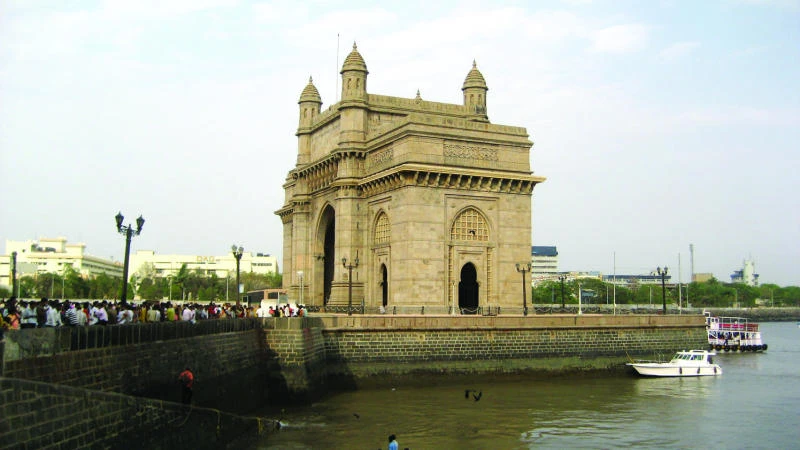
There’s something unique about Mumbai. It’s certainly not architectural grandeur; there are no more than a dozen outstanding buildings in the entire city, most of them a legacy of the Victorian era. Neither does it have any great natural attractions; for such a vast metropolis there is a notable absence of public gardens and parks. Mumbai is hot, noisy, polluted and over-populated. But despite all that, it remains, somehow, my favorite city in the world.
Perhaps it’s the sheer dynamism of 20 million highly industrious people, involved in every conceivable endeavor: finance, media, construction, fashion, film, engineering, manufacturing….you name it. You can feel the energy of all that productivity from the moment you arrive.
Then there is the sheer cultural diversity, all the people of India represented in terms of clothing, religion, endless varieties of street food and haute cuisine, and of course the city’s lingua franca — a rapid staccato mix of Hindi, English and Gujarati.
I lived in Mumbai from 1998 to 2003. It was a fascinating experience, as I worked in the film industry (please, not Bollywood- a term abhorred by Mumbai’s production fraternity), while also helping my wife with her steel fabrication company, which specialized in children’s playgrounds. I got to know Mumbai on many levels, from the ivory towers of finance to the industrial workshops in the outlying slums, and pretty much everything in between.
Therefore I was very curious upon recently visiting Mumbai after an absence of 10 years, to see what changes have taken place there.
Landing in Mumbai’s beautifully renovated airport, you’re welcomed back by the familiar perfume of the nearby creek; a pungent combination of brackish water, industrial effluent and raw sewage. Surprisingly, this is an evocative smell that grows on you — no doubt, quite literally — the longer you stay in the city. (I remember once getting a whiff of it when my wife opened her suitcase after arriving in London from Mumbai, and having a sudden sense of nostalgia.)
Exiting the airport into the busy neighborhood of Andheri, the signs of major transformation are all around, in terms of massive highway links and over-passes, glamorous hotels and floodlit billboards advertising an array of luxury property developments. What’s clear is that the Indian economy, which for 50 years was geared toward a kind of simple egalitarianism, is now clearly skewed in favor of the haves as opposed to the have-nots.
The latter may be sidelined by all this transformation, but they are still very much in evidence. Just as many people are living on the road as there were a decade ago. And in the shadows of all those flashy new high-rises are the vast and sprawling slums, where millions somehow survive from day to day in their crowded and flimsy shacks.
If you have money, Mumbai has become a great place to blow it. The old Phoenix textile mill in Lower Parel, which lay dormant and forgotten for a generation, has been converted into a world-class shopping mall featuring Burberry, Jimmy Choo and Lacoste. South Mumbai’s legendary Taj Mahal Hotel, badly damaged in the terrorist attack of 2008, is now renovated to an even higher standard of luxury than before, which speaks measures. And there are plenty of options for anybody with $ 5 or $ 10 million to spend on a Malabar Hill penthouse with acres of marble flooring and an ocean view.
Even more remarkable is what has been happening in the outer suburbs. We used to live in Gokuldham, up in the north of the city — in those days a sleepy little lower-middle-class backwater, known only as the entry point to the Film City complex of film production lots. Since then, most of Gokuldham’s crumbling old buildings have been demolished and replaced by a beautifully landscaped five-star hotel, a glitzy mall with a five-screen cinema, an international high school and a lot of upscale residential apartment blocks, with more under construction. Even non-luxury property there has multiplied ten times in value. Not to mention that the Film City is now a global production base where young animators work on the next big Disney features.
But some good things are disappearing in the process. We used to buy garden-fresh fruit and vegetables from roadside hawkers, most of whom have been banished to make way for bland supermarkets selling global food brands. More Americanization is seen in the proliferation of KFC’s, Domino’s and McDonald’s where South Indian ‘udupi’ snack bars used to be, and many women are discarding their colorful saris in favor of ubiquitous outfits from Zara and Gap.
Getting to and from the suburbs has been greatly eased by the impressive new ‘sealink’ — a massive bridge connecting the Great Western Highway with the downtown business district of Worli. Driving from Gokuldam to South Mumbai used to be a 90-minute journey, now you can do it in half the time — so long as you have a car or can afford a taxi. Those relying on public transport are still forced to cope with the SuperDenseCrushLoad (yes, that is the official term) of the rush-hour local trains.
For all its challenges and injustices, there is no doubt that Mumbai is re-assuming its identity as a global city — something it used to be, a hundred years ago, before diminishing in status after India’s independence and the unfortunate discarding of the name Bombay. Today, Mumbai is an important financial capital, technology hub, manufacturing base and outsourcing center, where English is the key to success. The economy is dynamic, attracting film producers, IT engineers, fashion designers, journalists and investors from all over the world.
This is an exciting time for Mumbai and the future looks bright — certainly for the haves but also, hopefully, for the have-nots.
Email: [email protected]