St. Augustine, Florida — This year, St. Augustine is celebrating the 450th anniversary of its settlement by 800 Spanish explorers who gathered on the shore of what was once a salt marsh, and claimed it for Queen Isabella of Spain.
The historic city, less than a two-hour drive from Orlando, Fl., holds many records; it has America’s narrowest street (seven feet wide); it is the home of the oldest wooden schoolhouse (built in 1716); and it is home to Florida’s first official “tourist attraction," the St. Augustine Alligator Farm and Zoological Park, established in 1893.
St. Augustine, America’s Oldest City
But what drew us to this lovely beachside city on Florida’s east coast was another unique distinction that, among American cities, entitles St. Augustine to special bragging rights: it is the oldest continuously occupied settlement established by Europeans in the continental United States.
First explored by Juan Ponce de Leon in 1513 for the famed Fountain of Youth, St. Augustine was settled by Pedro Menendez de Aviles in 1565.
Few Americans realize that Colonial America started right here in St. Augustine, 55 years before the Pilgrims landed on Plymouth Rock , Massachusetts, and 42 years before Jamestown was settled in Virginia. In 1763, with the Treaty of Paris, Spain ceded Florida and St. Augustine to the British, in exchange for their relinquishing control of Havana, Cuba. The Bahamas Islands, Grenada and Montserrat, captured by the French and Spanish, were also returned to Britain.
Florida fell under Spanish control again from 1784 to 1821, and was ceded to the United States by Spain in 1819 under the Adams-Onis Treaty. Florida officially became a US possession as the Florida Territory in 1822. As with much of the nation, Florida was pulled into the Civil War and in 1861, Florida seceded from the Union and joined the Confederacy.
All this is the backdrop as to why St. Augustine will celebrate this special anniversary with an entire 12-month calendar of festive events: music festivals, art exhibitions, concerts, and fireworks. As an added treat, throughout the year, historic ships will be open to visits on St. Augustine’s famed Bayfront.
Ghosts and Historic Homes
Our adventure in St. Augustine first began by checking into the St. Francis Inn, a charming, historic bed and breakfast lodging that has been hosting (and pampering) overnight guests since 1791, a time known as St. Augustine’s “Second Colonial Period.”
Fully modernized and updated, guests at this lushly landscaped lodge enjoy a complimentary (and massive!) breakfast, plus complimentary afternoon snacks and warmed up around a courtyard fire pit, and – for a perfect nightcap – a rich, southern-style dessert du jour.
As America’s oldest city, St. August offers a flamboyant history of four centuries of many legends of ghostly figures. Some believe that “Lily,” the ghost of a young house servant haunts the St. Francis Inn. Her tragic death, some say, has strange happenings reported on the third floor of the inn. Although we stayed in a lovely room on the third floor, alas, Ms. Lily did not trouble our sleep there. (note: one can request “Lily’s Room” when making a reservation there) http://www.stfrancisinn.com/ghosts/
Centuries of History,but – Alas – No ‘Fountain Of Youth’
What brought the founders to St. Augustine is simple: they were
seeking a mythical “fountain of youth.” Alas, they were unsuccessful in their quest, but their original settlement – along with a predecessor Native American village of the Seloy indian tribe – has been recreated, inside the city’s “Colonial Quarter,” at the Fountain of Youth Archeological Museum.”
This “living museum” features an exact replica of a Spanish military garrison quarters, a working blacksmith’s forge, and a 300-year-old carpenter’s shop.
While exploring this wonderful city, by all means visit its most iconic and recognizable landmarks: the St. Augustine Lighthouse and Museum, a brick and stone edifice built in 1871 that replaced a Spanish-era watchtower that once occupied the same spot.
Climb up the lighthouse's 219 steps for a panoramic view 165 feet above sea level. At the top, the original nine-foot tall Fresnel lens, made in France, still serves as beacon, but now is lit by a 1,000-watt bulb, whereas in the old days those tending the lighthouse had to haul oil up in buckets to keep the lens alight.
Old Town with new flavors
After such a climb to view all of St. Augustine, time to reward yourself with a well-deserved meal offered by the many delicious restaurants scattered throughout the town.
As dinner time approached, we decided on “Florida’s oldest restaurant,” the casually elegant “Columbia.” Since 1905, this Cuban-American eatery also has the distinction of being the “largest Spanish restaurant in the world.” The award-winning cuisine is set in an atmosphere of beautifully Spanish-influenced rooms. The signature dishes at the Columbia include a white asparagus salad and the “Original 1905” salad, the latter a crowd-pleasing tribute to hungry Sicilian cigar workers who frequented the Columbia at the turn of the last century.
A narrated tour aboard the Historic Tours of America’s “Old Town Trolley” helps one discover the city and navigate the most significant points of interest, including historic homes, museums, grand hotels, including the historic Hotel Alcazar, now the Lightner Museum, filled with antiquities from the American Gilded Age.
Dine at the bottom of An enormous swimming pool
The Café Alcazar is directly behind the museum. This elegant eatery is located in the former indoor swimming pool of the Alcazar Hotel, the largest in the world during its time. It’s easy to imagine the glamour of the times from what is now the bottom of this enormous pool while dining there.
Hop back on the trolley and be sure to tour the oldest stone fort in the United States, Castillo de San Marcos, built in 1672. The trolley allows you to hop on-and-off its 23 well-located stops in the historic district.
Next, drop by Flagler College, a small liberal arts institution of higher learning housed at the landmark Ponce de Leon Hotel. This hotel, built in the grand style of nineteenth century European spas, was erected in 1888. Built by Henry M. Flagler, the railroad magnate, in 1888, the Ponce de Leon is considered one of the finest examples of Spanish Renaissance architecture and was one of the most exclusive resorts of its day, and is also home to the largest collection of Louis Comfort Tiffany stained glass windows; over 79 windows adorn the dining hall, which is included in the tour offered by the college.
A new experience to try in the 2.5 hour culinary adventure walking tour, a great way to discover several restaurants during a limited visit to the area. St. Augustine’s Historic Walking Tours includes generous tasting of the city’s rich heritage of delicious food from five different restaurants, all within easy walking distance of each other.
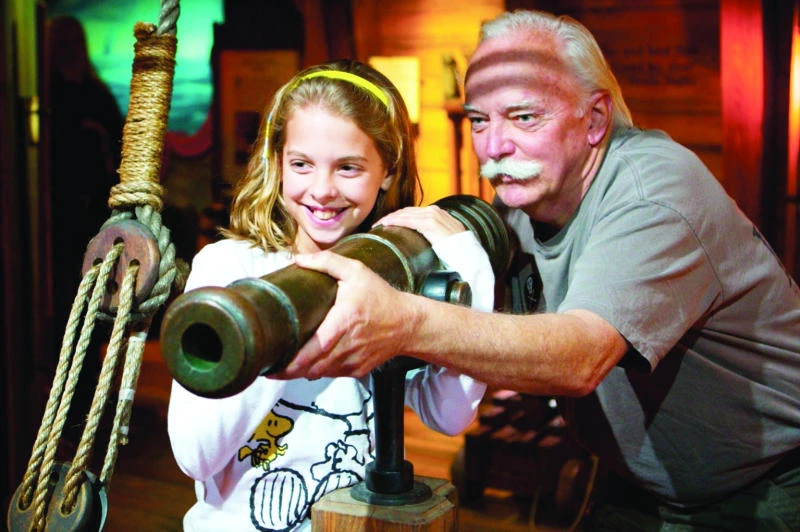
Don’t be deceived by the exterior of the St. Augustine Pirate and Treasure Museum, which offers a treasure trove of exciting and education museum experiences. The historic exhibits, shipboard dioramas, and 3-D effects (all designed by “Imagineers” hired from Walt Disney World), magically transport lucky visitors back 300 years, to experience first-hand what it is like to live in the “golden age” of piracy.
The latest addition to the exhibit features artifacts from the Red Sea Pirates, including a 17th century Khanjarli dagger and an 18th century trade sword. The appellation was used to identify buccaneers who traveled the West Indies around Africa into the Red Sea.
The sights, sounds and smells of St. Augustine’s history envelope you throughout the two-acre Colonial Quarter in the heart of the downtown historic district.
For a spooky finish to a perfect day, join a “ghostly pub tour through hauntingly delicious eats!” The Haunted Pub Crawl & Paranormal Investigation offers visitors a “true, gruesome history of the city’s lesser known dark side.”
The pub crawl brought us to some of St. Augustine’s notorious taverns while detecting and zeroing-in on poltergeists with the aid of actual paranormal detection equipment. The hand-held devices detect the electromagnetic fields that indicate ghosts, spirits and ghouls.
Even if we didn’t detect ghosts, the nighttime adventure showed us another fun facet of St. Augustine we would have never discovered.
For additional information about travel and tourism opportunities in St. Augustine, FL, visit this Web site: www.FloridasHistoricCoast.com
—
Email: [email protected]
St. Augustine: More than just the ‘Fountain of Youth’