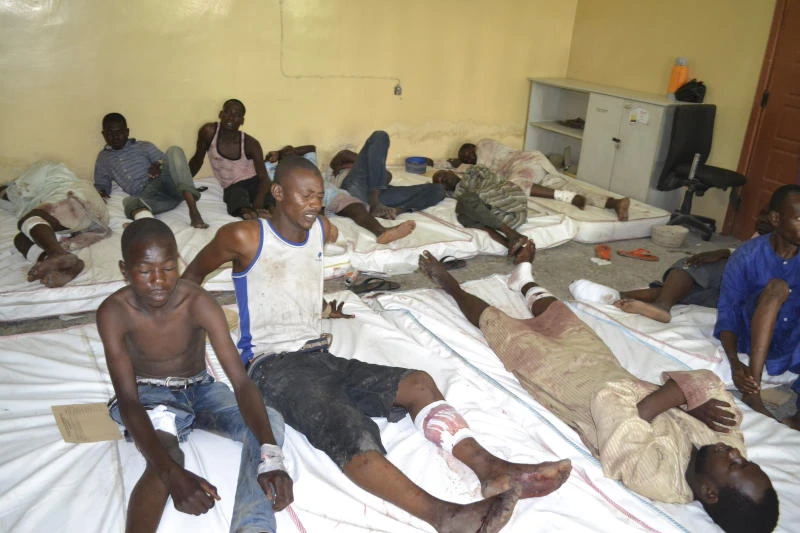
MAIDUGURI, Nigeria: Locals in Maiduguri, northeast Nigeria, on Monday said at least 85 people were killed in a series of bombings blamed on Boko Haram, disputing a lower figure of 54 given by police.
“I can assure you that no fewer than 85 people died,” said resident Sabo Ahmed. “The figure given by the police is just the number of people taken to hospital.
“Many more died and were just taken away by their loved ones.”
The Borno state police said earlier that 54 people had died in Sunday night’s explosions, which ripped through the Aljari Cross and Gomari areas of the city.
A mosque and a “viewing center” showing televised football were among the targets of the attacks, which the military blamed on Boko Haram militants.
Ahmed said 15 more bodies had been pulled from the rubble of the viewing center and that four were his brothers aged between 19 to 24.
Alhaji Jidda, a resident of the Binta Sugar neighborhood, said more than 35 people were killed at the mosque, which is thought to have been hit by a female suicide bomber.
“Apart from the imam and a few people, all the rest died instantly at the mosque because of the impact of the blast,” he said.
“From the figures we gathered, more than 85 people died,” he said.
A security source, who spoke on condition of anonymity, confirmed: “Yes, the dead should be higher than what was given to you but that (54) is the official figure,” he said.
Nigerian authorities have frequently underplayed tolls of deaths and injuries in previous attacks in the insurgency.
But Boko Haram’s shadowy leader Abubakar Shekau denied the group was a spent force, describing the military claims as “lies” in an audio recording published via social media on Saturday.
The explosions also followed a warning from Nigerian President Muhammadu Buhari that “conventional” Boko Haram attacks were decreasing but that suicide and homemade bomb outrages could continue.
Army spokesman Sani Usman said the blasts, which locals believed could have been aimed to distract security forces to enable an attack on the city, “signify (a) high level of desperation on the part of the Boko Haram terrorists.”
Bashir Ibrahim, who lives in the densely populated Gomari area, near Maiduguri airport, said there were “four separate blasts that went off simultaneously.”
Witness Faruq Ali, a trader, said the third bomb exploded at a mosque not far from the Binta Sugar area and may have been targeted by a woman wearing an explosives vest.
“Luckily enough, only few people were observing the Isha (night prayers) but we counted 11 dead bodies and about 21 others sustained injuries,” he said.
Markus John, a tire repairer, said the fourth bomb exploded close to the mosque near a football “viewing center,” where matches are shown to the public on a large screen.
“We counted four dead bodies here (at the viewing center) and many others sustained injuries,” he said.
Maiduguri, the capital of Borno state and the birthplace of Boko Haram in 2002, has been the epicenter of the six-year-old insurgency and repeatedly attacked since Buhari assumed office.
Since May 29, at least 1,100 people have been killed, with the majority of attacks in Borno.
Overall, the violence has left at least 17,000 dead since 2009, according to Amnesty International, while the UN estimates that more than two million have been made homeless in the same period.
Apart from suicide and bomb attacks on markets, bus stations and mosques, the insurgents have also carried out deadly cross-border raids in neighboring Chad, Cameroon and Niger.
All three countries have been assisting Nigeria in the counter-insurgency since the turn of the year, in recognition of the group’s threat to regional security.
A new 8,700-strong regional force comprising all four countries plus Benin is set to deploy against the jihadists.
85 dead as Boko Haram bombs Nigerian city of Maiduguri