BERLIN/BRUSSELS: German and EU officials on Saturday denied a media report that Berlin and Brussels were in informal talks about a type of European solidarity tax to help cover the costs of stemming a record-breaking influx of asylum seekers.
“The fact remains: We don’t want tax increases in Germany or to introduce an EU tax,” government spokesman Steffen Seibert said in a statement.
A spokesman for the European Commission also dismissed the report. “There is no such proposal currently on the table or under preparation,” he said, adding the Commission never comments on rumors in the press.
Earlier, the Sueddeutsche Zeitung had reported the German government and European Commision were mulling a levy that could be raised through a surcharge on petroleum tax or by increasing Value Added Tax (VAT).
The Munich paper said additional funds from a solidarity tax would be used to help EU member states, such as Spain, Italy, Greece and Bulgaria, secure their borders, as well as to help improve living condition in the home countries of asylum seekers to encourage their citizens to remain there.
The Sueddeutsche’s report cited no sources, and was datelined Lima, Peru, where Finance Minister Wolfgang Schaeuble was attending an International Monetary Fund meeting.
Last month, German Chancellor Angela Merkel said the country — which is Europe’s biggest recipient of asylum seekers — could handle the surge in new arrivals without raising taxes or jeopardizing its balanced budget. But worries about the influx have cut into the popularity of her conservatives.
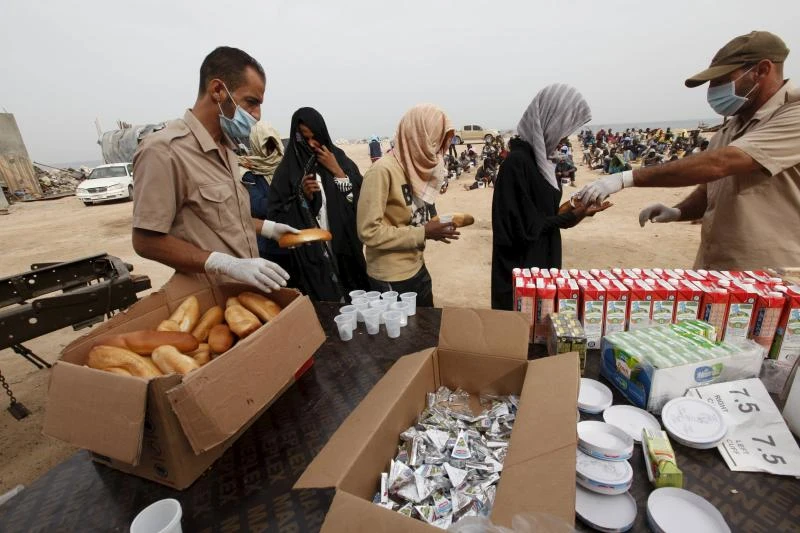
More than half a million people fleeing war and poverty in the Middle East and Africa have poured into the European Union this year, prompting bitter disputes over how to react and share out responsibility and costs.
The European Commission has said EU states, whose budgets risk being stretched by the crisis, might get budget relief.
More than 500 rescued
The Spanish Civil Guard said Saturday it had rescued 523 African migrants off the coast of Libya with the help of the Italian coast guard.
A Spanish patrol ship rescued 325 migrants from different boats about 25 nautical miles from Tripoli, while the Italian coast guard taking part in the same operation picked up another 198, a statement said.
The statement said the migrants were from Nigeria, Gambia, Senegal, Libya, Ivory Coast, Guinea-Bissau and Equatorial Guinea and that they included 125 women and 22 children.
Greece to open up to 5 processing centers
European Union officials say that Greece’s first migrant processing center will open over the next 10 days, allowing migrants and refugees to be flown to other EU countries — mostly of their preference — and have their asylum applications processed there.
Dimitris Avramopoulos, European Migration and Home Affairs Commissioner, said the first center will open on the island of Lesbos, with up to four more on other Greek islands. Tens of thousands of people fleeing war or poverty have landed in Greece, the main gateway of migrants crossing into the EU from neighboring Turkey. Most want to travel on to other European countries like Germany.
Luxembourg Minister for Foreign Affairs Jean Asselborn, who traveled to Italy and Greece with Avramopoulos, said it was extremely important to strengthen Europe’s external borders.
Spain bust people-smuggling ring
Spanish police have arrested 89 people accused of being part of a network which smuggled Chinese nationals into Britain, Ireland, Canada and the United States, the interior ministry said on Saturday.
The network, run by Chinese and Pakistani citizens, used Spain as a transit point, housing the people in apartments in the northeast of the country while they awaited falsified travel documents, the ministry said.
The smugglers charged up to 20,000 euros ($22,700) per person, half paid in the country of origin and the other half to be handed over once they arrived at their destination, according to ministry.
If the second payment was not made, travel documentation was withheld and, in many cases, family members were threatened, it said.
Four of those arrested face charges of belonging to a criminal organization, document falsification and crimes against foreign citizens, while the other 85 are accused of document falsification and crimes against foreign citizens, the ministry said.
The investigation began following several arrests in Spanish airports of people carrying fake passports from countries including South Korea, Japan, Malaysia and Portugal, it added.
Germany, EU deny report on European solidarity tax