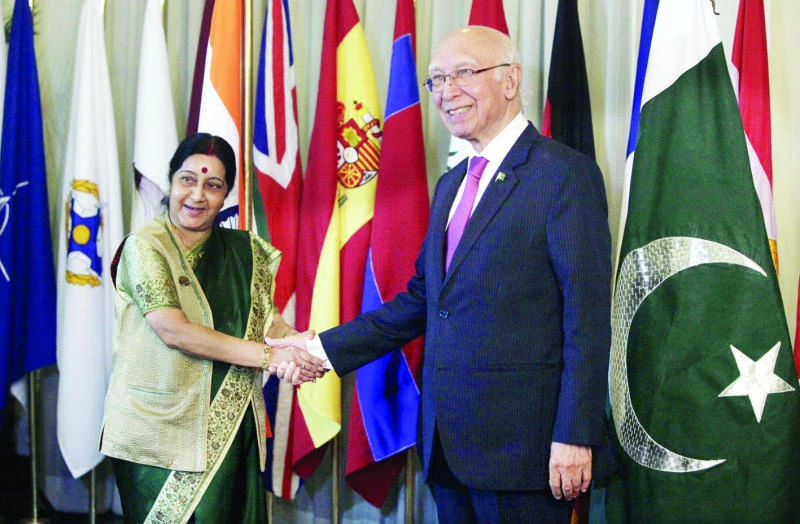
ISLAMABAD: India will resume high-level talks with rival Pakistan, the Indian foreign minister said on Wednesday, raising hopes that relations between the two nuclear-armed neighbors may be thawing slightly.
“India and Pakistan have decided to resume d.ialogue,” Sushma Swaraj told media at a news conference during the “Heart of Asia” meeting in Islamabad.
The last meeting in the process known as ‘Bilateral Dialogue’ was in September 2012. Relations between the two powers had chilled after Indian Prime Minister Narendra Modi came to power last year.
Swaraj, the first Indian foreign minister to visit Pakistan since 2012, said it was time India and Pakistan displayed “the maturity and self-confidence to do business with each other and strengthen regional trade and cooperation.”
“The entire world is waiting and rooting for a change. Let us not disappoint them.”
The nuclear-armed neighbors have fought three wars since their independence in 1947, and their rivalry has spilled over into Afghanistan.
Separately, Afghanistan’s foreign minister called on Pakistan to help restart stalled peace talks between his government and the Taliban, as he spoke at a conference on Wednesday that risked being overshadowed by a major Taliban attack in Afghanistan.
The “Heart of Asia” meeting comes months after the first, inconclusive talks between the Afghan government and the Taliban.
Afghan Foreign Minister Salahuddin Rabbani said he hoped to see “positive moves in the coming weeks” regarding peace talks.
“We very much hope that Pakistan can play a very influential role and very important role in the peace and reconciliation process,” he told a news conference in the Pakistani capital, Islamabad.
Pakistani Prime Minister Nawaz Sharif stressed his commitment to “an Afghan-led and Afghan-owned reconciliation process,” a reference to the talks, hosted by Pakistan, that foundered in July after news leaked that Taliban founder Mullah Mohammad Omar had been dead for two years.
Omar’s deputy, Mullah Akhtar Mansour, took over as leader but violent splits have emerged in the militant group, dimming prospects for negotiations while Mansour seeks to consolidate his position, analysts say.
Cooperation between Afghanistan and Pakistan is essential to ending the insurgency by the Afghan Taliban, who have bases on both sides of the countries’ porous border.
Afghan President Ashraf Ghani came to power last year vowing to improve relations but ties cooled after of a series of bomb attacks in Kabul this August.
Ghani blamed “regional and international terror groups” for the violence in his country.
“In the past, there has been the temptation to use non-state actors as instruments of foreign policy,” he told the conference, a clear reference to Afghan assertions that Pakistan supports the Taliban to maintain influence in Afghanistan and block the influence of India.
Afghanistan and Pakistan accuse each other of supporting insurgencies across their border, which they both deny. The Afghan and Pakistani Taliban are separate but allied.
Sharif also spoke of Pakistan’s aim to repatriate the 2 million Afghan refugees in Pakistan, some of whom have been in Pakistan for decades.
“The massive cross-border movement of refugees constitutes a security risk,” Sharif said.
In response, Ghani pointed out that an offensive by the Pakistani military against Pakistani Taliban has sent an influx of Pakistanis into Afghanistan.
“Unfortunately, recent events in Pakistan have forced us to host 350,000 to 500,000 refugees from Pakistan ... the refugee issue is a common issue, like all issues,” Ghani said.
High-level talks with Pakistan to resume, says Indian FM