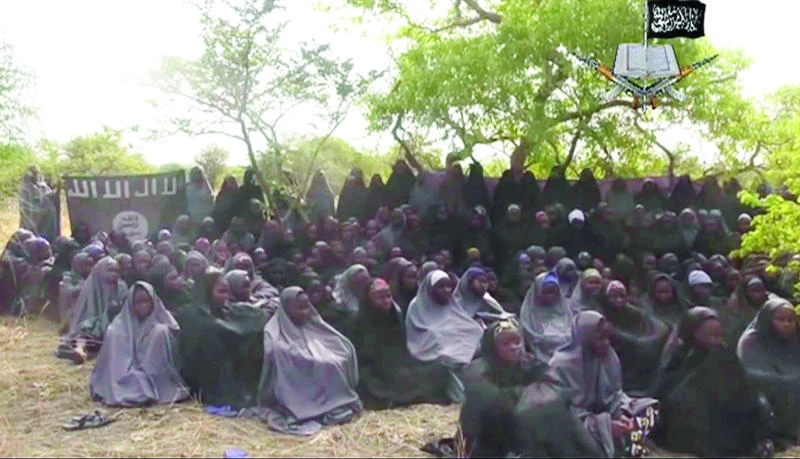
LAGOS: A wave of violence hours after Nigeria’s government announced a truce with Boko Haram raised doubt on Sunday about whether more than 200 schoolgirls kidnapped by the militants will really be released, deflating the new hopes of their parents.
Nigeria’s armed forces chief Air Chief Marshal Alex Badeh announced the cease-fire on Friday to enable the release of the girls, who were abducted from the remote northeastern village of Chibok in April.
But Boko Haram has not confirmed the truce and there have been at least five attacks since — blamed by security sources on the insurgents — that have killed dozens. Talks were scheduled to continue in neighboring Chad on Monday.
“We were jubilating. We had every reason to be happy ... but since then the cease-fire has been broken in quite a number of places already,” Lawan Abana, a parent of the one of the missing girls, said by telephone.
He added that there were doubts about the credentials of the reported Boko Haram negotiator Danladi Ahmadu, who was unheard of before. “Can we trust him that he can deliver on this promise of releasing the girls when he has not delivered on the promise of the cease-fire?” Abana said.
The government says the attacks may not have been Boko Haram but one of several criminal groups exploiting the chaos of its insurgency. Analysts point out that Boko Haram is anyway heavily factionalized, so what matters is whether the faction the government is talking to has control over the girls’ fate.
“Boko Haram is deeply fractured. The Nigerian government has had a ... difficult time identifying a Boko Haram representative who could make compromises and guarantee the entire group will observe them,” risk consultancy Stratfor said in a note.
“It is quite possible that Abuja has reached an agreement with a legitimate representative of a specific cell ... that holds the kidnapped schoolgirls captive,” it said on Saturday.
Boko Haram, whose name translates roughly as “Western education is sinful,” has massacred thousands in a battle to carve an Islamic state out of religiously mixed Nigeria.
Its only known method of conveying messages is via videotaped speeches by a man claiming to be Abubakar Shekau, its leader whom the military last year said it had killed.
Ahmed Salkida, a Nigerian journalist who was once close to Boko Haram and shared a jail cell with its founder Mohammed Yusuf in 2009, tweeted that whoever Ahmadu is, he is not a member of Boko Haram’s senior “Shoura council” nor does “he speak for them, as far as I know.”
A swift release of the girls would bode well for the campaign of President Goodluck Jonathan for Feb. 2015 elections. Jonathan has faced relentless criticism for failing to protect civilians in the northeast or resolve the Chibok girls crisis.
Nigerians doubtful of girls’ release after Boko Haram ‘truce’ breached