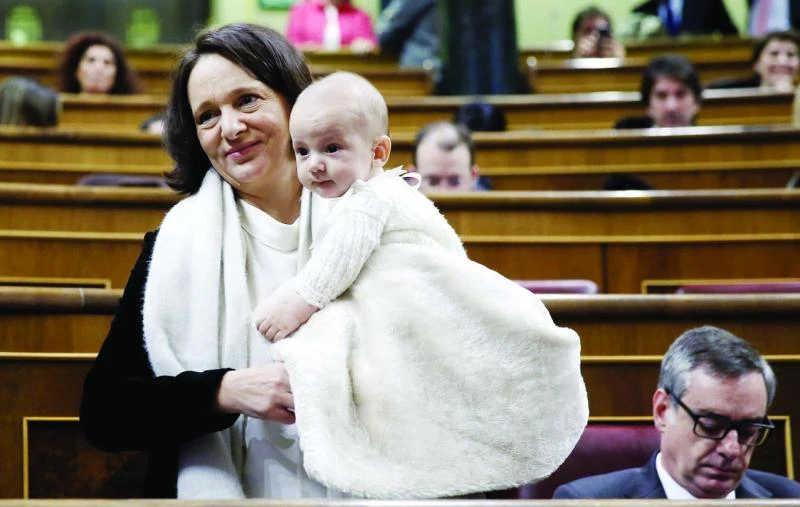
MADRID: Spain’s lower house of Parliament reconvened on Wednesday for the first time since an inconclusive election last month with political parties still wrangling over the formation of a government.
The failure to make progress in forging a coalition before deputies took their seats again suggested the stalemate could last weeks and a new election might be have to be called.
Parties agreed on naming a Socialist lawmaker as the lower house’s speaker, although the way the deal was reached signalled more divisions rather than a political rapprochement.
But expectation of change was in the air after the Dec. 20 election broke the mold of Spanish politics in the four decades since the restoration of democracy and brought two new parties — the leftist Podemos and liberal Ciudadanos — into the Cortes.
“Politics in this country has already changed, now we must change the institutions,” Socialist leader Pedro Sanchez said as the session opened. In a tweet, Ciudadanos leader Albert Rivera called it “a second transition.”
Their comments reflected the sentiment that Spain’s first transition after the 1975 death of dictator Francisco Franco is now history and the country needs a new generation of leaders.
In the election, the conservative People’s Party (PP), in power for the past four years, won the most seats but not a majority. The Socialists (PSOE) came second but lost much of their support to third-placed Podemos, which sprang up in response to the PP government’s stiff austerity measures.
The result reflected widespread discontent in Spain even as the country left behind its long recession with growth of 3.3 percent in 2015 and 3 percent forecast for this year. A period of political instability could dent that recovery.
The fraught negotiations in Parliament are also complicated by the future status of Catalonia, whose regional assembly is now controlled by a separatist coalition.
Mariano Rajoy, the outgoing and now acting prime minister, on Wednesday again called for a broad coalition of the PP, Socialists and the fourth-placed Ciudadanos. PSOE leader Sanchez favors a coalition of “progressive forces.”
A big sticking point is Podemos’s promise to allow an independence referendum to go ahead in Catalonia, which the Socialist leader rejects.
If Rajoy and Sanchez both fail to form a government, that would probably lead to new elections in May or June.
PP sources said King Felipe wanted to start contacts with the political groups this week. The monarch’s position is ceremonial but he does have a role to play as a facilitator.
Spanish Parliament reconvenes with no new govt in sight