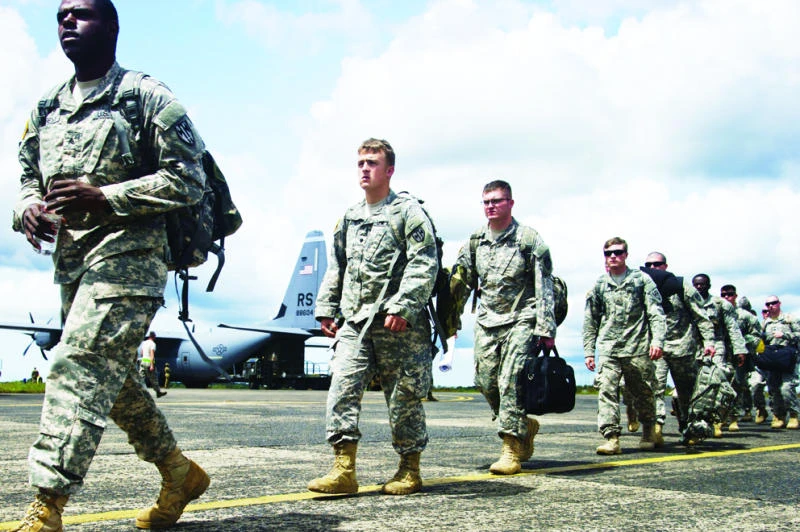
WASHINGTON: The US Army has isolated a dozen soldiers returning from West Africa at a base in Italy, including the top general who oversaw the military’s initial response to the Ebola outbreak, even though none of them showed symptoms of infection, the Pentagon said on Monday.
Dozens more troops would be isolated in the coming days as they rotate out of West Africa, where the US military has been building infrastructure to help health authorities treat Ebola victims, the Pentagon said.
“They’re not allowed to leave,” said Col. Steve Warren, a Pentagon spokesman, describing the precautions as “enhanced monitoring.”
Officials say a nurse who was quarantined after working in West Africa with Ebola patients is being released.
The New Jersey state Health Department said in a statement Monday that Kaci Hickox had been symptom-free for 24 hours and would be taken on a private carrier to Maine.
Hickox was the first person forced into a mandatory quarantine in the state, announced Friday by New Jersey Gov. Chris Christie for people arriving at Newark Liberty International Airport from three West African countries.
Christie, along with New York Gov. Andrew Cuomo have been at odds with scientists over Ebola in backing 21-day quarantines for medical workers returning from West Africa.
Infectious-disease experts warn that such restrictions are unnecessary and could discourage volunteers from aiding disease-ravaged countries.
The two governors late Sunday night emphasized separately that their policies permit home confinement for medical workers who have had contact with Ebola patients if the workers show no symptoms. They will receive twice-daily monitoring from health officials.
Hickox had complained about her treatment in New Jersey and was talking about suing.
Speaking at a campaign event in Florida on Monday morning, Christie “when she has time to reflect, she’ll understand” the quarantine.
The United States will help fight Ebola over “the long haul,” the American ambassador to the United Nations said on a trip to the West African countries hit by the outbreak.
Samantha Power, who travels to Sierra Leone on Monday, met Sunday with religious leaders in Guinea, where the Ebola outbreak was first identified in March.
“We are in this with you for the long haul,” she told them. The outbreak has killed nearly 5,000 people, the vast majority of them in Guinea, Liberia and Sierra Leone. “We have got to overcome the fear and the stigma that are associated with Ebola.” Many people hide in their homes rather than seek medical care because of fears that an Ebola diagnosis is an automatic death sentence and the social stigma attached to the disease, further fueling its spread. So far, more than 10,000 people are believed to have been infected.
On her Twitter account, Power expressed confidence that the epidemic would be defeated but quoted one worker at a non-government organization as saying that aid workers are “running behind a train & the train is going faster than us.” She also described a “heartbreaking change” in Guinea: No one hugs or even touches, for fear of catching the disease.
Ebola is forcing such changes throughout the region. In August, Liberia’s government ordered that the body of anyone who died of Ebola in Monrovia must be cremated — a practice deeply at odds with the typical funeral rites in the country.
US isolates soldiers after Ebola response mission in W. Africa