- ABUJA, Nigeria: Nigeria’s president vowed Saturday to bring terrorism “under control” as he visited the bombed headquarters of the United Nations in his country, a day after at least 18 people died in an attack claimed by a radical Muslim sect.
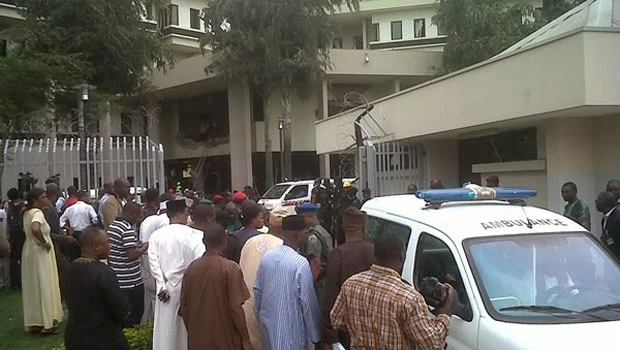
President Goodluck Jonathan walked amid the debris left behind after Friday’s attack in Nigeria’s capital, Abuja. Jonathan toured the shattered reception area of the building, where a suicide bomber crashed an explosive-laden sedan before detonating his bombs.
He promised to address the threat posed by the sect known locally as Boko Haram, though so far, his weakened government has been unable to stop the group from carrying out assassinations and bombings at will in Africa’s most populous nation.
“Boko Haram is a local group linked up with terrorist activities,” Jonathan told journalists gathered at the site. “As a government, we are working on this and we will bring it under control.”
The president did not elaborate on the statement, as his aides hustled him off into a convoy of armored Mercedes Benz sedans, police trucks and motorcycles.
Security appeared tighter than normal in Abuja, about 550 miles (880 kilometers) from the country’s megacity of Lagos. Soldiers wearing flak jackets blocked the main highway heading into the city from Abuja’s international airport Saturday morning, checking passing vehicles. At the UN building, soldiers, police and members of Nigeria’s secret police cordoned off the area, looking out at the nearby embassies and buildings, some with broken windows from Friday’s blast.
The UN headquarters sits on a hill overlooking the same neighborhood occupied by the US embassy and other diplomatic posts in Abuja. A US embassy car carrying what local authorities described as FBI agents arrived at the bomb site a short time after Jonathan left.
Deb MacLean, a spokeswoman for the US embassy in Abuja, said FBI agents “were on the ground” to assist after the bombing. She declined to elaborate.
The brazen assault Friday represented the first suicide attack to target foreigners in oil-rich Nigeria, where people already live in fear of the sect.
Friday’s bombing is a major escalation of the Boko Haram’s fight against Nigeria’s weak central government. The group, which has reported links to Al-Qaeda, wants to implement a strict version of Shariah law in the nation and is vehemently opposed to Western education and culture.
The UN had yet to complete a head count of its staff at the building, which houses about 400 workers, said Agathe Lawson, the acting resident coordinator in Nigeria for the international body. Lawson said her workers had begun to try to find other locations to operate from, and promised the UN would continue its work in Nigeria.
“We prepared. Security was in place, but it is never enough,” she said as workers salvaged printers and computers from the building’s shell.