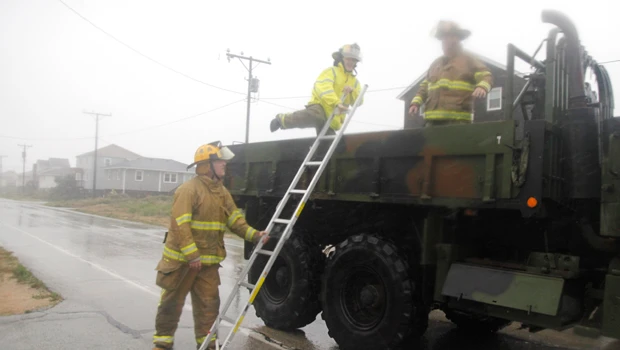
- MOREHEAD CITY, North Carolina: Hurricane Irene battered the North Carolina coast Saturday, wreaking havoc as it began a potentially catastrophic run up the US East Coast.
- More than 2 million people were told to flee and New York City ordered the nation’s biggest subway system shut down for the first time because of a natural disaster.
The National Hurricane Center in Miami said Irene’s maximum sustained winds were around 85 mph (137 kph) on Saturday morning, down from about 100 mph (161 kph) a day earlier. But they warned the hurricane would remain a large and powerful one as it trekked toward the mid-Atlantic coast Saturday night and southern New England on Sunday.
“The hazards are still the same,” NHC hurricane specialist Mike Brennan said. “The emphasis for this storm is on its size and duration, not necessarily how strong the strongest winds are.”
Hurricane-force winds first arrived near Jacksonville, North Carolina, at dawn. A little more than an hour later, the storm’s center passed near the southern tip of North Carolina’s Outer Banks. At the resort town of Nags Head, winds whipped heavy rain, tall waves covered the beach and the surf pushed up to the backs of some houses and hotels.
As the storm’s outer bands of wind and rain lashed the North Carolina coast, knocking out power in places, authorities farther north begged people to get out of harm’s way.
“Don’t wait. Don’t delay,” said President Barack Obama, who cut short his summer vacation and returned to Washington. “I cannot stress this highly enough: If you are in the projected path of this hurricane, you have to take precautions now.”
Obama has declared state of emergencies for North Carolina, Virginia, New Jersey, New York, Connecticut and Massachusetts.
Wind and rain knocked out power to more than 91,000 customers along the North Carolina coast, including a hospital in Morehead City which was running on generators.
Residents along the Outer Banks said there wasn’t serious damage yet. Alan Sutton, who owns a bait and tackle shop on Ocracoke Island, said he saw only a few tree limbs down.
A coastal town official in North Carolina said witnesses believed a tornado spawned by Irene lifted the roof off a car warehouse in Belhaven on Friday night.
Hurricane warnings were issued from North Carolina to New York and farther north to the islands of Nantucket and Martha’s Vineyard off Massachusetts. Evacuation orders covered at least 2.3 million people, including 1 million in New Jersey, 315,000 in Maryland, 300,000 in North Carolina, 200,000 in Virginia and 100,000 in Delaware.
“This is probably the largest number of people that have been threatened by a single hurricane in the United States,” said Jay Baker, a geography professor at Florida State University.
US airlines canceled at least 6,100 flights through Monday, grounding hundreds of thousands of passengers as the storm could strike major airports from Washington to Boston.
New York City ordered more than 300,000 people who live in flood-prone areas to leave, including Battery Park City at the southern tip of Manhattan, Coney Island and the beachfront Rockaways. But most New Yorkers don’t have a car, and city was shutting down public transportation at noon Saturday.
The New York City transit system carries about 5 million people on an average weekday, fewer on weekends. It has been shut down before, including during a 2005 transit workers’ strike and after the Sept. 11 attacks a decade ago, but never for weather.
Aviation officials said the five main New York City-area airports would close to arriving domestic and international flights at noon on Saturday. Many departures also were canceled.
Mayor Michael Bloomberg said authorities can’t force people to evacuate but warned: “But if you don’t follow this, people may die.”
Shelters in New York opened Friday when the city was placed under its first hurricane warning since 1985.
Transit systems in New Jersey and Philadelphia also announced plans to shut down, and Washington declared a state of emergency.
Some hardy holdouts in North Carolina put plywood on windows, gathered last-minute supplies and tied down boats. More than half the people who live on two remote islands, Hatteras and Ocracoke, had ignored orders to leave.
“I anticipate we’re going to have people floating on the streets,” said Richard Marlin, fire chief for a village on Hatteras. “The Coast Guard will either be pulling people off their roofs like in Katrina or we’ll be scraping them out of their yards.”
Some took to shelters for protection. Susan Kinchen, her daughter and 5-month-old granddaughter came to West Carteret High School with about 50 others. She said they didn’t feel safe in their trailer. The Louisiana native said her old trailer lost its roof to Hurricane Katrina almost six years ago to the day, on Aug. 29, 2005.
“I’m not taking any chances,” she said.
After the Outer Banks, the next target for Irene was southeast Virginia, a jagged network of inlets and rivers that floods easily and is vulnerable to storm surges.
In Delaware, Gov. Jack Markell ordered an evacuation of coastal areas on the peninsula his state shares with Maryland and Virginia.
Kenneth Roe was filling up three 5-gallon gas cans at an Exxon station in Salisbury, Maryland. A manager at a Home Depot in Lewes, Delaware, the 34-year-old had worked 18 hours straight on Thursday and another five hours on Friday, his day off. He said the store was staying open 24 hours to help people protect their property.
In Baltimore’s Fells Point neighborhood, one of the city’s oldest waterfronts, people filled sandbags and packed them at the entrances to buildings. A few miles away at the Port of Baltimore, vehicles and cranes rushed to unload huge cargo ships that were hurrying to get away from the storm.
And in Atlantic City, New Jersey, all 11 casinos announced plans to shut down, only the third time that has happened in New Jersey’s 33-year history of legalized gambling.
“I like gambling, but you don’t play with this,” Pearson Callender said as he waited for a Greyhound bus out of town. “People are saying this is an act of God.”