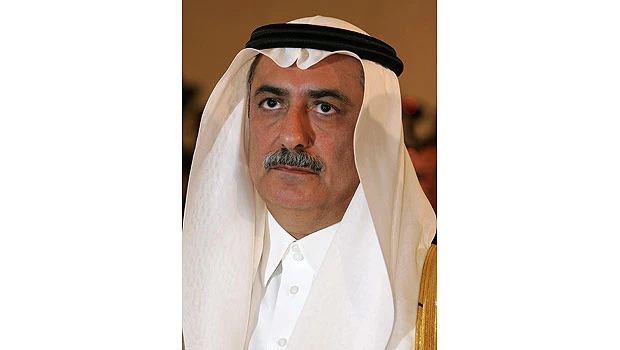
- JEDDAH: The latest investment-grade rating given to Saudi Arabia by Fitch highlights the strength and soundness of the financial and economic policies being pursued by the Kingdom, Finance Minister Ibrahim Al-Assaf said yesterday.
He called the Fitch action as excellent.
Fitch Ratings yesterday backed the Kingdom's investment-grade rating, pointing to soaring oil revenue.
The firm rates Saudi Arabia at double-A-minus, or three steps down from the coveted triple-A rating. The outlook is stable.
The country ceiling has been affirmed at "AA" and the Short-Term foreign currency Issuer Default Ratings (IDR) at "F1+".
Fahd Al-Mubarak, governor of Saudi Arabian Monetary Agency (SAMA), said the rating shows the Kingdom's political and financial stability, thanks to the wise policies being pursued by the government.
"The Kingdom is determined to continue modernizing its infrastructure and accelerating economic activities in order to realize diversification of the sources of income," he said.
Paul Gamble, head of research at Jadwa Investment, said the credit rating is important for the Kingdom.
It gives foreign investors a clear and consistent way to assess country risk and provides a benchmark for borrowers wishing to tap the international debt markets, said Gamble.
"There has been more debt issuance from government-related companies recently and the Kingdom's strong credit rating plays an important role in allowing them to secure funds at a low cost," Gamble said.
"Fitch's assessment reflects the enviable fiscal situation the government now finds itself in. There is little in the near-term outlook to suggest that Saudi Arabia will not continue to reap a substantial oil windfall at a time when prices remain elevated and production levels edge up with Saudi Arabia as the only true swing producer globally," Jarmo T. Kotilaine, chief economist at the National Commercial Bank, said.
He said the economic fundamentals more generally support the favorable assessment. The macroeconomic picture is one of stability against the backdrop of a relatively benign growth outlook. Saudi growth looks likely to remain fairly close to its recent trends and, moreover, promises to be increasingly broad-based as private sector activity strengthens and bank credit accelerates.
Kotilaine, however, said: "The main challenge for this outlook comes from risks linked to the oil market. However, only a temporary closure to the Straits of Hormuz is likely to significantly compromise the government's revenue stream, and this is still deemed relatively unlikely. Pronounced price corrections are unlikely under the prevailing demand-supply dynamics and should be very manageable with the sizable reserves."
As highlighted by Fitch, he said persistent government overspending remains a challenge but one that can be turned into an opportunity by redoubling current efforts to involve the private sector in economic development, whether through privatization, PPPs, or the development of the capital markets.
"The recent GACA sukuk is a very welcome development in the right direction and even more generally, the market has seen the emergence of a growing number of structures and solutions that can be replicated to more effectively mobilize the deep pools of capital in the Kingdom," Kotilaine pointed out.
Saudi Arabia recorded an increased surplus of 14 percent of GDP in 2011, as growth in oil revenues outweighed the impact of a 25 percent rise in spending. Fitch forecasts a government fiscal surplus of at least 12 percent of GDP in 2012.
The government will continue to pay down public debt, although the recent government guaranteed sukuk issue could be followed by more to finance cash-generative projects.
Oil prices are forecast to average at least $40 a barrel above the level needed to balance the budget in 2012, and the high share of capital spending affords extra fiscal flexibility.
The Fitch report said government deposits at the SAMA rose by SR195 billion ($52 billion), or 9 percent of GDP in 2011.
However, the value of future spending commitments also continues to rise.
SAMA's international reserves rose by SR405 billion ($108 billion) to SR2.13 trillion ($568 billion) over the same period, and will likely exceed SR2.62 trillion ($700 billion) by end-2013.
Fitch expects the economy to grow by 4 percent in 2012, with risks to the upside as oil production may more than match 2011 levels.
Inflation is 5 percent and rising but the economy is far from overheating, with credit growth under control.
Real GDP growth rebounded to 6.8 percent in 2011, the highest since 2003, driven by a boost to oil output and fiscal stimulus.