When artist Wael Shawky attended the 10th Sharjah Biennal in 2011 he became aware of something a little unsettling. This was the unintentional disconnect between the words being spoken by the art curators at the press conferences and a large part of the ‘community’ which the organizers declared it was their intention to reach. He noticed that a certain phrase was used over and over again in the press releases: ‘The main purpose of the Biennal is to bridge the gap between the local community and contemporary art’. This statement set him thinking about ‘who’ the local community was and ‘why’ a large part of the community in Sharjah did not seem to feature in the event other than behind the scenes.
Specifically, he observed that the significant majority of the Pakistani and Indian workforce who was employed in staging the event, and people from these communities, were conspicuously absent at the public events. “At the opening I saw the same type of people that you would see at a Biennal in Venice or Sydney – but where was the local community?” he asked.
During his two weeks soaking up the atmosphere he came to a decision. He would make an artwork based on the ideas of these under-represented people and he would provide them with a platform to raise their voices. Moreover, he would find a way of communicating that reflected the cultural roots of the mostly Pakistani workforce and give them free rein to shape their message. He began this project during the Witness Program, an artists’ residency at the Biennal.
He set about making transcripts of all the press releases; (pity the poor pen pushers who never imagined that their words would be subjected to such intense scrutiny). Then he had the entire output translated from Arabic into English and then into Urdu. Next, in a series of workshops held over two years, thirty Biennal Pakistani and Indian workers, including members of the technical and production teams, were invited to select which phrases they wanted to preserve and shape into a poem. “They attended all the workshops and fought over the sentences to be included – they took it seriously,” recalled Shawky. Eventually, they managed to whittle down the reams of carefully crafted curatorial phrases to just two and a half pages. Shawky commented about the result, “It is their poem – not mine.”
The next step was to take this poem to Karachi to be turned into a song. But not just any type of song: Shawky was after something very specific to the culture of South and East Asia. To this end he sought out the renowned professional musicians or qawwals, Fareed Ayaz and Abu Muhammad. They are famed for their renditions of centuries old devotional Sufi music. Now, they and their family of musicians joined Shawky in setting the contemporary poem made by the Sharjah Biennal workforce into an art work that could be performed in the traditional manner.
The fruits of all this creative effort were seen at the Sharjah Biennal in 2013 in an amazing live art performance featuring the Sufi musicians and the Biennal workforce. Shawky filmed every performance of the ‘poem’ which was performed thrice daily over three days at the Biennal.
Today, a film of that performance is on show as part of Shawky’s Dictums exhibition at the Lisson Gallery in London. Next month it will be shown in Sharjah to coincide with the seventh annual March meeting of the Sharjah Art Foundation exhibition.
The six minute film, accompanied by a soaring soundtrack that fills the gallery, captures an extraordinary depth of emotion. The sound of the workers singing, clapping and chanting under the direction of singers and musicians Ayaz and Muhammad’s mesmerizingly beautiful music is very moving. Shawky said that he noticed that Urdu speakers who witnessed the event found it especially meaningful. He also observed that it seemed to have a universal appeal: “Many people liked it although they don’t understand the language, which was also very important to me. It transmits energy – so you get it,” he said.
It’s hard to say what makes this performance so effective, but there is something very special about the atmosphere it creates and the feeling of humanity conveyed.
The vitality of Ayaz and Muhammad is electric as they lead the workforce in their performance which was watched by people from all over the world. Shawky feels that the participants found the project enriching. “They really loved the experience. They felt the work presented their voice and looked like an answer to something,” he said.
He had decided at the very outset that the live performance in Sharjah would never be repeated. He received invitations from Sydney and New York to showcase it overseas but he declined because he sees it as being unique to Sharjah, especially in terms of how it was developed in relation to the language used in the press conferences and releases for the Biennal.
So the film is the lasting record of the amazing live performance that found its time and place in Sharjah and will not be repeated. Shawky observed, “The exhibition speaks mainly about my experiences in the UAE. The majority of people who built the UAE are from Pakistan and India. It is very profound. You see the presence of Indian and Pakistani culture in the food and in the streets but otherwise they are not present. I am not trying to analyze this politically. I am more into the poetic vision. We are trying to dream.”
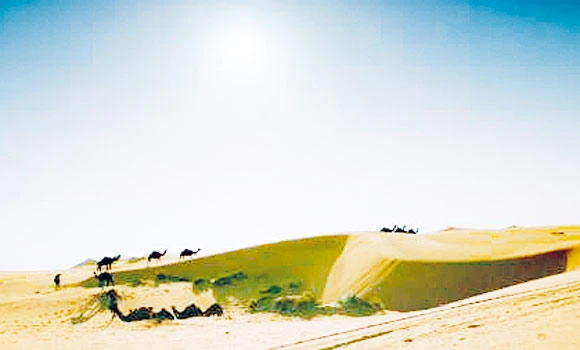
The second art installation in the gallery features Shawky’s film of rare black camels which seem to come to life before your eyes. He filmed the prized camels, which are native to Saudi Arabia, in the desert in Abu Dhabi. Filming took three days and was not easy as the camera had to be fixed onto a vehicle moving alongside the animals; even with stabilizers and special equipment it was difficult to get perfectly smooth shots of the herd in motion across the sands. However, using a cinematic quality camera, the results are stunning and pay tribute to these magnificent animals which, as Shawky pointed out, are mentioned in the Qur’an.
His love of camels, he said, comes partly from his early childhood which was spent in Makkah. His father, an Egyptian, worked in Saudi Arabia; for about eight years the family would spend summers in Egypt and winters in Saudi Arabia. Shawky said that he associates camels with ideas of patience, beauty and emigration.
In the film the camels are filmed in such a way as to make them seem almost within reach. You can see wonderful details of their eyes, eyelashes, toes and above all their marvelous easy gait. They seem to move across the desert like a wave – with the lower lips quivering constantly as though in conversation with each other. This herd of prized camels was in fact en route to one of the many mazaynas or camel parades held in the Gulf region. Those who win ‘best in show’ are often traded for astronomical sums and even appear on dedicated TV channels complete with poetry and music extolling their many attributes.
The exhibition features many delicately drawn images of camels; these drawings, in a palette of soft blues, rose and gold, were made during the preparation stage and, as Shawky explained, reflect his spontaneous and sub-conscious thoughts about the exhibition. Often the images show the outlines of camels containing magical cityscapes that mix symbols from Arab and South Asian cultures. They have a dreamlike quality. He said that for him there is something quite extraordinary about how cultures from India and Pakistan, “these old, rich, colorful cultures”, have come to the deserts of the Gulf. He is fascinated by the mixing of peoples from the contexts of traditionally agricultural and Bedouin nomadic societies.
This mix of cultures and traditions with the modern is a constant theme in
his work.
Wael Shawky’s Dictums runs at the Lisson Gallery, London, from Jan, 31–March, 8 2014
The artist was born in Alexandria in 1971 where he lives and works. Recent solo exhibitions include Serpentine Galleries, London (2013-14); KW Contemporary Art Institute, Berlin (2012); Nottingham Contemporary (2011); Walker Art Center,
Minneapolis (2011); Delfina Foundation, London (2011) and Cittadellarte – Fondazione Pistoletto, Biella (2010). He has participated in the 11th Sharjah Biennial (2013); Documenta 13, Kassel, (2012); the ninth Gwangju Biennial, (2012); SITE
Santa Fe Biennial (2008); Istanbul Biennial (2005); and the 50th Venice Biennale (2003). Recent awards include the Award for Filmic Oeuvre created by Louis Vuitton and Kino der Kunst (2013); the Abraaj Capital Art Prize (2012), the Schering
Foundation Art Award (2011), as well as The International Commissioning Grant and an award from the Lower Manhattan Cultural Council, in 2005. Shawky founded the educational space MASS Alexandria in 2010 and is represented by Sfeir-Semler Gallery in Beirut and Hamburg.
Email: [email protected]