
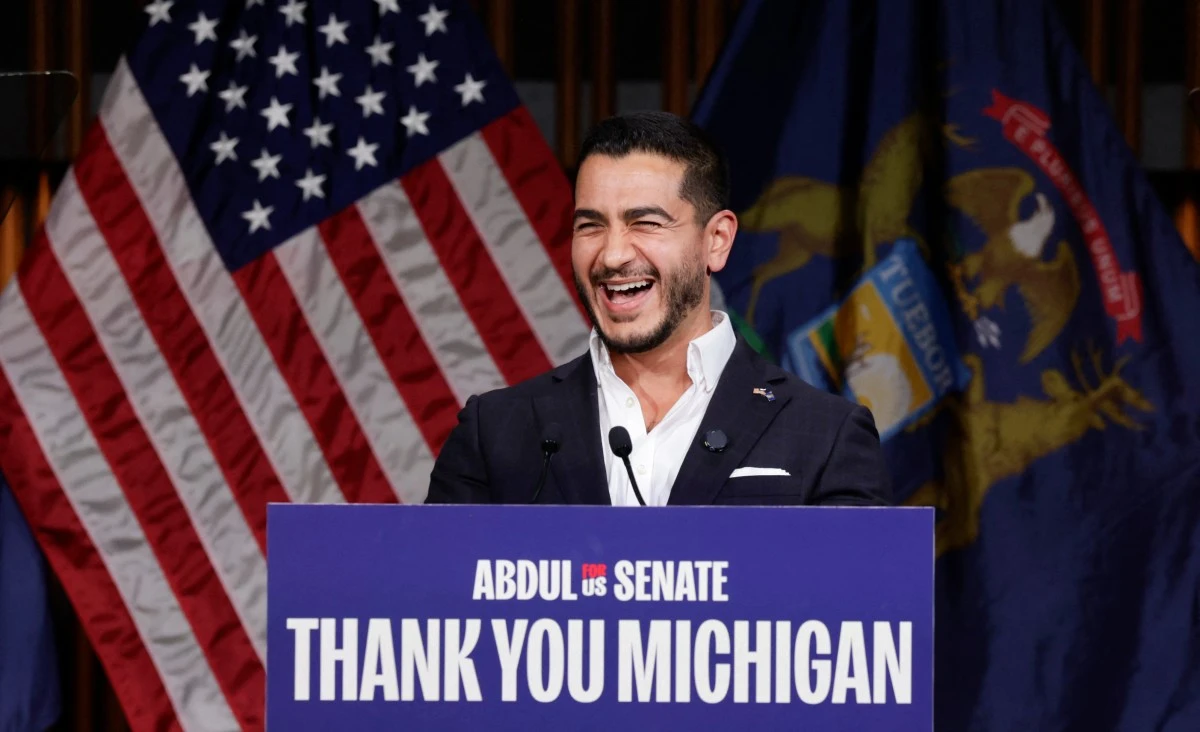

The Arab argument over Abdul El-Sayed’s election to the US Senate says as much about our expectations as it does about his victory. Some have celebrated as though an Arab government had gained a seat in Washington. Others have treated any expression of pride as proof of political ignorance. Between the enthusiasm and the ridicule, there has been too little scrutiny of what he actually stands for.
A politician’s ancestry is an unreliable guide to the policies he will pursue. Yet much of this debate has proceeded as though an Egyptian name were a foreign policy commitment, waiting only for its owner to take office.
El-Sayed is an American politician of Egyptian descent. Born and raised in Michigan, he is a physician and former public health official who has become the first Muslim elected to the Senate. His mandate comes from Michigan’s voters. His responsibilities will be to his state and country and his decisions will reflect his political convictions and his understanding of American interests.
His family’s origins may shape his outlook. They do not place him under any obligation to support Cairo’s policies or those of another Arab capital. Nor would disagreement with those policies make him less Egyptian by ancestry. The mistake begins when cultural affinity is treated as a political guarantee.
The case for expecting gains for Arab states or causes must rest on something more substantial than shared origins
Dr. Abdellatif El-Menawy
People are entitled to take pride in someone whose background they recognize. For Arab and Muslim Americans, his election also has a significance rooted in their own struggle for full participation. He faced attacks on his faith and loyalty during the campaign. His victory matters in that context. But the case for expecting gains for Arab states or causes must rest on something more substantial than shared origins.
Those investing political hopes in him should begin with his program. El-Sayed opposes what he calls “blank-check funding” for foreign militaries. His campaign explicitly includes Egypt, Israel, Saudi Arabia and the UAE among the countries concerned. He also supports an arms embargo on Israel and renewed funding for foreign assistance, including for UNRWA.
These positions deserve to be read together. Anyone welcoming his stance on arms for Israel while assuming that his Egyptian roots will protect assistance to Cairo is supplying an exception that his program does not offer.
There may be arguments for supporting or opposing his approach. For Egypt, the implications would have to be assessed in terms of security cooperation, regional stability and the wider bilateral relationship. For Palestinians, his positions on weapons and humanitarian assistance may offer grounds for seeking common cause. Neither assessment can sensibly be made by looking at his name.
Support on one issue also gives no assurance of agreement on the next. Arab interests themselves differ across countries and questions. The idea that one American politician could embody them all is difficult to sustain even before his own priorities enter the discussion.
His program is not, in any case, an enacted American policy. A proposal to change military assistance would have to confront congressional procedures, committee priorities, competing legislators, the administration and established strategic relationships. The Egyptian-American relationship has accumulated interests and commitments over decades. It will not be remade by the arrival of one senator.
What concerns me most about the Arab celebration is the tendency to declare a political gain before identifying its substance
Dr. Abdellatif El-Menawy
That does not make his election irrelevant. Senators can introduce legislation, scrutinize the executive, vote on funding and help shift the terms of public debate. Their influence can grow through alliances and committee work. Institutions provide ways to exercise power as well as to place limits on it. The task is to judge how effectively he uses those opportunities, rather than assuming either that he can transform Washington or that he can achieve nothing.
The same caution applies to the Democratic majority. El-Sayed’s election does not turn his platform into the party’s collective program. Democrats disagree among themselves, including over the Middle East. Their control of Congress will change the balance of oversight and legislative power but it does not settle every foreign policy argument within their ranks.
Invoking Barack Obama or Hillary Clinton is therefore no substitute for examining the emerging balance of forces. Past experience can inform a judgment. It cannot do all the work of analyzing new legislators, their alliances and the decisions before them.
What concerns me most about the Arab celebration is the tendency to declare a political gain before identifying its substance. A victory becomes “ours” because the winner’s name is familiar. The question of what he can deliver and whether we would agree with it is postponed until after the applause.
That is an especially weak basis for a political wager. It encourages people to expect commitments he has not made, then risks turning disappointment into accusations of betrayal. He cannot break a promise that others invented for him.
The anger directed at those celebrating can be equally revealing. Some critics appear to assign him a role in our domestic disputes before examining his American political setting. Enthusiasts see a champion of their identity, detractors see an extension of their opponents. Both can lose sight of the politician himself.
There is a wider habit here that deserves criticism: seeking reassurance in the success of individuals abroad while neglecting the work required to build influence. A sympathetic voice in Washington may be useful. Making effective use of it requires knowledge, sustained engagement and arguments that address American political interests. Shared heritage cannot perform that work on our behalf.
America’s approach to the region has not been transformed by his election. No Palestinian right has been restored and no Egyptian interest secured by the result alone. El-Sayed has won an American mandate. Those celebrating from this region should be careful about claiming an Arab victory before they can say what, precisely, has been won.
Dr. Abdellatif El-Menawy has covered conflicts worldwide. He is the author of “The Copts: An Investigation into the Rift between Muslims and Copts in Egypt.”
X: @ALMenawy


