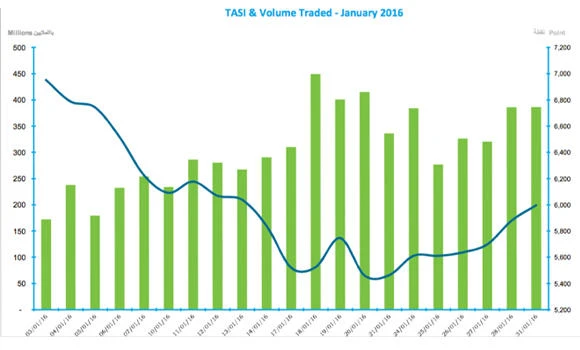
JEDDAH: January was a bad month for commodities and the broader financial markets, top analysts acknowledged Tuesday as the Saudi stock market fell by 1.9 percent amid investor concerns over depressed oil prices.
The benchmark Tadawul All-Share Index (TASI) has lost 15 percent this year.
“The performance of the Saudi Stock market for the rest of the year will be directly linked to the oil market,” commented Akber R. Naqvi, executive director, Al-Masah Capital Management Limited.
TASI has been highly correlated to the oil price this year, Naqvi and other analysts pointed out.
On Tuesday, TASI dropped by 111.53 points — led by petrochemicals — to close at 5,874.19 points.
The sector's biggest stock, Saudi Basic Industries Corp, tumbled 3.6 percent.
Construction company Jabal Omar Development Co. slid 3.6 percent, bringing its losses to 7.5 percent in the three days since it said it was in talks with creditors after failing to make the first repayment of SR650 million on a SR3 billion loan from the government.
Only 22 stocks gained against 141 decliners, Reuters reported.
Among the gainers, Al-Bilad Bank added 4.2 percent after its board recommended a share capital increase through a one for five bonus issue, paid for with financial reserves and retained earnings.
On Tuesday, the value of traded shares on the Saudi stock market exceeded SR6.15 billion.
At the end of January 2016, TASI closed at 5,996.57 points, decreasing by (915.19 points) 13.24 percent over the close of the previous month.
“Clearly a lot of this is oil price-driven,” a regional analyst told Arab News.
He added: “The prospect of some sort of agreement on output cuts has breathed some optimism into the oil market, but the timing of progress is still very uncertain and unclear.”
The analyst said: “I see the prospect of near-term volatility because of the continued cluster of uncertainties. However, we may have elements of a clearer narrative emerging with some emerging markets showing signs of bottoming out and more and more governments moving toward a more permissive policy stance. But timing is still the key uncertainty.”
James Reeve, deputy chief economist and assistant general manager, Samba Financial Group, said: “The outlook for the TASI is not good. Corporate results are likely to be weak this year, given the reduction in government spending and the decline in petrochemical prices.”
Reeve added: “Petrochemicals prices are closely linked to oil prices and the sector is facing additional supplies from the US.”
Naqvi of Al-Masah Capital commented further: “Currently the world is awash with oil as supply exceeds demand by approximately 1.5 million barrels per day. Since OPEC producers, led by Saudi Arabia, removed their production cap of 30 million barrels a day at the end of last year, the price has plummeted to below $30 a barrel reaching a level last seen 12 years ago.”
Naqvi said: “The lifting of Iran sanctions means at minimum an additional 1 million barrels a day to be added to the already oversupplied market this year. China’s growth decelerating and putting pressure on emerging market economies means a key driver of recent demand in the oil market is faltering. The timidly growing US economy itself cannot make up this extra demand meaning at least for most of 2016, one can expect the oil market to remain oversupplied.”
He added: “So if the oil price remains under pressure, TASI will most likely struggle for the rest of the year.”
According to Reuters, Brent for April delivery was down $1.09 at $33.15 a barrel by 1557 GMT Tuesday, after touching a low of $32.23, down 5.9 percent, in the session.
The front-month contract for US West Texas Intermediate (WTI) was down $1.18 at $30.44 per barrel after falling to as low as $29.81.
2016 Tadawul performance ‘directly linked to oil market’