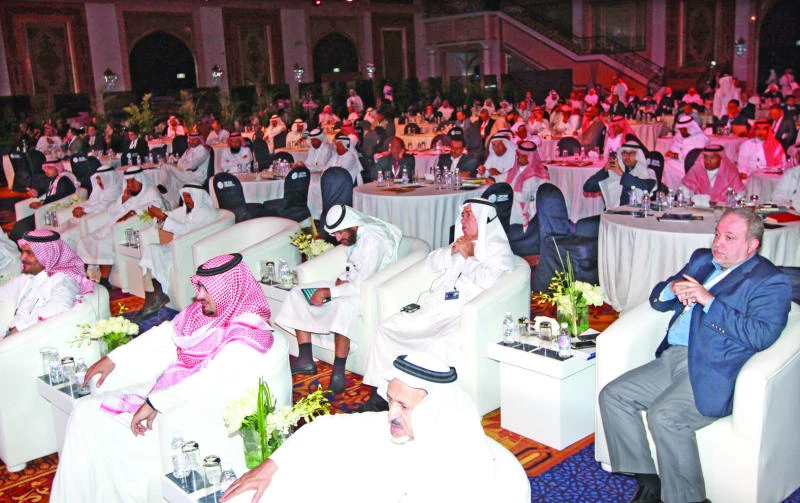
JEDDAH: Saudi Arabia has been strongly recommended to embrace technology and education in order to thrive in the global marketplace with the support of PPP.
This was the consensus of speakers who addressed different panel sessions at Jeddah Economic Forum (JEF) 2016, which ended on Thursday, after a two-day run.
JEF, with public-private partnership (PPP) as its theme, was inaugurated on Tuesday night by Makkah Gov. Prince Khaled Al-Faisal with his keynote address.
Keynote speeches and participants in the discussion panels focused on the steps needed to implement PPP with foundational industries in Saudi Arabia.
Panelists were clear that Saudi Arabia needs to ensure that its youth are educated to global standards and employed in vital industries.
Arvid Mahajan, partner, head of infrastructure and government services, KPMG Advisory Services Private Limited, set the tone for the day. “Technology is disrupting how we design infrastructure. This creates a real opportunity for countries like Saudi Arabia to “leapfrog” ahead of nations with older infrastructure, avoiding the legacy issues, which hold many nations back.”
Following general discussion on establishing PPP readiness, there were panels on the opportunities and challenges faced by sectors, especially, education, health care and finance.
Monira Jamjoom, cofounder and CEO, Emakn Education, was very clear on the urgent need for disruptive action. “The Saudi education system isn’t broken, it’s obsolete. We shouldn’t waste our energy trying to fix it; we need to think out of the box. We need transformational education if we are to educate our growing middle class and reduce our bloated public sector.”
The panel agreed that the emphasis should be on solutions suited to Saudi Arabia’s specific circumstances, rather than importing policy options from other nations. There should be a particular emphasis on developing technological skills and using data analytics as a tool to improve outcomes. This wasn’t simply a job for government but there was a role for innovative SMEs at every level of education.
The panel discussion on health was followed by keynote speakers, including Fahd Al-Rasheed, group CEO and managing director of Emaar Economic City (EEC), who was interviewed about his plan for EEC.
Sultan bin Jamal Shawli, undersecretary mineral resources, explained how metal ore mining can be vital in driving employment and SME development in rural areas.
The afternoon began with a focus on health care. Irfan Sencan, deputy undersecretary Turkish Ministry of Health, explained how Turkey used the PPP model to develop state-of-the art health care systems since 2006 and was followed by a panel explaining the wider applications for Saudi Arabia.
Gabriel Chahine, head of health care practice, Strategy& explained: “The private sector only provides 15 percent of health care in Saudi Arabia. If the government could double this figure to 30 or 35 percent, this would represent investment opportunities equivalent to SR50 billion over three to five years.”
Khalid Al-Shaibani, responsible for transformation, Ministry of Health, said the ministry would be publishing a transformation plan for the whole health sector in the next four weeks.
“The position of the ministry as the sole supplier, regulator and purchaser of health care is in urgent need of reform. Our reform program has several key points. The ministry intends to create a holding company into which all delivery components will be moved. There will be an insurance scheme for the whole population and we will partner with the public sector to improve quality of care. In addition, we will ensure that we take full advantage of technological advances and improve our training of the human professionals on whom the whole system is built.”
The session concluded with a session on the difficulties in financing PPP initiatives in an increasingly competitive international environment marked by the Chinese slowdown, tightened US monetary policy and low commodity prices.
Nader Mohammed, president of World Bank Office, Riyadh lauded the reforms taking place across the GCC. “Subsidy reform in the GCC has been extremely helpful in addressing fiscal imbalances caused by the low oil price. However, it’s essential that there shouldn’t be a reduction in investment; this would be counter-productive. It’s essential that GCC countries take a strategic approach to reform. There’s more work to be done at the GCC level to increase liquidity. However, steps toward integration are helpful, especially moves to create a common currency and develop the regional and Saudi bond market,” Mohammed added.
Throughout the day there were sectorial focused panels on housing, infrastructure, electricity and desalination running in parallel.
Call to embrace new technology