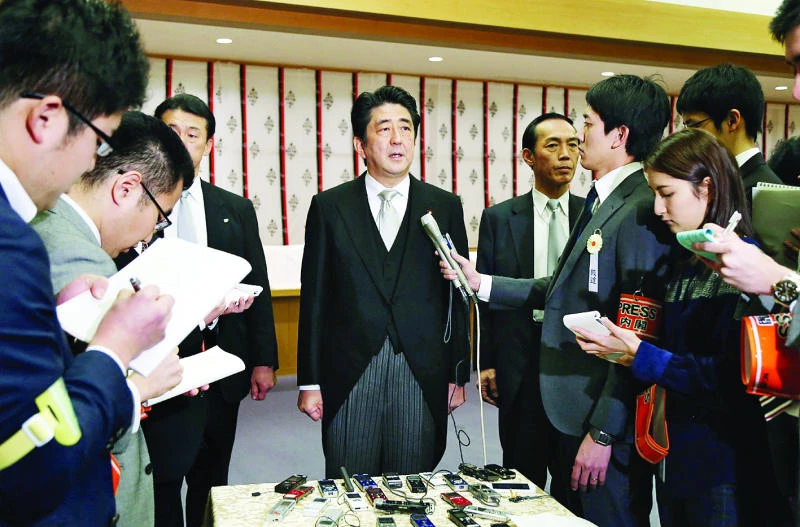
BEIJING: Japanese automakers are bracing for a potential consumer backlash should tensions with China escalate after Prime Minister Shinzo Abe visited a shrine memorializing war-dead on Chairman Mao Zedong’s birthday.
Nissan said it was “closely monitoring” developments in Japan-China ties after Abe’s visit.
The appearance at Tokyo’s Yasukuni Shrine drew a condemnation from China in less than an hour, with Foreign Ministry spokesman Qin Gang saying that his nation “strongly” protests. Shares of Japan’s three biggest automakers rose in Tokyo trading.
“As a company we have no means to intervene in politics,” Huo Jing, a Beijing-based spokeswoman for Nissan, said by phone. “All we can do is to be better at our job.”
Toyota and Honda reported their first annual sales declines in China last year after the Japanese government purchased a group of disputed islands from their private owner, sparking nationwide protests and a consumer backlash. Thursday’s visit by Abe coincides with the 120th birthday of Mao, with Chinese leaders including President Xi Jinping honoring the founder of the communist state.
“They chose today to visit the shrine, which makes it even harder for Chinese people to accept,” said Cui Dongshu, deputy secretary-general of the Shanghai-based Passenger Car Association.
“The signal they are sending is very dangerous. It will deter some buyers as they may worry about the safety issue of their car and even themselves if the political environment worsens.”
Japanese automakers are regaining ground in China, though the recovery has come at a cost as they sacrifice profit for volume, said Cui. Thursday’s visit may spark a repeat of last year when consumers boycotted Japanese cars, he said.
Honda’s Beijing-based spokesman, Zhu Linjie, declined to comment, citing the company’s policy against commenting on politics. Toyota’s Beijing-based spokesman Liu Peng didn’t answer two calls to his mobile phone.
The Japanese consulate in Shanghai urged its nationals to be cautious as there’s a risk of worsening sentiment given the “strong anti-Japanese” tone in Chinese media reports, according to an e-mailed statement. The consulate was unaware of protests or demonstrations as of noon, it said in the statement.
At the height of last year’s demonstrations, hundreds of riot police watched over groups of protesters as they gathered outside the Japanese consulate chanting, “down with Japan devils, boycott Japanese goods, give back Diaoyu,” using the Chinese name for the group of islands in the East China Sea.
Thousands of Japanese cars were vandalized and businesses attacked by mobs in last year’s demonstrations. Fast Retailing Co., owner of the Uniqlo clothing brand, closed shops in Beijing at the height of the protests in the city.
Two dealerships selling Toyota and Honda vehicles in Qingdao in eastern China were set on fire by anti-Japanese protesters last year, while many owners of Japanese-brand cars pasted Chinese flags or patriotic slogans on their vehicles in the hope of avoiding being attacked.
Abe is the first sitting prime minister since 2006 to visit Yasukuni, which honors dead including 14 World War II leaders convicted as Class-A war criminals.
Japan’s carmakers brace for China backlash