- Lebanon's 2027 draft budget aims for tax revenue exceeding double that of 2024, set at $3.41 billion, although economists consider this target unrealistic amid a shrinking economy.
- The proposed budget of $6.87 billion represents a 14.2% increase from 2026, relying heavily on taxes for 85.9% of its revenue.
- The World Bank projects a 6.4% economic contraction for 2026, following a 4.2% growth in 2025, complicating revenue growth expectations.
- The draft budget proposes limited capital spending of $745 million, with wages and social benefits consuming over half of the allocated expenditures.
- The International Monetary Fund urges Lebanon to implement key financial reforms to secure financial assistance and address ongoing banking crisis losses.
- Economists warn that revenue growth is overstated as it relies mainly on higher nominal fees rather than true economic activity, affecting actual tax collection capacity.
BEIRUT: Lebanon’s 2027 budget is asking a shrinking economy to deliver tax revenue more than double what it collected in 2024 — a target one economist calls unrealistic — while the country has yet to resolve how the losses from its banking crisis will be shared.
The Ministry of Finance has submitted a draft 2027 budget of $6.87 billion, up 14.2 percent from 2026, with taxes supplying 85.9 percent of revenue.
The budget assumes revenue will keep climbing while the economy shrinks. The World Bank’s August Lebanon Economic Monitor projects a 6.4 percent contraction in 2026, after growth of 4.2 percent in 2025.
To hit its revenue target, the government would need to collect 100.9 percent more than the $3.41 billion raised in 2024 — a gap economist Jassem Ajaka told Arab News was “highly unrealistic.”
Capital spending is limited to $745 million, or 10.8 percent of total expenditure, according to the draft law reviewed by Arab News, while wages, salaries and social benefits absorb 53.5 percent.
On Oct. 1, the Council of Ministers adopted the draft as the International Monetary Fund dialled up the pressure on Lebanon, urging it to pass key reforms, including a financial gap law, to secure a support programme.
Can the revenue target be met?
Ajaka said weakening consumer purchasing power, revenue growth driven by higher nominal fees and import prices rather than real economic activity, and enforcement measures that reach only taxpayers already inside the system, could thwart the projected revenue increase.
The draft budget leans on new enforcement tools rather than base-widening ones: cross-checking payroll and social security declarations, requiring non-resident digital service providers — including streaming platforms, now subject to 11 percent VAT — to appoint local tax representatives, and an invoice-based lottery to encourage receipt demands.
Income tax receipts from salaries and wages are projected to rise 66 percent, against just 22 percent for tax on business profits, a split that signals where enforcement actually bites.
Ajaka said these steps “may squeeze tax revenues from businesses that are operating in compliance with tax law, but they do nothing to pull into the tax net large portions of the informal economy.”
Fee increases reinforce the pattern
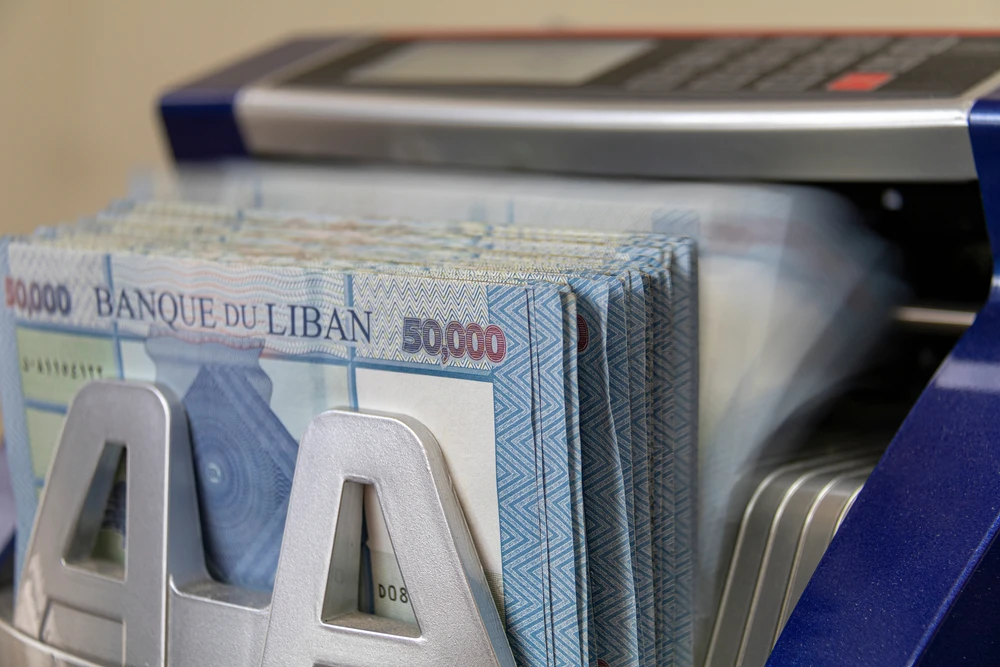
The national ID card fee rises 200-fold under Article 55, from 5,000 Lebanese pounds ($0.056) to 1 million pounds.
The budget line for fees on inflammable materials, including the internal fuel levy introduced in February, rises more than 870 percent to $363.5 million.
These are nominal catch-ups for currency depreciation as much as new revenue, which is part of why Ajaka doubts the target holds up once purchasing power is accounted for.
Who pays for the banking losses?
“Collection without spending is just levying,” said Mohamad Farida, economic adviser to the Depositors' Union in Lebanon, whose members have been locked out of their savings since Lebanon’s 2019 financial collapse.
Ajaka said budget execution produced a surplus of about $1 billion in 2025, with public-sector deposits at Banque du Liban reaching around $10.26 billion by the end of August 2026.
The economist said that liquidity helps stabilize the pound and fund depositor payouts, but without a Gap Law allocating banking-sector losses among BDL, banks and the state, any state contribution is not formally recorded as recapitalization.
In effect, he argued, taxpayers carry the cost through consumption taxes and constrained public spending, while bank shareholders avoid dilution and write-downs.
Arab News asked Banque du Liban how it uses public-sector deposits and whether they amount to a state contribution to bank recapitalization. The central bank had not responded by the time of publication.
Attorney Jihad Chidiac told Arab News that the main obstacle to passing the Gap Law is deciding who bears the losses — BDL, the commercial banks, the state, or all three.
“Each side has sought to protect its own position and limit the share of losses it would ultimately have to absorb,” he said. The law cannot move apart from bank restructuring legislation, he added, since depositors’ recoveries depend on the banks’ solvency.
Without it, Chidiac explained, public-sector deposits remain ordinary claims against BDL, but no statute sets how they rank beside its other liabilities. If the state demanded full value while BDL lacks the assets to pay, someone must absorb the shortfall.
For depositors still locked out of their savings since 2019, Farida said the starting point is an audit. “We need to start knowing the numbers,” he said.
What would close the gap on both fronts
Ajaka said reforms should include enacting the banking resolution and Gap laws, auditing BDL and bank balance sheets, beginning formal talks with Eurobond holders, moving toward a funded IMF program and publishing audited closing accounts.
Farida is skeptical that reform happens without a reckoning.
“Even with the IMF it looks like a hard exit if there is no confrontation,” he said, an assumption backed up by IMF spokesperson Julie Kozack telling reporters the budget and medium-term fiscal framework needed to be "consistent with debt sustainability for the country."