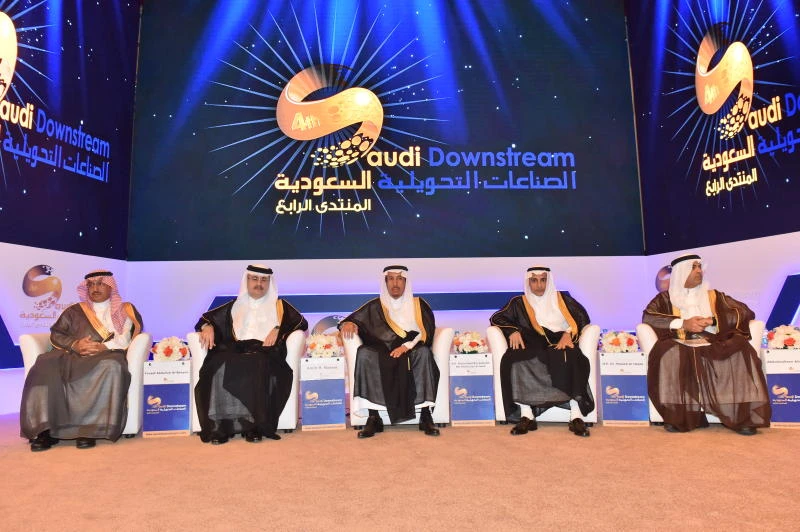
JUBAIL: Prince Saud bin Abdullah bin Thunayan Al-Saud, chairman of the Royal Commission for Jubail and Yanbu (RCJY), opened the 4th Saudi Downstream Forum on Tuesday.
The forum is being held with the support of Custodian of the Two Holy Mosques King Salman, at Al-Fanateer Cultural Center in Jubail Industrial City.
Prince Saud said that while the world economy suffers from major problems, the Saudi economy once again proves its flexibility and durability.
Effective management and excellent investment policies create a solid and strong economy in the face of these variables, he added.
Prince Saud said that the RCJY played a major role in supporting the manufacturing sector through the establishment of the plastic and chemical industry complex (PlasChem) in Jubail 2, which contains plastic, chemical, and manufacturing industries for the production of consuming finished products.
Mosleh Al-Otaibi, CEO of the Royal Commission for Jubail, said: "The forum, hosted by Jubail Industrial City, is a strong supporter of industrial development in the Kingdom, where it offers significant competitive advantage in the value-added of the downstream sector."
Saudi Aramco CEO Amin Nasser said: "No doubt this year's forum is held in circumstances that differ radically compared to the prevailing conditions during its previous editions, regarding the oil and chemicals markets and the global economy variables," confirming that despite the external challenges, the march of development in the Kingdom is going on and able to face all obstacles.
Yousef Al-Benyan, vice-chairman and CEO of Saudi Basic Industries Corporation (SABIC), stressed the importance of developing SMEs in the private value chains across the manufacturing sector, as such projects are driving the economies of the most successful countries in the world.
Ziad Al-Labban, CEO of Sadara Chemical Company (Sadara), a joint venture developed by Saudi Aramco and the Dow Chemical Company, highlighted how Sadara’s business model is a game changer, which capitalizes on Saudi Arabia’s unique competitive advantages to enable downstream investments and job opportunities for the local skilled work force.
Al-Labban identified four key competitive advantages enjoyed by Saudi Arabia during a presentation entitled "Downstream Manufacturing Opportunities in Saudi Arabia." These include the Kingdom’s abundant natural resources, skilled human capital, proximity to growth markets, and access to finances.
“Sadara’s range of differentiated, high value products, enabled by the cracking of naphtha as well as ethane, makes us a true game changer. Sadara is positioned to become a key enabler for downstream investments and value added job opportunities for Saudis, which in turn will accelerate the Kingdom’s economic diversification, and create a nurturing environment for ‘Made in KSA’ to truly take shape,” he noted.
In addition to its vast natural resources, which include 20 percent of the world’s proven oil reserves and the sixth largest proven natural gas reserves, Saudi Arabia also offers competitive corporate taxes, a range of funding sources, a growing Islamic bond (sukuk) market, the largest stock exchange in the MENA region, and a large number of locally-based companies and investors.
Rasheed Al-Shubaili, CEO of Saudi Arabian Industrial Investments Company (SAIIC), outlined the major role the newly formed organization will play in promoting the Kingdom’s economic diversification by establishing profitable companies that will stimulate private sector industrial investments. He explained how SAIIC will support the national diversification agenda of Saudi Arabia’s leadership.
SAIIC is a joint venture between the Saudi Arabian Public Investment Fund (PIF), Saudi Aramco and SABIC with a mandate to support the establishment of globally competitive industrial sectors.
The company will focus on investments in the Kingdom through joint venture partnerships with global industry leaders.
Al-Shubaili, who was appointed SAIIC CEO in 2015, said: “Inspired by the words of Prince Turki bin Faisal and in line with the vision laid out by the leadership of the Kingdom, SAIIC is now operational and ready to develop sectors that will provide quality, skilled jobs for Saudi nationals for generations to come.”
Al-Shubaili noted that while the Kingdom’s diversification has increased in recent years, including through the greater participation of the private sector and numerous government initiatives, there remains room to advance the agenda.
Although SAIIC is a new investment and development company, Al-Shubaili confirmed that industrial investments — including those made in and around manufacturing — would be priority for initial investments.
Saudi economy resilient amid global challenges