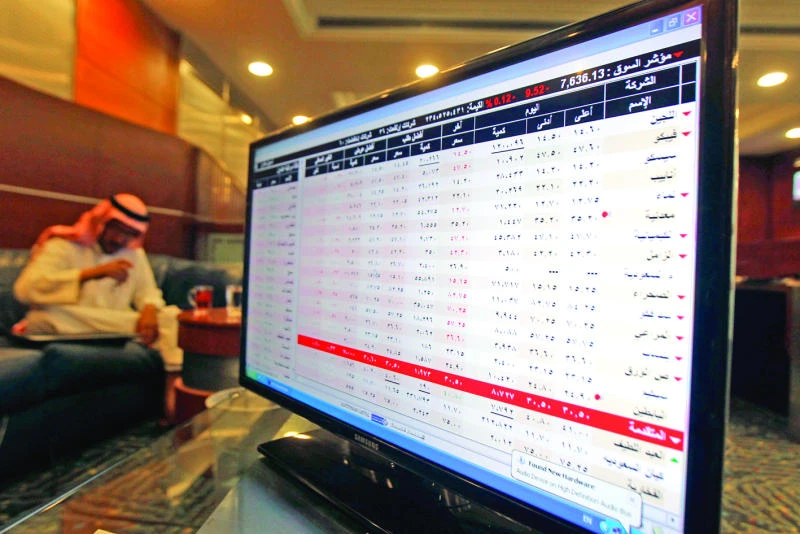
JEDDAH: Several major stock markets in the Middle East rose on Monday as local investors bought back shares, though blue-chip banks weighed on Abu Dhabi.
Equity markets in the region, where government revenues largely depend on petrodollars, have been struggling to break free of the negative impact of weak oil prices.
“Investors’ propensity to react to changes in oil prices has increased,” said a Riyadh-based analyst, noting even a slight change in rhetoric between OPEC and non-OPEC producers can send crude prices up or down and with it Gulf stock markets.
Brent futures were trading slightly firmer at a little over $34 a barrel for most of the Gulf day.
This helped Saudi Arabia’s Tadawul All-Share Index close 0.2 percent higher at 5,906 points, though it came well off a session high of 5,972 points after oil prices pulled back.
The petrochemical sector, which has been the main drag on the bourse this year, slid 0.5 percent. But small and mid-cap stocks favored by the local traders were strong. Insurers Al-Sagr Cooperative Insurance and Solidarity Saudi Takaful each surged more than 8.0 percent.
Dubai’s index climbed 1.9 percent on higher trading volumes than in the previous session, trimming its losses for 2016 to 1.8 percent.
Emaar Malls closed flat at AED2.49 after reaching a session high of AED2.58. The blue-chip retailer reported a 5.5 percent rise in fourth-quarter net profit to AED435 million ($118 million).
Emaar Properties, the majority shareholder in Emaar Malls, surged 3.1 percent on its third day of gains. Dubai’s largest developer by market capitalization is expected to file its quarterly earnings in the coming days.
Air Arabia edged up 0.8 percent. The UAE’s only publicly listed airline reported its third consecutive quarterly profit drop on Sunday with a net profit of AED59 million, below SICO Bahrain’s estimate of AED79.3 million.
DAMAC Properties and Shuaa Capital, shares favored by local traders, each jumped more than 3.5 percent.
Abu Dhabi’s index closed flat at 4,103 points, 33 points below its intra-day high. The benchmark has fallen 4.7 percent this year.
The banking sector was the main drag, with Union National Bank and Abu Dhabi Islamic Bank falling 3.7 and 1.4 percent respectively.
UNB reported that its net profit dropped to AED1.86 billion last year from AED2.02 billion in 2014 because of higher impairment charges.
Doha’s index rose 0.8 percent with Barwa Real Estate surging 9.3 percent in unusually heavy trade. Blue-chip banks also lifted the market, with Qatar Islamic Bank advancing 1.6 percent.
Qatar Gas Transport, a natural gas carrier, added 1.7 percent.
Kuwait Food Co. (Americana) surged 10.0 percent after the food company said its board had agreed to give a Gulf- based investment firm 60 days to carry out due diligence for the acquisition of a controlling stake in the company. Kuwait’s main index edged up 0.1 percent.
Egypt’s main benchmark added 0.8 percent to 6,175 points, closing 86 points below its intra-day high, in the highest volume since Jan. 24. Foreign and Egyptian traders were net sellers while non-Egyptian Arab investors were net buyers, bourse data showed.
Mid-tier stocks were top gainers, with Credit Agricole Egypt and Juhayna Food Industries adding 5.2 and 1.3 percent respectively.
Palm Hills fell 2.2 percent, erasing early gains. On Sunday, Egypt’s second-largest listed property developer reported a 128 percent jump in fourth-quarter net profit and proposed its first cash dividend.
“We believe the need to hedge against currency devaluation and elevated inflation is the key driver of real estate investment in Egypt in the near term,” said a note by NBK Capital.
Egypt’s central bank has been striving to maintain stability in the currency over the past several months, but foreign investors are still jittery about the possibility of a devaluation and the negative impact it would have on their investment returns and companies’ earnings.
Saudi stocks edge up in volatile trade