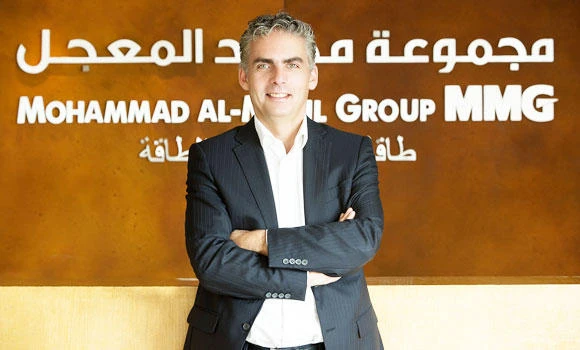
You were brought in to restructure the group last year. Would you elaborate more on your “restructuring” experience profile? And why did you decide to take up this assignment?
As a matter of fact, I was chosen by the group to take on the restructuring program since June 2012. I started my career in the Middle East in 2008 as the CEO of Fawaz Al-Hokair Group, and was tasked with delivering a strategic realignment of the Group toward core profitable growth. I also managed other successful restructuring programs in the UK, Jordan, the UAE and Kuwait. I think we can realize another success story with MMG by capitalizing on the strengths that MMG provides.
Could you briefly outline the Group’s background? In which area did it win its first contract and how did it reach its current position?
Mohammed Al-Mojil Group started its operation in 1954 and soon become a key contractor in onshore and offshore oil, gas and petrochemical projects. MMG provides a number of construction services like steel fabrication, project management, equipment services, labor services and scaffolding. It has historically bundled all these construction services together to bid for and win large contracts with likes of Saudi Aramco, Sabic and Ma’aden. It further won and executed over 20 projects over the past five years with total value of SR5.7 billion.
Can you give us a breakdown of how big each part of the Group’s operations is in terms of number of employees, turnover, EPC, civil and industrial contracting, fabrication.etc.?
Most of MMG’s human resources are engaged in construction projects for major companies such as Saudi Aramco. However, the group intends to focus on other services like scaffolding, equipment, camp services, construction management, steel fabrication, technical services, and other logistic services to projects as well as high-return and low-risk projects to feed its cash flows and help regain profitability.
Could you run through your current portfolio of construction projects?
Major projects currently underway includes two projects at Yanbu, two projects at Wasit NGL Plant — one directly with Saudi Aramco and one through Korean EPC SKEC and other two projects are underway with Saudi Aramco at Shaybah. We have recently completed our work at two projects in Manifa and over the past three months have agreed terms with several companies that will keep over 3,000 (a third of our work force) fully utilized for the next 12 months.
The company has been through some straits recently both in terms of management and finance. Could you explain this?
The company posted significant losses during 2012, but the situation that caused these losses started two or three years earlier when the company won a number of lump sum and turn-key contracts. The company is under restructuring and has reduced the risks associated with its legacy contracts. The business has become more stable and we are on the road to recovery.
The shareholders voted against a wind-up of the Group at its EGM held on Nov. 5, 2012 to back a new restructuring plan for the business instead. Would you talk about this plan?
The Business Recovery Plan centered on the following objectives:
l Reduce and minimize the risk to the business caused by its existing lump sum and turn-key projects;
l Improve controls and management to better manage risk;
l Rebuild the business core capabilities focusing on Quality and Heritage;
l Restructure its financial liabilities to secure long-term stability.
Why do you feel stakeholders should agree to a restructuring? What are the Group’s strengths? And how do you see it developing over the next few years?
The current situation only represents a temporary hurdle in a long history of success and strong corporate presence in the local and regional marketplace and I’m confident that MMG can get back on track. MMG stock has been out of listing since July 22, 2012. However, MMG is determined to regain stability and profitability. The group’s strengths can be summed up in two words: QUALITY and HERITAGE. The demand for the skills and services we have in the company continues to grow significantly.
Recently, you have held the annual general meeting. What topics have been discussed? And what are your expectations for the next quarters?
At the meeting, shareholders were given an update on the progress on our Recovery Plan and an overview of how we are planning to move forward to deliver profitable growth for the future. Our forecast is for continued improvement in our financials in the fourth quarter.
How do you see the progress you have achieved so far?
We have made good progress against the first three objectives, and we are currently focused on finalyzing the financial restructuring plan with the assistance of our advisers GIB Capital. Our first priority was to stop the losses and build controls to sustain this. This key milestone has now been achieved. And now our focus is to rebuild the business to deliver profit for our shareholders and repay our creditors.
You have appointed GIB Capital to oversee a financial restructuring. Do you have a timetable as to how and when you’d like to achieve this? Does the Group need to achieve a restructuring for a sustainable future?
Yes, that is true. MMG signed an agreement with GIB Capital lately appointing it as a financial adviser for the financial restructuring program intended with all stakeholders of the group to financially restructure the business. MMG has now reached a level of stability that both the board of directors and management believe will allow the group to finalize a Restructure Plan with its lenders and other stakeholders to further support the recovery of the business.
MMG discussed the sale of some inactive assets at its Nov. 2012 EGM to remedy the cash flow problem. Have you ever taken any steps in this respect?
That is right. We have completed several transactions in this regards, especially as regards, to land and equipment. Other deals remain in the pipeline and we expect to realize the value from asset sales that we initially intended.
What do you think will be the main challenges for all contractors in the Saudi market over the next few years?
The two key challenges will be retaining skilled talent to meet the growing demand for construction work and funding for large scale construction projects.
The current construction model in Saudi Arabia places a high risk on contractors. The customer typically selects a foreign EPC based on the cost and quality. The EPC will select local contractors based on price and ensures significant contractual protection in any contractual agreement.
MMG’s Q2 financials have been relatively positive compared to previous periods. Do you expect this improvement to continue in the future?
Yes. As the risk continues to reduce in the completed and legacy projects, our focus shall be business that will provide continued improvement in our financial results. A key focus for MMG over the next three years is to invest in our staff and to significantly increase the percentage of Saudi nationals as skilled labor. We are developing a certified apprenticeship program for Saudi school leavers to learn a trade. Our first year intake will be 250 participants but we are looking to grow this over the next couple of years.
What are your long-term plans for growth and development of the group?
Mohammed Al-Mojil Group’s operational restructuring has been ongoing for a year and we have now re-developed our strategy and plans over the next five years. The group will focus on being a leading provider of construction services and to limit our financial risk in terms of the work that we engage on. The group provides capabilities such as scaffolding, equipment, camp services, skilled labor, construction management, steel fabrication or technical services. Historically we have only bundled all these elements together to bid and win large projects. Now we are focused in developing each of these capabilities and providing them directly to the market either individually or as a part of a project or in partnership with other companies.
Skilled talent ‘major challenge for builders’