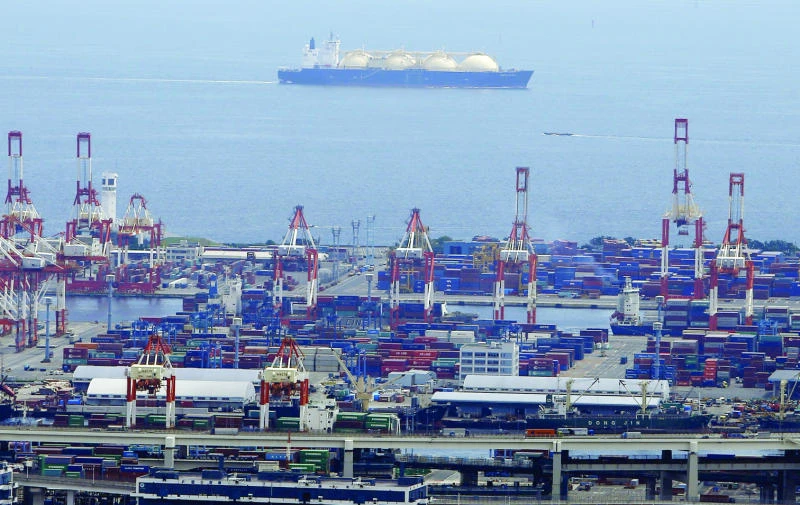
TOKYO: Japanese exports slowed further in August, data showed, offering yet more evidence of global difficulties spurred by China’s stumbling economy.
The figures also highlight the challenge facing Prime Minister Shinzo Abe as he struggles to reignite growth and come a day after Standard & Poor’s cut Japan’s credit rating, saying the government had little chance of fixing underlying problems.
They will add to pressure on the country’s central bank to add more stimulus, despite the bank’s upbeat assessment this week.
The finance ministry said Thursday that exports rose 3.1 percent year-on-year to 5.88 billion yen ($49 billion) thanks to a rise in “automobiles and ships.” That was slower than the previous month and included a 4.6 percent tumble in shipments to China.
But Junko Nishioka, chief economist at Sumitomo Mitsui Bank, said: “The weakness (in Japan’s exports) is not only coming from China, but also from the US and Europe.
“I think the third-quarter net trade data should add a negative contribution to growth, and bring headwinds for Prime Minister Shinzo Abe and the Bank of Japan.”
Exporters are not getting the boon they might be hoping for from the fall in the value of the yen, with weakness in China, a key driver of worldwide growth, and Europe the main concerns.
Abe has for more than two years pushed a huge spending blitz and monetary easing drive — called “Abenomics” — to inject life into the moribund economy and reverse almost two decades of deflation.
But he is struggling to make good on his pledges to cut red tape and open up the economy — a so-called third arrow of his plan — while inflation remains near zero and growth actually contracted in the second quarter.
Abe’s stewardship of the economy took a blow when Standard & Poor’s on Wednesday downgraded its sovereign credit rating on Japan, and took a swipe at the government.
“We believe that the government’s economic revival strategy — dubbed ‘Abenomics’ — will not be able to reverse this deterioration in the next two to three years,” S&P said.
“Economic support for Japan’s sovereign creditworthiness has continued to weaken in the past three to four years,” the agency said, pointing to “slow decision-making among policy institutions” as a particular issue.
The Bank of Japan held fire on expanding its 80 trillion yen annual asset-buying program, saying the economy “has continued to recover moderately... exports and production are affected by the slowdown in emerging economies.”
However, many economists expect the bank to expand its already unprecedented easing measures.
Trade slowdown highlights growth challenge for Abe