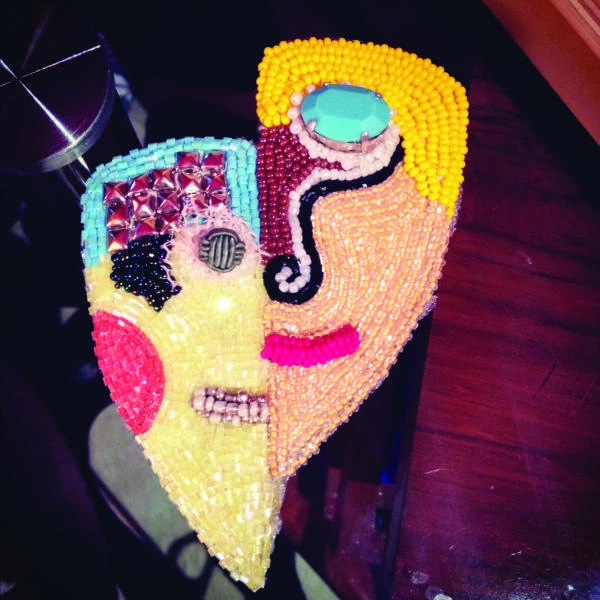
I first discovered Hanan Shammari’s beautiful beaded items at Maison Bo-M in Riyadh. It is hard to believe that this talented Saudi artist is still not making a living from her beadwork.
“I started beadwork as a hobby, but with the support of family and friends, I decided to show my work and teach people about the art of beading. Since I am still not making a living out of my beadwork, I have a full-time job. I try to cover my expenses.”
Beadwork consists of attaching beads to one another or to string them together with a needle and thread or a pliable wire. Adorning clothing with beads is not a new fashion trend. Items adorned with small faience beads dating back 4000 years have been found in Egypt. A small pair of beaded slippers was found in Tutankhamon’s tomb which suggests that they were worn when the young pharaoh was a child.
Beading is often used in haute-couture. At the recent New York Fashion Week, the design duo, Mark Badgley and James Mischka, presented their fall and winter 2013 collections which featured gold-beaded jackets and flowing gowns with beaded shoulders and waists.
Although Al Shammari started beading relatively recently, she mastered the craft quickly.
“In the beginning, I simply bought the beads and strings and tried to work with them. I followed amazing online tutorials in the beginning to learn new techniques and I started training through books,” says Hanan.
Fascinated by the art of beading, she enjoys both the process of designing and playing with colors, as well as the actual beading with its many techniques and rhythms.
Al Shammari has created beaded collars, bracelets, earrings, broaches, rings, hair accessories and wall hangings. Her beautiful collars and intricate bracelets are fast-selling items and continuously on order.
The earliest beads were made from animal bones, teeth, seashells and colorful stones. Later, beads were crafted out of coral, agate, serpentine and lapis lazuli. However the most popular form of beaded work is glass jewelry. Glass beads were appreciated because they were long lasting and inexpensive.
Hanan acknowledges that beaded jewelry is just as popular today, if not even more popular than it was in ancient Egypt.
“I am constantly inspired by Arab culture, especially ancient Arabic writing. The ancient Nabatean and Sumerian letters inspire me to create unique and interesting patterns. I’m also attracted to the striking combination of colors found during the 1970’s Retro era” explains Hanan.
She prefers to work with 2mm beads, which are smaller than the average bead, but result in finer, high-end products. A beaded collar made with these small beads can take up to three weeks to finish.
This year, Al Shammari will be launching a collection of beaded clutch bags and beaded clothes. Although she has used most types of seed beads, she prefers working with “Toho”, “Miyuki beads” and Swarovski.
“First, I create the design, draw it on a pattern paper and then I start my work. For three-dimensional bead works, it becomes harder for me to draw and I find it easier to simply picture the item in my head, and start the project,” she said, acknowledging that she does not have a favorite color. “I love to mix all the colors together. That is just one of the things I love about working with beads: it allows me to be so creative!”
Email: [email protected]