- In her latest show, the Saudi artist pairs her works — and some by her famous father — with AI animations
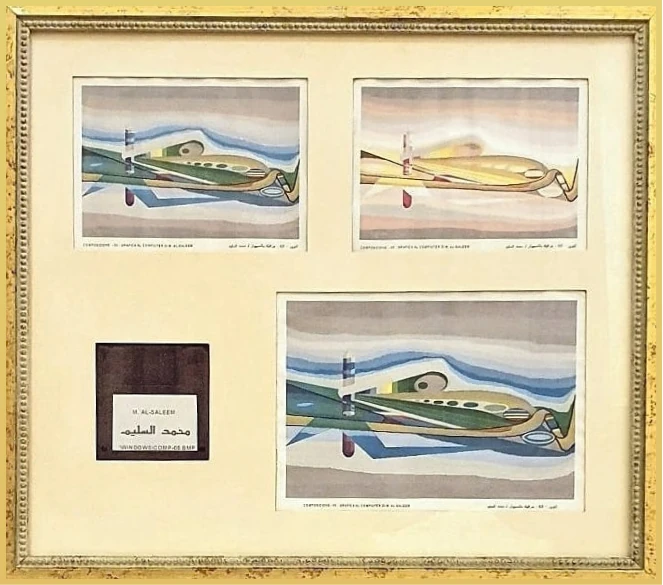
RIYADH: In the first room of Najla Al-Saleem’s solo exhibition “A Shifting Horizon,” which runs until Nov. 19 at Gallery Naila in Riyadh, is “Composition No. 5,” three framed, brightly colored artworks that her father, the pioneering Saudi modernist Mohammed Al-Saleem, created on a computer in 1995.
She believes they were among the first digital works by a Saudi artist, and calls “Composition No. 5” the “most important painting in this show,” because it connects the 1990s to the present.
The exhibition features both her own and her father’s work, and alongside each piece is a screen showing a short AI-created animated story building on the original image.
Mohammed Al-Saleem, who died in 1997, was one of the most significant figures in Saudi Arabia’s modern-art scene. He staged Riyadh’s first art exhibition in 1967 and, in 1979, founded the city’s Saudi Art House. He is best known for developing “horizonism” (also known as “desert style”). Najla, as a young girl, watched him build it “step-by-step.”
In horizonism, the subject of each painting sits at the center, on the horizon line. Around it, bands of color build outward from dark to light, suggesting both sand dunes and the force of the desert sun. The horizon was also a metaphor. Its abstract forms stood for thoughts and ambitions, whatever a person is reaching toward.
“There’s always a horizon you can’t reach,” Najla said, describing her father’s philosophy. “It’s like a mirage.”
Najla, who took inspiration from the style when she went to study art in the US, keeps the method but widens its subject.
Desert style, she said, does not have to depict the desert — “It’s an atmosphere.” She applies it to homes, from traditional Najdi mud houses to modern high-rises.
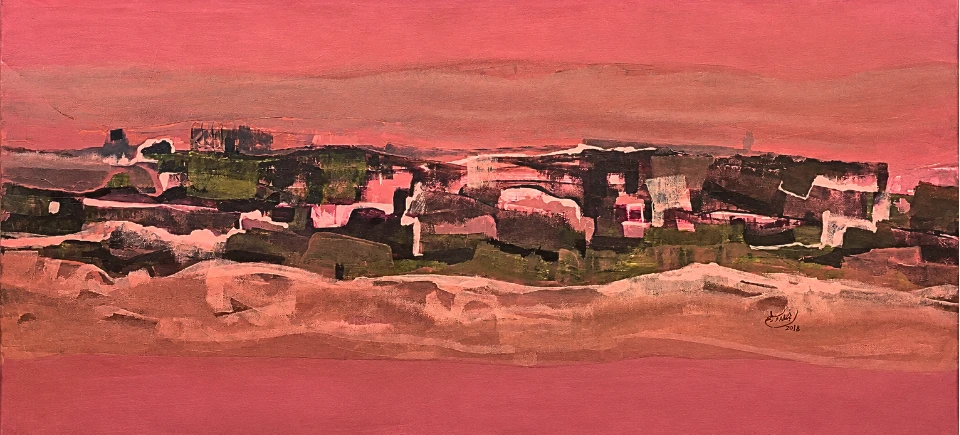
Her 2018 work “Jamsh,” for example, keeps the structure of horizonism but shifts its attention from the sky to the ground. Across the center runs a dense frieze of mud buildings in dark, blocky strokes edged in pale pink, set between bands of sand and coral. Mud, she said, is “a very primary element, and it’s very important in our culture.”
Incorporating AI into the show was Najla’s idea. Her son Tariq AlZaid’s company, LetsGoSky, built the animations from sessions in which she described the figures and elements in her paintings.
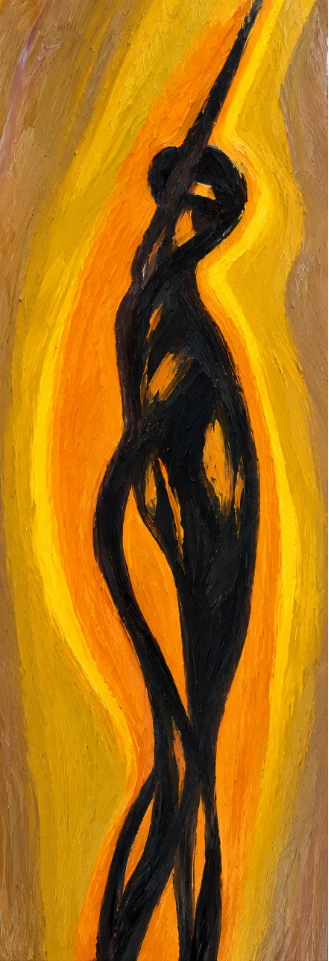
In 2012’s “Woman,” a painting Najla connects to the push for women’s rights in Saudi Arabia, a dark, slender figure stands at the center of radiating bands of yellow and orange. In the animation beside it, the figure begins to twirl, arms moving fluidly, as if breaking free.
The animations, she said, “can add a new depth to the paintings.” The gallery first tried the idea at an earlier exhibition of her father’s work, in which visitors could scan QR codes to see a few paintings move.
“AI is just a tool that can be used for good or bad,” AlZaid told Arab News. “If there are certain guardrails and approvals, it can be very useful.” He said the artwork data is stored in Saudi Arabia under the Kingdom’s data protection law and is not used to train AI models for anyone else, and that the rights to the work remain with the artists.
For exhibition manager Ameera AlZaben, pairing a pioneer like Mohammed Al-Saleem with AI is “a great opportunity for different generations.” It gives younger artists both a shared artistic history to build on and a model for experimenting with new tools.
Al-Saleem taught himself to draw on a computer and paid little attention to critics. “He wasn’t afraid of trying something new,” his daughter said.
His example, she added, has made her own experiments easier.
“Everything my father started doing, now I’m doing it with comfort, because he did it.”