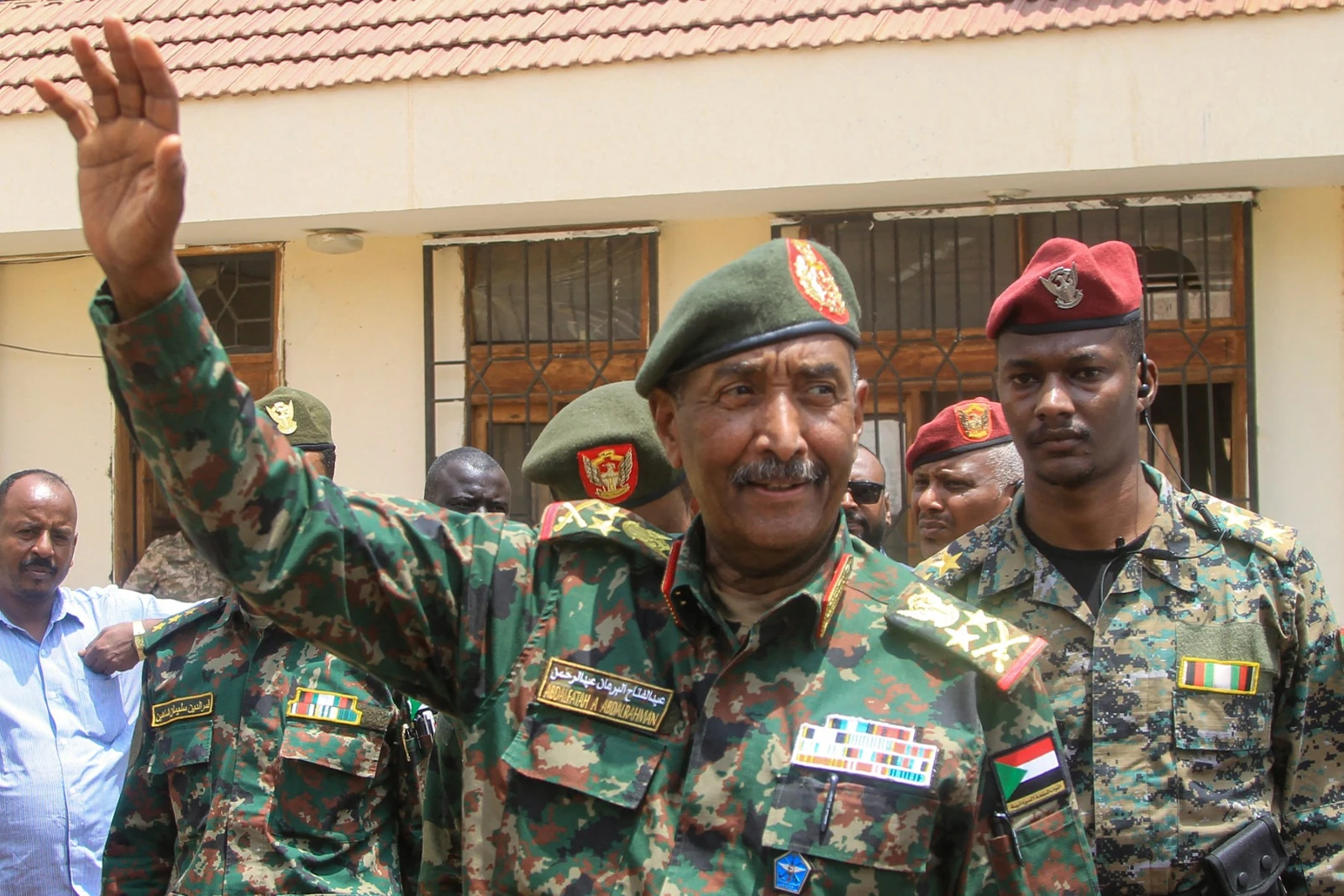
Sudanese Sovereignty Council Chief and Army Commander Abdel Fattah al Burhan has outlined his vision for ending the ongoing war in Sudan, calling for an internally driven settlement that leads to a permanent ceasefire, the consolidation of arms under a single national army, and a Sudanese political dialogue resulting in a constitution and elections, while rejecting any move to grant the Rapid Support Forces (RSF) status equal to that of the state in any political process.
In an article published by Foreign Policy magazine titled "How to Bring Peace to Sudan," Al Burhan stated that ceasefire efforts led by external parties over the past years had failed to end the war. He argued that the current priority must go beyond merely silencing the guns temporarily; instead, it must ensure that fighting does not resume once international attention wanes.
The article appeared at a time when Sudan is witnessing a debate regarding the path to ending the war and the nature of the subsequent political process. In August, Al Burhan had proposed an initiative to launch a "Sudanese-Sudanese dialogue" a move accepted by some political and civil forces but opposed by others.
Peace must be Sudanese
Al Burhan’s proposal is primarily grounded in the principle of Sudanese ownership of the peace process, while allowing for an international role in monitoring and assistance, rather than in dictating the form of the political settlement.
In his article, Al Burhan stated that "peace must be home-grown by the Sudanese, for the Sudanese, and in Sudan," adding that international partnership is welcome and that credible observers can lend greater legitimacy and discipline to any agreement.
However, he deemed agreements dictated from abroad unsustainable, attributing the collapse of ceasefire agreements to the fact that they were drafted without sufficient Sudanese participation.
This perspective aligns with moves initiated by Al Burhan over the past few months toward an internal political dialogue. In May, he had announced a readiness for comprehensive political dialogue regarding the foundations of state reconstruction and the completion of the democratic civilian transition; subsequently, in August, he proposed interim guarantees allowing figures facing legal proceedings to participate in the proposed dialogue.
Al Burhan places the distinction between the state and the Rapid Support Forces (RSF) at the core of his vision for any settlement, rejecting any characterization of the war as a confrontation between equals or merely a "civil war."
He stated that the Sudanese state and the RSF "do not stand on equal footing, either morally or legally," maintaining that the state he leads represents the legitimate authority of a UN member state, whereas he describes the RSF as a "paramilitary group."
On this basis, Al Burhan rejects any settlement that he believes would grant political legitimacy to the RSF leadership or treat the force as an entity on par with the state.
Al Burhan had previously announced in March that, in his view, any peace initiative must entail the withdrawal of the Rapid Support Forces (RSF) from their positions and the assembly of their troops; it must also lead to the elimination of armed forces and weaponry existing outside state institutions, while establishing a timeline for implementing the settlement.
In his article, Al Burhan also linked his position to events in the city of El Fasher, accusing the RSF of committing widespread violations following the city's fall in October 2025. He argued that these events demonstrate the danger of allowing a ceasefire to become merely an opportunity for the parties to regroup.
A single army without parallel forces
A cornerstone of Al Burhan’s plan is the restructuring of the security apparatus following a ceasefire, ensuring that only a single national army remains in Sudan.
He stated that, once the ceasefire is consolidated, security must rest upon a "unified national army," rather than the existence of parallel armed forces with differing loyalties and funding sources.
This requirement is central to the military leadership's vision for the settlement process. Al Burhan has previously emphasized that lasting peace must ensure the absence of weapons outside state institutions or military formations operating beyond national legitimacy.
Al Burhan links the unification of the military establishment to a return to political life; he envisions a post-ceasefire security arrangement that enables the state to restore its authority, followed by a transition to a broader political process.
A plan before the Security Council
Al Burhan stated that he had presented a plan to the UN Security Council aimed at achieving a permanent ceasefire and subsequently transitioning to a system of governance that includes civilians.
According to the vision outlined in the article, the security phase entails the removal of fighters and weapons from civilian areas under United Nations supervision and assistance. This would create the conditions necessary to move from a cessation of hostilities to a political settlement under which the state can effectively perform its functions.
This vision emerges amidst a broader disagreement regarding the sequencing of the settlement process. Al Burhan’s previous positions have emphasized the necessity of addressing the status of the Rapid Support Forces and their weaponry as a fundamental component of any permanent end to the war, whereas anti-war civilian forces have proposed a simultaneous approach encompassing a ceasefire, the delivery of aid, and the launch of a political process.
A Constitution "Crafted by Sudanese Hands"
As for the political aspect of Al Burhan’s vision, it centers on launching an internal dialogue through which the Sudanese people themselves determine the nature of the post-war political system.
He stated that any political settlement must result from a "Sudanese dialogue" and that the future constitution should be drafted by "Sudanese hands," rather than abroad.
Under the proposed framework, the subsequent phase is intended to lead to free and fair, internationally monitored elections, followed by a smooth transfer of power that restores to the Sudanese people the right to determine their form of governance.
Al Burhan characterizes the government he leads as a transitional one, acknowledging that it is "far from ideal" while simultaneously affirming its commitment to international law and its accountability.
Cutting off funding and supplies
Al Burhan does not limit the conditions for ending the war to the military and political tracks alone; rather, he identifies the cessation of foreign interference and the severing of funding and supply lines to the Rapid Support Forces (RSF) as essential elements of any sustainable settlement.
In his article, he accused external actors and transnational networks of financing foreign fighters and bolstering the RSF’s military capabilities, arguing that an armed group could not sustain a war of this magnitude on its own.
Al Burhan contends that if sources of external support remain active, any truce failing to address these networks could simply become an opportunity for rearmament and force reorganization, rather than a pathway to ending the war.
Against this backdrop, he has made the cutting off of the funding and supply lines that enable the RSF to continue fighting a key demand directed at the international community.
Four Demands of the International Community
In his article, Al Burhan outlined four measures he seeks the international community to support, coinciding with the UN General Assembly meetings.
The first demand is for support regarding the plan he stated he had submitted to the Security Council to achieve a permanent ceasefire and pave the way for a political process.
The second involves cutting off the funding sources and supply lines reaching the Rapid Support Forces.
The third concerns providing assistance and support to the United Nations to enable it to monitor any future ceasefire.
The fourth point entails granting the Sudanese people the space to determine their own political future, rather than having political arrangements imposed from the outside.
These demands reveal the role Al Burhan envisions for the international community: providing security, humanitarian, and monitoring support for the agreement, as well as exerting pressure on the sources supplying the Rapid Support Forces, while leaving the determination of the political system, the constitution, and the future of governance to the internal Sudanese process.
Al Burhan summarized his message to the international community by saying, "Trust our nation to write its own peace," asserting that the Sudanese people, who have endured years of war, are the ones with the right to define the nature of the peace that brings it to an end.
He concluded his vision by calling for a peace that is "homegrown, not imposed”, one grounded in the rule of law and strong institutions, believing that Sudan can build this itself, albeit with the assistance of the international community.