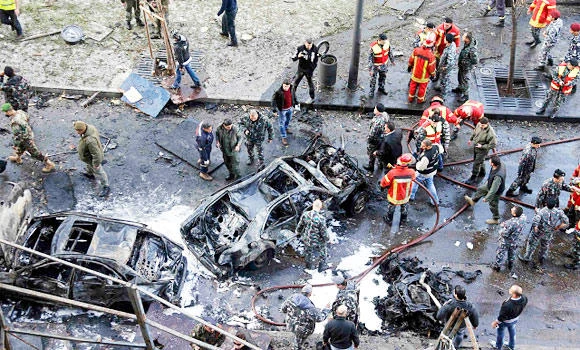
Saudi Arabia on Friday “strongly” condemned a car bomb blast in Beirut that killed six people, including former Finance Minister Mohammad Chatah.
Saudi Arabia “has followed with great concern and disturbance the outrageous terrorist bombing” that rocked the Lebanese capital, SPA said.
“The Kingdom strongly condemns this cowardly criminal act and urges all parties in Lebanon to listen to the voice of rationalism and common sense... and insists on the need of the state to enhance its authority and that of the army across all Lebanese territories.”
Chatah, an economist, former finance minister and Lebanon’s ambassador to the United States, was the ninth high-profile anti-Syria figure killed in Lebanon since the 2005 assassination of former Prime Minister Rafik Hariri.
Meanwhile, Saudi Embassy in Beirut warned its citizens not to travel to Lebanon in view of the poor security condition there. The embassy urged Saudis in Lebanon to return home to avoid unsafe situations.
Lebanon’s March 14 Coalition, led by Saad Hariri, accused Hezbollah and Syrian President Bashar Assad’s regime of being behind the blast.
“As far as we are concerned the suspects...are those who are fleeing international justice and refusing to represent themselves before the international tribunal,” Hariri said, referring to five Hezbollah suspects indicted for the 2005 killing of his father.
The trial of the five suspects is due to open in The Hague in January. The suspects are all fugitives and Hezbollah, which denies any role in the Hariri assassination, has refused to cooperate with the court.
“The criminal is the same, he who is thirsty for the blood of Syrians is the same one spilling Lebanese blood ... from Beirut to Tripoli ... in all of Lebanon, the criminal is the same, he and his Lebanese allies, as in Daraa, Aleppo, Damascus and all of Syria,” said ex-prime minister Fouad Siniora.
The country, which fought a long civil war between 1975 and 1990, is no stranger to violence and has seen a rise in attacks linked to the fighting in neighboring Syria, but Friday’s explosion in the heart of Beirut brought the unrest even closer to home.
“The pressure of the blast was so powerful. All the buildings shook around me,” said street cleaner Ali Aoun as he swept up piles of broken glass outside a damaged building.
“I can’t believe I am still alive.”
— With input from agencies
Assad regime, Hezbollah ‘behind Beirut car bomb’